

Motmot

Bird course · Lesson 15 · 10 minutes

Swallows and swifts

Four fast fliers, and one of them is not a swallow

In April a small bird lands on a telephone wire, and summer has begun. Swallows, martins and swifts spend their winters in Africa and come back here to breed. They catch insects in the air, so you mostly see them in flight.

That makes them tricky for beginners: they are fast, and they don't sit still. But each one has a clear mark. A forked tail with long streamers, a white rump, a brown band across the chest. And one of the four is not a swallow at all, despite how it looks.

At the end there's a quiz of eight questions, with birds from the last two lessons mixed in.

Today: 4 birds

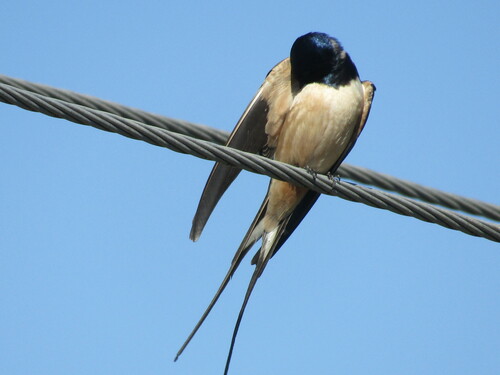
Swallow, adult adult
Photo: stevem4560 · CC BY

Bird 1 of 4

Swallow

Hirundo rustica

How to recognise it

  • Long tail streamers, a deeply forked tail
  • Red-brown forehead and throat
  • Blue-black above, pale below
streamers The two long, thin points on the tail of a Swallow.
forehead The part of the head between the bill and the crown.

Where and when

Farmland, villages and lakes, from April to October. Skims low over fields, and nests inside barns and stables. Sits on wires.

Song A pleasant, twittering song, ending in a dry trill, often from a wire. Recording: Beatrix Saadi-Varchmin · xeno-canto

Bird 2 of 4

House Martin

Delichon urbicum

How to recognise it

  • A bright white rump
  • Short, forked tail with no streamers
  • Blue-black above, pure white below

Where and when

Villages and towns, nesting in mud cups under the eaves of houses. Flies higher than a Swallow, in groups.

Call A dry, short "prrt" or "chirrp", given in flight. Recording: Lars Edenius · xeno-canto

Bird 3 of 4

Sand Martin

Riparia riparia

How to recognise it

  • Small, and brown above
  • A brown band across the chest, on a white underside
  • Short, slightly forked tail

Where and when

Rivers, lakes and gravel pits, the first of the three to arrive in March. Nests in holes in a sandy bank, in colonies.

Call A dry, buzzing "brrrt", given in flight. Recording: Peter Boesman · xeno-canto
Swift, adult adult
Photo: diddisch · CC BY-NC

Bird 4 of 4

Swift

Apus apus

How to recognise it

  • All dark brown, almost black
  • Long, narrow, sickle-shaped wings
  • Pale throat patch, only up close
throat patch A patch of a different colour on the throat.

Where and when

Over towns and villages, from May to August, in screaming groups around the rooftops at dusk. It hardly ever lands: it eats, drinks, mates and even sleeps in the air.

Call A high, screaming "sree-ee-ee", from a whole group racing round the roofs. Recording: Arjun Dutta · xeno-canto

Not related to swallows at all. A Swift spends almost all of its life in the air, and only lands to nest.

Swallow or Swift?

SwallowSwallow
SwiftSwift

Look at the wings and the colour. A Swift is all dark, with long, narrow, sickle-shaped wings, and flaps in quick bursts. A Swallow is blue-black above and pale below, with a red throat and long tail streamers, and it glides in loops.

Quiz

8 questions, with a few birds from earlier lessons mixed in. Your answers stay in this browser.

Out and about this week

On a summer evening, look up above your street or over a field. Do you see sharp, dark crescents, screaming round the roofs? That's the Swifts. Also check the wires for Swallows, and the eaves for House Martin nests.