Motmot

Bird course · Lesson 12 · 10 minutes

Birds of prey

Four hunters you can see from almost any road

Birds of prey seem difficult: they are often far away, and they are usually in the air. But you don't need to see every feather. Look at shape and behaviour: the way it flies is half the identification.

Britain's birds of prey have had an extraordinary comeback. The Red Kite was almost extinct, down to a few pairs in Wales. Today you can see one from the motorway in the Chilterns. In this lesson we meet four of the ones you are most likely to see: one circling, one hovering, one flashing through a garden, and one forked-tailed glider.

At the end there's a quiz of eight questions, with two birds from last week mixed in.

Today: 4 birds

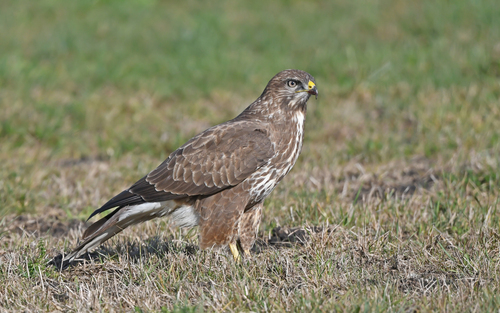
Buzzard, adult, pale to dark adult, pale to dark
Photo: christoph_moning · CC BY

Bird 1 of 4

Buzzard

Buteo buteo

How to recognise it

  • Stocky, broad wings, short tail
  • Often a pale breast band
  • In flight: dark wrist patch under the wing
wrist patch A dark patch on the underside of the wing, at the bend.

Where and when

Over woods and fields, soaring in circles, or sitting on a post or a pylon. The commonest bird of prey in Britain, especially in the west.

Call A far-carrying, mewing "pee-ow", often given high up in the sky. Recording: Beatrix Saadi-Varchmin · xeno-canto

They vary a lot, from almost white to nearly black. The shape does not.

Kestrel, adult male adult male
Photo: alexislours · CC BY

Bird 2 of 4

Kestrel

Falco tinnunculus

How to recognise it

  • Hovers: hangs in the air with fluttering wings
  • Grey head, chestnut back with black spots
  • Grey tail with a black band near the tip

Where and when

Roadside verges, fields and motorways. Hovers over the grass, looking for voles. Sits on poles and wires.

Call A shrill, quick "kee-kee-kee-kee", usually near the nest. Recording: David Darrell-Lambert · xeno-canto

The female has a brown, barred tail, and a brown head.

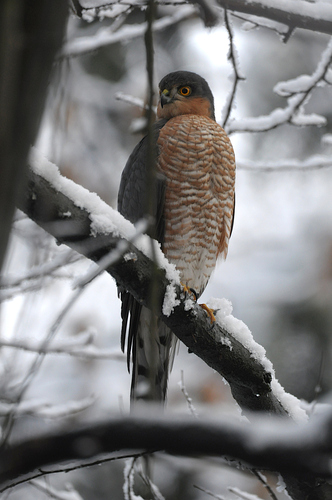
Sparrowhawk, adult adult
Photo: Alexei Kouprianov · CC BY-NC

Bird 3 of 4

Sparrowhawk

Accipiter nisus

How to recognise it

  • Short, rounded wings and a long tail
  • Grey back, fine bars underneath
  • Yellow cere above a small hooked bill
hooked bill A bill with a sharp hook at the tip, for tearing meat.
cere A bare patch of skin, often yellow, at the top of the bill, where the nostrils are.

Where and when

Woods, hedges and gardens. Flies low and fast, then bursts out from behind a hedge to catch a small bird. You often see a flash, then a puff of feathers.

Call A fast, chattering "kek-kek-kek-kek", usually only heard near the nest. Recording: David Darrell-Lambert · xeno-canto

Don’t confuse with: Kestrel (just before): longer, pointed wings, and a habit of hovering.

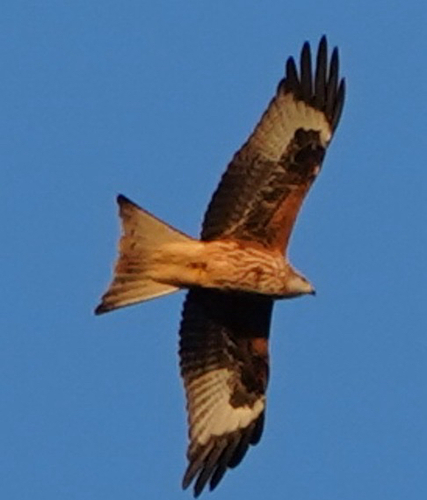
Red Kite, adult adult
Photo: sam_a7c · CC BY-NC

Bird 4 of 4

Red Kite

Milvus milvus

How to recognise it

  • Rusty-red body, with a pale grey head
  • Long, deeply forked tail, twisting as it steers
  • Long wings, with white patches under the tips

Where and when

Open countryside in the Chilterns, Wales, central Scotland, Yorkshire and the east Midlands, soaring slowly and gliding low over fields. Often seen over villages and roads, and at feeding stations.

Call A thin, mewing "weeoo-weeoo-weeoo", higher and thinner than a Buzzard. Recording: Paul Driver · xeno-canto

Red Kites were reintroduced to England and Scotland from 1989, with birds from Spain and Sweden.

Buzzard or Red Kite?

BuzzardBuzzard
Red KiteRed Kite

Look at the tail and the wings. A Red Kite has a long, forked tail that it twists as it steers, and long, narrow wings with a bend. A Buzzard has a short, rounded tail and broader wings, held in a shallow V when it soars.

Quiz

8 questions, with a few birds from earlier lessons mixed in. Your answers stay in this browser.

Out and about this week

Watch the sky next time you are on a car trip or walk. Is the bird soaring in circles (Buzzard), hovering (Kestrel) or twisting its forked tail (Red Kite)? Write down what the bird did, not just what it looked like.