Motmot

Bird course · Lesson 11 · 12 minutes

Fields and farmland

Five birds of the open countryside in spring

Today we leave the town behind and walk out onto the fields. On a spring morning, the open countryside is full of life: a bird that seems to climb a ladder of song in the sky, another tumbling over a ploughed field, a long-tailed gamebird that bursts out of the hedge.

Farmland birds are among the ones that have declined most in Britain. That makes each one you find worth a bit more. We start with the black-and-white ones, then turn to the brown and the yellow.

At the end there's a quiz of eight questions, with birds from the last two lessons mixed in.

Today: 5 birds

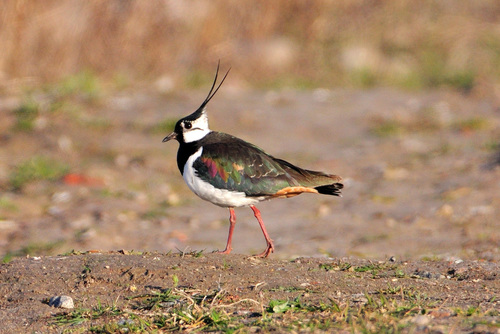
Lapwing, adult adult
Photo: viktor_chekan · CC BY

Bird 1 of 5

Lapwing

Vanellus vanellus

How to recognise it

  • Black and white, with a long, thin crest
  • Green gloss on the back
  • Black breast band, white belly
breast band A dark band across the breast.

Where and when

Ploughed fields, wet meadows and the edges of lakes. In spring the male tumbles in the air, to impress the females. In winter they gather in big flocks.

Call A wheezy, whining "pee-wit", the bird's other name. Recording: Lars Edenius · xeno-canto

Also called a Peewit, after its call, and a Green Plover, after the gloss on its back.

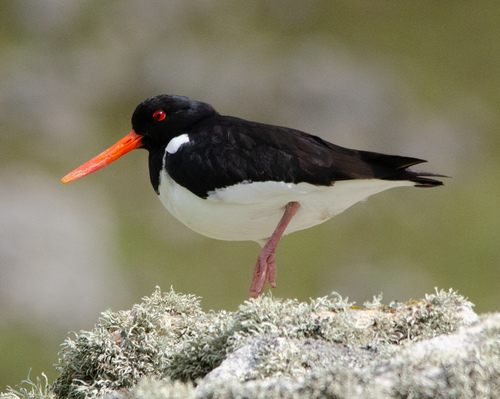
Oystercatcher, adult adult
Photo: dloarie · CC BY

Bird 2 of 5

Oystercatcher

Haematopus ostralegus

How to recognise it

  • Black and white, stocky
  • Long, straight orange-red bill
  • Pink legs and a red eye

Where and when

Estuaries and beaches, and more and more on fields, riverbanks and even roofs in the north. Noisy, in groups, probing the ground.

Call A shrill, piping "kleep, kleep, kleep", from a whole group at once. Recording: Jorge Leitão · xeno-canto

Don’t confuse with: Lapwing (just before): a crest and a black breast band, with a short, thin bill.

Lapwing or Oystercatcher?

LapwingLapwing
OystercatcherOystercatcher

Both are black and white. The Lapwing has a thin crest, a short bill and a black band across the breast. The Oystercatcher has a long, bright orange bill, and its black goes all the way up to its chest. It also has pink legs.

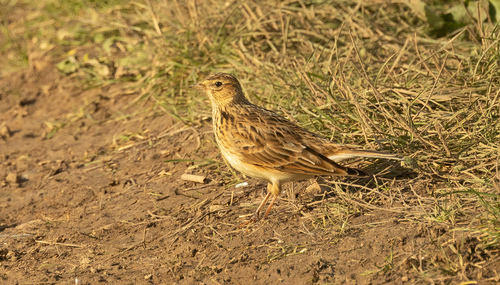
Skylark, adult adult
Photo: Jon J. Laysell · CC BY-NC

Bird 3 of 5

Skylark

Alauda arvensis

How to recognise it

  • Streaky brown, a bit bigger than a sparrow
  • A short crest that it can raise
  • White along the sides of the tail

Where and when

Open fields, moors and dunes. Sings while hovering high in the sky, for minutes at a time. On the ground it is very well hidden.

Song A non-stop, bubbling song that goes on for minutes, while the bird climbs and hovers high above you. Recording: Bram Piot · xeno-canto

Skylarks have declined sharply on farmland since the 1970s.

Yellowhammer, adult male adult male
Photo: unknown

Bird 4 of 5

Yellowhammer

Emberiza citrinella

How to recognise it

  • Bright yellow head and underparts
  • Streaky chestnut-brown back
  • Long tail with white on the sides

Where and when

Hedges and field edges with scattered trees. The male sings from the top of a bush, on a warm day.

Song The famous "little-bit-of-bread-and-no-che-e-ese": a rattle of short notes, ending with a long, wheezy one. Recording: Martin Billard · xeno-canto

The females are much duller, brownish-yellow with streaks.

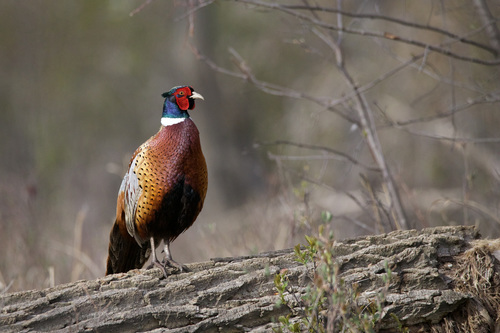
Pheasant, adult male adult male
Photo: johnkrampl · CC BY

Bird 5 of 5

Pheasant

Phasianus colchicus

How to recognise it

  • Big and chunky, with a very long tail
  • Red face, bottle-green head and a white neck ring
  • Coppery body with dark spots

Where and when

Fields, woods and hedges. Walks along the ground, and bursts out of the undergrowth with a clatter when startled. Roosts in trees.

Call A loud, hoarse "kok-kok" crow, followed by a whirr of the wings. Recording: Simon Elliott · xeno-canto

Pheasants were brought here long ago, and tens of millions are released every year for shooting. The female is brown, with a shorter tail.

Quiz

8 questions, with a few birds from earlier lessons mixed in. Your answers stay in this browser.

Out and about this week

Walk a field edge, a footpath or a country lane this week, in the morning if you can. Count the Skylarks you hear. Look up, and then look at the hedge: is a Yellowhammer singing from the top?