Motmot

Advanced birding · Lesson 31 · 22 minutes

Pratincoles and rare waders

Collared and Black-winged Pratincole, Stilt, Dotterel and four sandpipers that are not on the usual list

Not every wader on a muddy edge is a Dunlin. Some of the best birds of a good day are rare waders: a pratincole in a field in May, a Black-winged Stilt on a flooded meadow, a Broad-billed Sandpiper in with the Dunlins. You do not need to be an expert to find one. You need to scan every flock carefully and to know what "odd" looks like.

Pratincoles are a strange group: waders that hunt insects in the air like a swallow, and run on the ground like a plover. They breed in southern Europe and sometimes overshoot in May and June. The Stilt does the same. The Dotterel is a different story: it is a very tame mountain breeder that stops in the same fields on spring passage, and Dutch birders go to Flevoland to see it each May.

The three sandpipers (Broad-billed, Marsh and Terek) are scarce passage migrants. We look at the features that separate them from the commoner species you already know.

Today: 7 birds

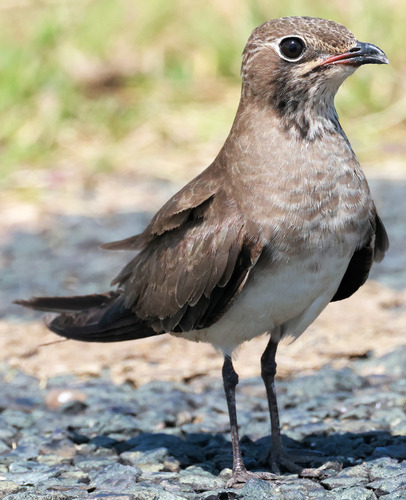
Collared Pratincole, adult adult
Photo: Rob Leslie · CC BY-NC

Bird 1 of 7

Collared Pratincole

Glareola pratincola

How to recognise it

  • Brown-grey, with a creamy throat bordered by a thin black line
  • A deeply forked tail, a white rump and white trailing edge to the inner wing
  • Chestnut underwing, seen as it hunts insects like a big swallow
forked tail A tail with a deep notch in it, like a swallow's. Pratincoles have one, and it shows well in flight.
underwing The underside of the wing. Chestnut in a Collared Pratincole, black in a Black-winged.

Where and when

FR: scarce summer visitor in the south, from April. NL, BE, DE, DK, UK, SE: very rare overshoots, mostly May and June. IE, NO, FI: almost never. A bird of the Mediterranean that sometimes turns up on a flooded field.

Call A tern-like, rolling “kikik” or “kitik” in flight. Recording: Stanislas Wroza · xeno-canto

A strange bird that seems half wader, half swallow. A perched bird looks plover-like, a flying bird looks like a tern.

Don’t confuse with: Black-winged Pratincole (this week): a black underwing, and no white trailing edge to the wing.
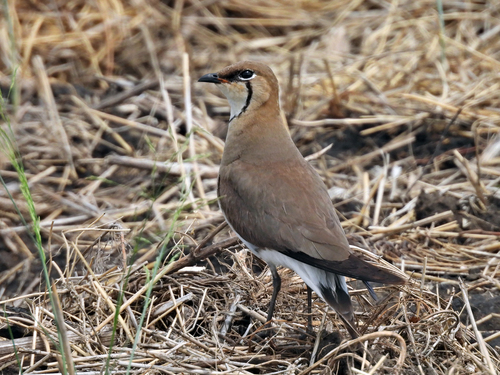
Black-winged Pratincole, adult adult
Photo: Dmitry Zhukov · CC BY-NC

Bird 2 of 7

Black-winged Pratincole

Glareola nordmanni

How to recognise it

  • Like a Collared Pratincole, but with a black underwing
  • No white trailing edge to the wing, and a bit darker above
  • A forked tail and a white rump, and a short, red-based black bill
forked tail A tail with a deep notch in it, like a swallow's. Pratincoles have one, and it shows well in flight.
underwing The underside of the wing. Chestnut in a Collared Pratincole, black in a Black-winged.

Where and when

NL, DE, DK, UK, FR, SE, FI: very rare, usually in May and June. BE, IE, NO: almost never. A bird of the Russian steppes, much rarer than the Collared in the west.

Call A dry, ringing “kirli” or “kit-kit”, harsher than the Collared. Recording: Frank Lambert · xeno-canto

A black underwing is the sure sign, but it is easier said than done: the bird must fly with the sun at a good angle.

Don’t confuse with: Collared Pratincole (this week): a chestnut underwing and a white trailing edge.

Collared or Black-winged Pratincole?

Collared PratincoleCollared Pratincole
Black-winged PratincoleBlack-winged Pratincole

It is all in the underwing. A Collared has a chestnut underwing and a white trailing edge to the inner wing. A Black-winged has a black underwing and no white trailing edge. Both have a forked tail and a white rump, and a cream throat patch. A perched bird is difficult: look at the wing tip, which projects beyond the tail in the Black-winged.

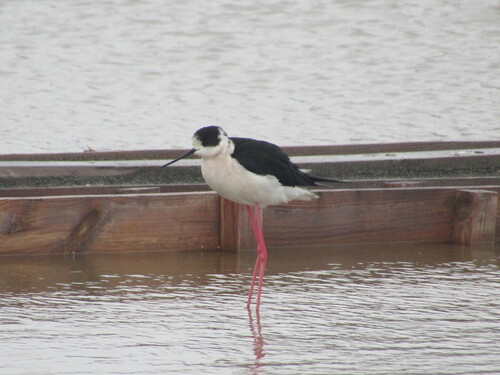
Black-winged Stilt, adult adult
Photo: stevem4560 · CC BY

Bird 3 of 7

Black-winged Stilt

Himantopus himantopus

How to recognise it

  • A black back and wings, and a white head and underparts
  • Extremely long, pink-red legs that trail behind in flight
  • A long, thin, straight black bill

Where and when

FR: fairly common breeder in the south and the west, from March. NL, BE, DE, UK, DK: rare overshoots in April to June, with an increasing number of breeders in the Netherlands and in the UK. IE, NO, SE, FI: very rare.

Call A sharp, yelping “kyik, kyik” or “kek”, repeated. Recording: Adrien Peillon · xeno-canto

Its legs are the longest of any wader relative to the body. A pair that attempts to breed in the UK or the Netherlands is a big event.

Don’t confuse with: Pied Avocet (week 14): an upturned bill, black-and-white wings, and short blue-grey legs.

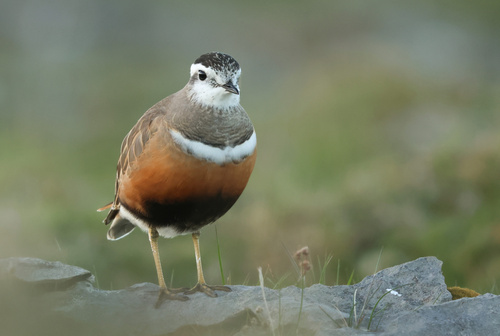
Eurasian Dotterel, adult adult
Photo: Tate Lloyd · CC BY-NC

Bird 4 of 7

Eurasian Dotterel

Eudromias morinellus

How to recognise it

  • A bold white eyebrow that meets at the back of the neck in a V
  • A white band across the breast, a chestnut belly and a grey-brown back
  • Very tame, running in short bursts across ploughed fields and mountain tops

Where and when

UK (Scottish Highlands), NO, SE, FI: scarce breeders on mountains, from May. NL, DE, DK, FR: rare on spring passage, especially late April to May, in Flevoland. BE, IE: very rare. A bird that stops on regular fields each spring.

Call A soft, short, trilling “pit-pit-pit” and a gentle “wit”. Recording: Hans van Loon · xeno-canto

The female is the brighter bird and the male incubates the eggs. In spring, a few birds visit the same Dutch fields every year.

Don’t confuse with: European Golden Plover (week 13): a gold-spangled back and a black belly, but no white V on the head.

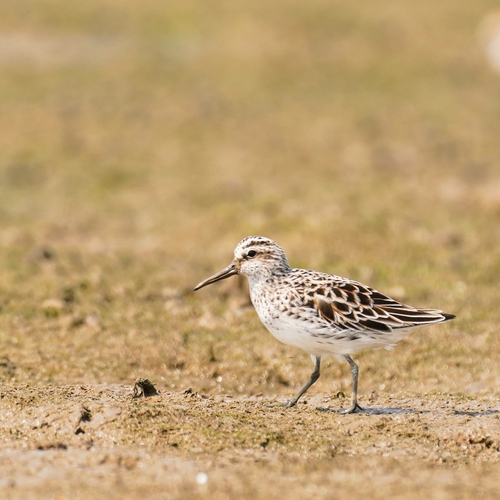
Broad-billed Sandpiper, adult adult
Photo: Jigar Patel · CC BY-NC

Bird 5 of 7

Broad-billed Sandpiper

Calidris falcinellus

How to recognise it

  • A small, dark-backed sandpiper with a split supercilium
  • A long, heavy bill with a slight droop at the tip
  • A short-legged, hunched shape, smaller than a Dunlin
split supercilium An eyebrow that forks in front of the eye into two stripes, as in the Broad-billed Sandpiper.

Where and when

FI, NO, SE: scarce breeders on northern bogs, from late May. UK, NL, DE, DK, FR: rare on passage, May to June and August to September. BE, IE: very rare. A species that is always in a flock of Dunlins.

Call A dry, short, buzzing “tirrek” or “tr-r-rit”. Recording: Stein Ø. Nilsen · xeno-canto

A bird to find by looking at each Dunlin in a flock. The double eyebrow and the heavy bill show up at a good distance.

Don’t confuse with: Dunlin (week 11): a plain face with no split eyebrow, and a longer, thinner bill.

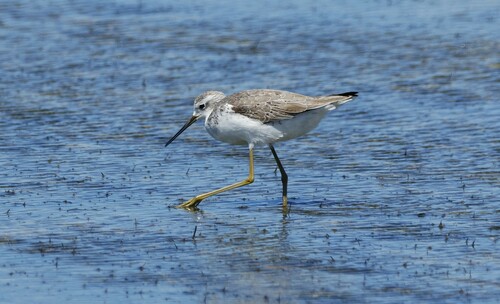
Marsh Sandpiper, adult adult
Photo: Jacobus Retief · CC BY-NC

Bird 6 of 7

Marsh Sandpiper

Tringa stagnatilis

How to recognise it

  • Like a small, slim Greenshank, with a needle-thin bill
  • Very long, greenish legs that trail beyond the tail in flight
  • A white wedge up the back and a delicate, elegant shape

Where and when

UK, NL, BE, DE, DK, FR: very rare on passage, May and August to September. SE, FI, NO: very rare. IE: almost never. A bird of the steppe that turns up on freshwater pools.

Call A soft, clear, single “tiu” or a thin “yeep”, quite different from a Greenshank. Recording: Martin Billard · xeno-canto

A Greenshank that has been to a gym for the wrong exercises: smaller, slimmer, and very long-legged. A bird for a warm day in May.

Don’t confuse with: Common Greenshank (week 12): bigger, a thick, slightly upturned bill, and a loud, ringing three-note call.

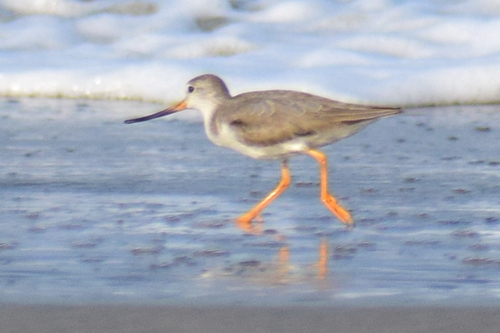
Terek Sandpiper, adult adult
Photo: Alen Alex Pathisseril · CC BY-NC

Bird 7 of 7

Terek Sandpiper

Xenus cinereus

How to recognise it

  • A long, upturned bill with an orange base
  • Short, bright orange-yellow legs and a grey-brown back
  • Runs fast, bobbing and flicking the tail, like a Common Sandpiper
upturned bill A bill that curves upwards, like the Terek Sandpiper's.

Where and when

FI: very rare breeder on the eastern edge. UK, NL, DE, DK, SE, NO: very rare, in May and June, with one or two a year. BE, FR, IE: almost never. A bird from the Russian taiga.

Call A rapid, fluty trill, “wiwiwiwi”, with a ringing quality. Recording: R. Martin · xeno-canto

An odd bird: the upturned bill and the orange legs make it look like a Common Sandpiper that has gone wrong.

Don’t confuse with: Common Sandpiper (week 12): a straight bill and greenish legs, and a bobbing action.

Quiz

12 questions, with birds you have to repeat mixed in. Your answers decide when each bird comes back.

Out and about this week

In May, check the flooded fields and the mudflats near your coast, and look for the unusual: a long-legged wader, an odd bird among the Dunlins. Take a photograph and compare with the lesson.