Motmot

Advanced birding · Lesson 21 · 22 minutes

Female dabbling ducks

Mallard, Gadwall, Wigeon, Pintail, Teal, Garganey and Shoveler: the brown ones

Every duck in this lesson is a female, and that is the point. From a distance a flock of female dabbling ducks is a mass of mottled brown. The males are easy: you learned them in the beginners course. The females are a different matter, and they decide whether you are a duck birder or not.

The rules: size and shape first (the head, the bill, the neck), then the bill colour and pattern, then the face (eyebrow, eye-stripe, spot at the bill base) and last the wing patch, the speculum, if she opens a wing. In winter, from October to March, the lakes of north-west Europe are full of ducks from Siberia, Scandinavia and the Baltic. A single flock can hold five of today's species. The Garganey is the odd one out: it is a summer visitor that arrives in March to April and leaves in August.

Today's photos show females only, and every photo is checked against that. In the quiz, the wrong answers are other females, not males.

Today: 7 birds

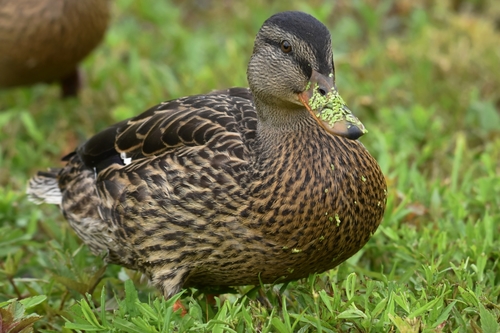
Mallard, adult female adult female
Photo: gwpiel · CC BY

Bird 1 of 7

Mallard

Anas platyrhynchos

How to recognise it

  • Mottled brown, with an orange bill pattern: a dark saddle on the top
  • A dark crown and eye-stripe, on a paler face
  • A blue speculum edged in white, on both sides
speculum The coloured patch on the wing, usually iridescent, bordered by white lines. Its colour differs by species.
bill pattern The colours on the bill. The female Mallard has an orange bill with a dark blotch on top.

Where and when

All ten countries. UK, IE, NL, BE, DE, FR, DK, SE, FI, NO: abundant to common all year, in any water. Breeding from March; ducklings in April to July. The female is the one that says “quack”.

Call The loud, descending, laughing quack of the female: “quaak-quak-quak-quak-quak”. Recording: Irish Wildlife Sounds · xeno-canto

A big, bulky duck with a flat head. All other females are compared with this one, and they are often smaller.

Don’t confuse with: Gadwall (this week): smaller, a steeper forehead, a more orange side to the bill and a white wing patch.

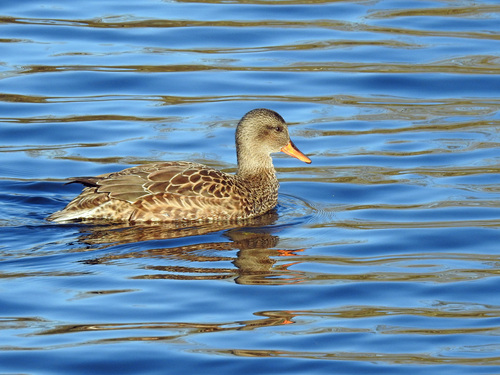
Gadwall, adult female adult female
Photo: Neil Shepherd · CC BY-NC

Bird 2 of 7

Gadwall

Mareca strepera

How to recognise it

  • Looks like a small Mallard with a neat, steeper forehead
  • An orange-sided bill with a dark grey centre: the bill pattern is two-tone
  • A white speculum that shows as a white square in flight or on the water
speculum The coloured patch on the wing, usually iridescent, bordered by white lines. Its colour differs by species.
bill pattern The colours on the bill. The female Mallard has an orange bill with a dark blotch on top.

Where and when

UK, IE, NL, BE, DE, FR, DK: fairly common on lakes and gravel pits, all year, with more in winter. NO, SE, FI: uncommon, scarce. It dabbles with the head under water and the tail up.

Call A low, quiet quack, flat and nasal: “kak-kak”. Recording: Ashley Fisher · xeno-canto

Grey-brown, rather neat, and she prefers Coots' company, as she steals the food they bring up from the bottom.

Don’t confuse with: Mallard (this week): bigger, with a flat head, a bolder face and no white speculum.

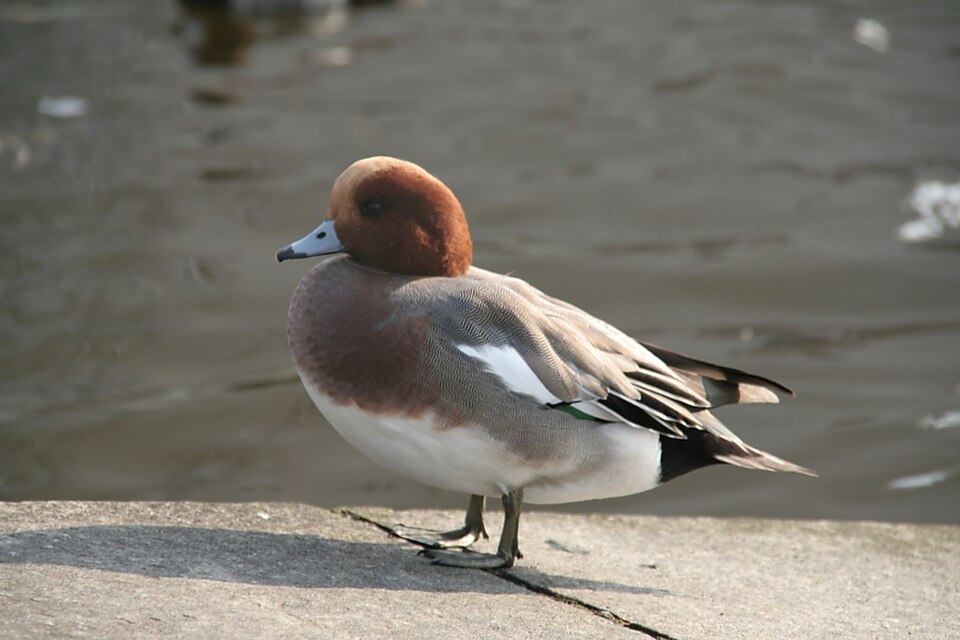
Eurasian Wigeon, adult female adult female
Photo: Maga-chan · CC BY-SA

Bird 3 of 7

Eurasian Wigeon

Mareca penelope

How to recognise it

  • A round head, a short, steep forehead and a small, blue-grey bill with a black tip
  • Rufous or grey-brown body and a white belly
  • A speculum that is dull grey-green, with no bright patch
speculum The coloured patch on the wing, usually iridescent, bordered by white lines. Its colour differs by species.

Where and when

UK, IE, NL, BE, DE, FR, DK: common to abundant in winter, from October to March, on coastal marshes and fields. NO, SE, FI: breeds in the north. A grazing duck in big flocks.

Call A low, growling, purring “rrrr” from the female. The male whistles “whee-oo”. Recording: David Darrell-Lambert · xeno-canto

Grazes on grass like a goose and sits as a flock on the grass. A small, round-headed, short-billed duck is a Wigeon.

Don’t confuse with: Gadwall (this week): a pale orange bill and a flatter head. Teal: smaller, with a dark eye-stripe.

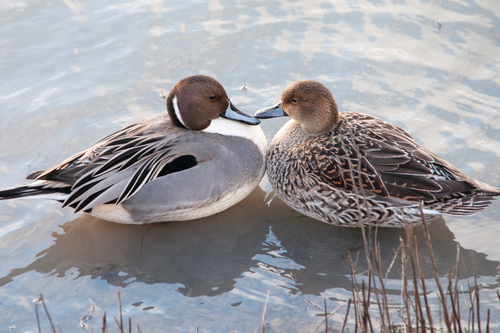
Northern Pintail, adult female adult female
Photo: ryan_elliott · CC BY

Bird 4 of 7

Northern Pintail

Anas acuta

How to recognise it

  • Slim, elegant and long-necked, with a plain pale head
  • A grey bill with a blue-grey centre and a plain face with no eye-stripe
  • A pointed tail and a brown speculum with a bold white back edge
speculum The coloured patch on the wing, usually iridescent, bordered by white lines. Its colour differs by species.

Where and when

UK, IE, NL, BE, DE, FR, DK: fairly common in winter. SE, FI, NO: uncommon, breeds in the north. A bird of open, shallow, wet places, and an early migrant in autumn.

Call A low, soft quack and a short, rough “kruk”. Recording: David Darrell-Lambert · xeno-canto

She has the longest neck and the most elegant shape of all the dabbling ducks. The plain, pale head with no stripes is the key.

Don’t confuse with: Mallard (this week): a heavier body, a short neck and a bold bill pattern.

Eurasian Teal, adult female adult female
Photo: Stavros Toumanidis · CC BY-SA

Bird 5 of 7

Eurasian Teal

Anas crecca

How to recognise it

  • Small and compact, with a dark eye-stripe and a pale loral spot
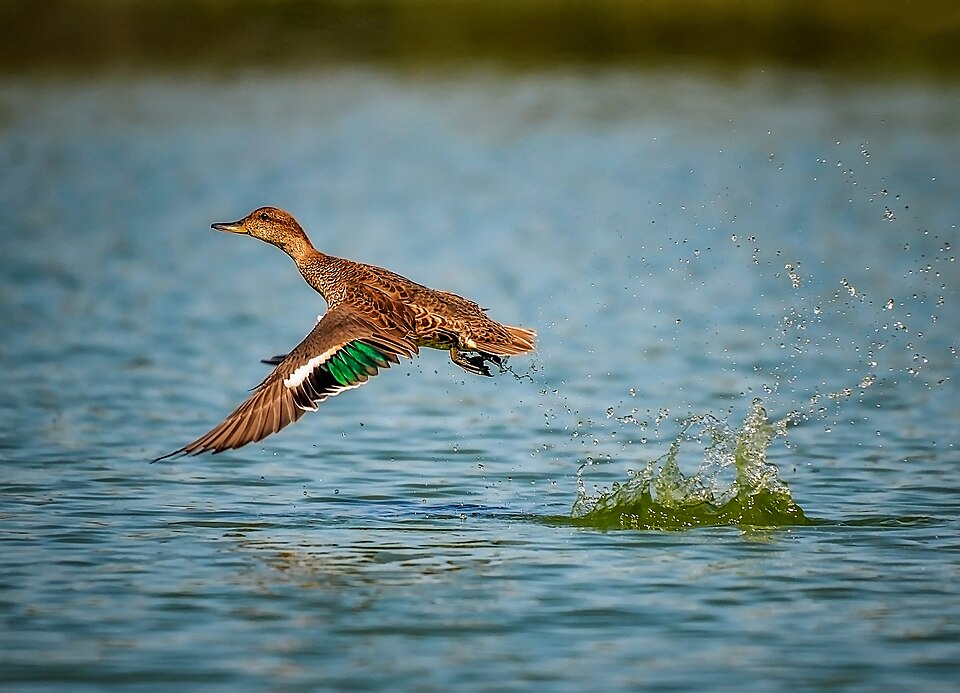
  • A green speculum with a buff front edge, seen in flight and when she stretches
  • A thin, dark grey bill, and a white line along the side of the undertail
speculum The coloured patch on the wing, usually iridescent, bordered by white lines. Its colour differs by species.
loral spot A pale spot at the base of the bill, as in the Teal and Garganey female.
eye-stripe A dark line running back from the eye. In Teal and Garganey it is strong.

Where and when

UK, IE, NL, BE, DE, FR, DK: common in winter. NO, SE, FI: breeds in the north. The smallest dabbling duck of the region, found on shallow pools and marshes.

Call A short, high, quacking “krrick” from the female, and a clear whistle from the male. Recording: Jack Berteau · xeno-canto

A very small duck, with a very compact shape. A flock of Teal takes off with a sudden, fast, twisting flight.

Don’t confuse with: Garganey (this week): a bold white eyebrow and a pale spot on the cheek. Gadwall: bigger, and an orange bill.

Teal or Garganey female?

Eurasian TealEurasian Teal
GarganeyGarganey

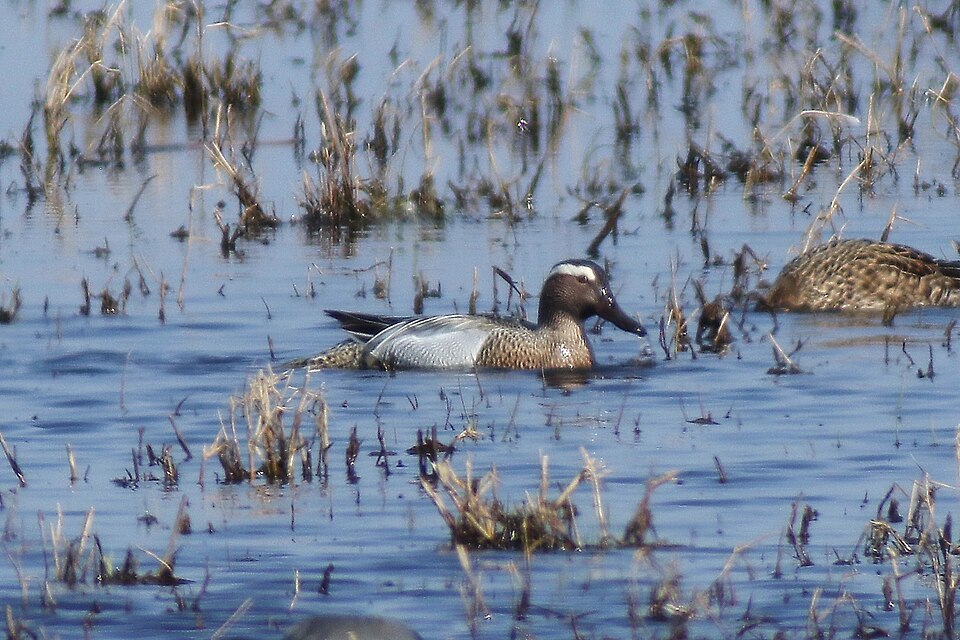
Look at the face. A female Garganey has a bold pale eyebrow above a dark eye-stripe and a pale spot at the base of the bill, which gives her a pale-and-dark face. A female Teal has a much plainer face: a dark eye-stripe and a small pale spot, with a white streak by the tail. In the wing, a Teal has a green speculum and a Garganey does not.

Garganey, adult female adult female
Photo: Donald Hobern · CC BY

Bird 6 of 7

Garganey

Spatula querquedula

How to recognise it

  • A bold, pale supercilium and a dark eye-stripe, with a pale spot at the base of the bill
  • A pale line below the eye, and a dark cheek stripe
  • A greyish, plain wing, with no green speculum, and a pale belly
speculum The coloured patch on the wing, usually iridescent, bordered by white lines. Its colour differs by species.
eye-stripe A dark line running back from the eye. In Teal and Garganey it is strong.

Where and when

NL, DE, DK, BE, FR, UK: scarce summer visitor, March to August, to flooded grassland. IE, NO, SE, FI: rare. A migrant to West Africa. The only duck of the region that arrives in spring and leaves in autumn.

Call A short, dry, rattling “krrk”, from the female. Recording: Irish Wildlife Sounds · xeno-canto

A summer duck. If there is a Teal-sized duck with a very bold face pattern in April, it is probably a Garganey.

Don’t confuse with: Eurasian Teal (this week): a dark stripe on the eye and a green wing patch, but no bold eyebrow.

Northern Shoveler, adult female adult female
Photo: danielmcnair · CC BY

Bird 7 of 7

Northern Shoveler

Spatula clypeata

How to recognise it

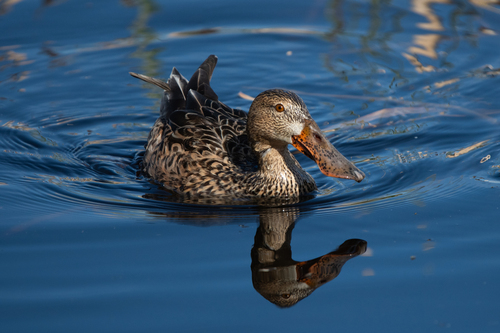
  • A huge, spoon-shaped bill, much wider at the tip
  • Mottled brown, with an orange edge to the bill, and a large head
  • A dull speculum and pale blue-grey forewing, visible in flight
speculum The coloured patch on the wing, usually iridescent, bordered by white lines. Its colour differs by species.

Where and when

UK, IE, NL, BE, DE, FR, DK: fairly common, all year, with peaks in winter. SE, FI, NO: uncommon, in summer. It swings the bill through the water, filtering food.

Call A low, nasal “kuk-kuk” and a soft quack. Recording: David Darrell-Lambert · xeno-canto

A heavy, front-heavy duck, with a bill like a spade. She is always found feeding in a tight group, spinning and sieving.

Don’t confuse with: Mallard (this week): a smaller bill and a bolder head pattern.

Quiz

12 questions, with birds you have to repeat mixed in. Your answers decide when each bird comes back.

Out and about this week

Visit a lake or a pond with dabbling ducks this month. Pick out only the females and name each one. In March and April look for the Garganey female among the Teal.