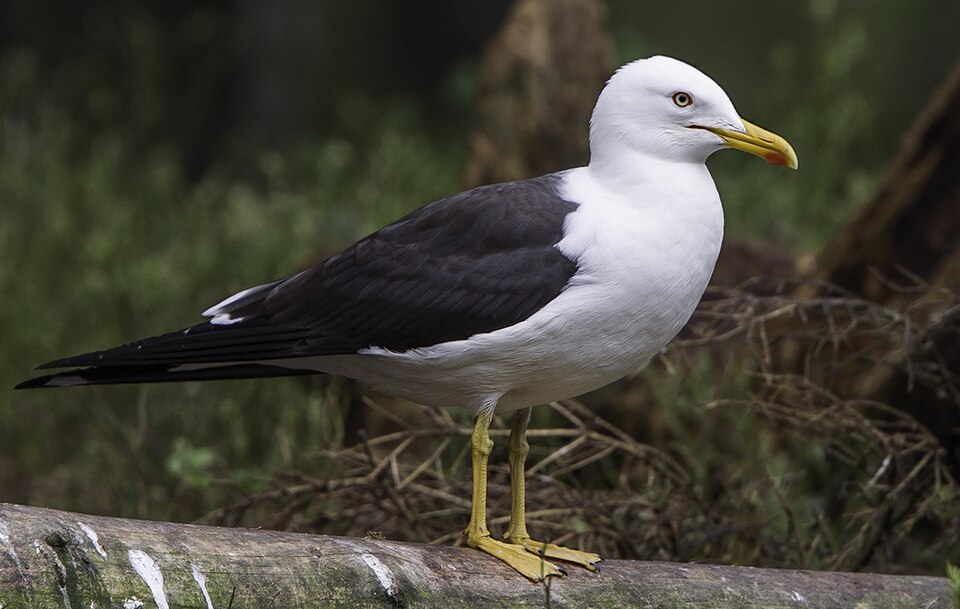
Motmot

Advanced birding · Lesson 2 · 20 minutes

Big gulls and their young

Herring, Yellow-legged, Caspian and the black-backs, with first-winters side by side

The big gulls are the group that makes birders reach for a coffee. In north-west Europe four look-alikes share the same coast: Herring, Yellow-legged, Caspian and Lesser Black-backed. They hybridise, they vary, and the young are harder than the adults. So today we learn the adults of the two difficult newcomers (Yellow-legged and Caspian) and, for the three you met last week, how their first-winters differ from each other.

The method is the same every time: size and shape first (head, bill, leg length), then the shade of the mantle, then the colours of the soft parts, and the wing tips last. For young birds, check the tertials and the tail. Do not let a single feature decide: a Yellow-legged Gull is not identified by yellow legs alone.

Season matters. Yellow-legged Gulls from the Mediterranean and the French Atlantic coast spread north after the breeding season, from July to the autumn, which is why you find them on inland pits in August. Caspian Gulls come from the east, from Poland and Ukraine, and are mainly a winter bird in NL, BE and DE, with a few in the UK.

Today: 6 birds

Herring Gull, first-winter first-winter
Photo: Phil Miller · CC BY-NC

Bird 1 of 6

Herring Gull

Larus argentatus

How to recognise it

  • Brown, streaky and mottled overall, with a paler head and underparts
  • Pale panel in the inner primaries of the flying bird, dark tail band and a paler rump
  • Dark bill with a pale base, pink legs, and tertials with pale notches along their edges

Where and when

UK, IE, NL, BE, DK and NO: the commonest first-winter big gull from August to March. DE and FR: coastal, with Yellow-legged mixed in. SE and FI: coastal and inland, mostly in autumn.

Call Thin, mewing begging calls and the “kee-ow” of the adults. Recording: Colm Philpott · xeno-canto

A first-winter is a lot browner than a first-winter Yellow-legged or Caspian: think of a Herring Gull as a tweed jacket, a Caspian as a white shirt.

Don’t confuse with: Lesser Black-backed Gull (this week): darker and plainer, with a more solidly dark inner wing.
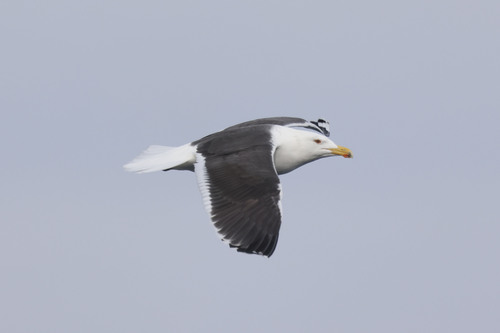
Lesser Black-backed Gull, first-winter first-winter
Photo: Perhols · CC BY-SA

Bird 2 of 6

Lesser Black-backed Gull

Larus fuscus

How to recognise it

  • Dark, brown and scaly, with a dusky head and a densely streaked breast
  • Dark inner primaries, a solid dark wing and a broad black tail band
  • Black bill, dull pink legs and dark, plain tertials

Where and when

UK, IE, NL, BE, DK and FR: from July to October. Fewer are left in winter, as most move to Iberia and Africa. DE, NO, SE and FI: passage birds.

Call A hoarse begging “keeah” and the deeper barking of adults. Recording: david m · xeno-canto

The inner wing is very dark, and only a thin pale window shows in the inner primaries. A first-winter that looks "too dark" for a Herring Gull is usually this species.

Don’t confuse with: Herring Gull (this week): paler head and underparts, and a clear pale window in the inner primaries.

Great Black-backed Gull, first-winter first-winter
Photo: dansmall · CC BY-NC

Bird 3 of 6

Great Black-backed Gull

Larus marinus

How to recognise it

  • Huge, with a thick bill and a white head, with a dark mask behind the eye
  • Black-and-white chequered upperparts: pale spots on dark scapulars
  • Whitish tail with a thin dark band, and a heavy bill that is mostly dark
scapulars The feathers that cover the shoulder, between the back and the wing. In young gulls they show the first grey.
mask A dark patch around and behind the eye on a pale head.

Where and when

UK, IE, NO and DK: fairly common, on the coast and at fishing ports. NL: uncommon, in winter. DE, SE, FI, FR and BE: scarce.

Call A deep “owk, owk” and a low, hoarse begging cry. Recording: Stein Ø. Nilsen · xeno-canto

At a distance it is a big chequered gull. Look for the size and the plain white head, not for streaks: first-winter Herring Gulls are brown and streaky, the great black-back is pale and pied.

Don’t confuse with: Herring Gull (this week): browner and streaky rather than chequered, with a smaller bill.

Yellow-legged Gull, adult adult
Photo: terathopius · CC BY

Bird 4 of 6

Yellow-legged Gull

Larus michahellis

How to recognise it

  • A mid-grey mantle, darker than a Herring Gull and paler than a Lesser Black-back
  • Bright yellow legs and a heavy yellow bill with a large red spot at the gonys
  • A white head even in autumn and a pale eye with a red eye ring

Where and when

FR: fairly common, and the usual big gull on the Atlantic and Channel coasts. UK, BE, NL, IE, DK, DE and SE: uncommon to rare, peaking July to October when young and adult birds come north from the Mediterranean. NO and FI: very rare.

Call A deep, harsh “ow-ow-ow” and a long laughing call, rougher than a Herring Gull. Recording: David Darrell-Lambert · xeno-canto

A pale-headed gull in late summer, with a clean head while Herring Gulls are still streaked. The shape is the Herring Gull's, but heavier in the bill and the neck.

Don’t confuse with: Caspian Gull (this week): a longer, thinner bill, dark eye and a smaller head. Lesser Black-backed Gull: darker back.

Caspian Gull, adult adult
Photo: MPF · CC BY-SA

Bird 5 of 6

Caspian Gull

Larus cachinnans

How to recognise it

  • Small flat head, long thin bill with a small red spot, and a dark eye
  • Long legs and a long primary projection, with a sleek, swan-necked jizz
  • Pale grey mantle, white head in winter, and a big white tertial crescent
primary projection How far the wing tip sticks out behind the tertials on a resting gull. Long in Caspian and Lesser Black-backed.
tertial crescent The white edge along the tertials of an adult gull, forming a crescent on a perched bird.
jizz The overall impression: shape, posture and movement together. Often right before you can say why.

Where and when

NL, BE, DE and DK: regular in winter, best from October to March. UK: scarce in winter on the east and south-east. FR, SE, NO and FI: very rare or occasional. IE: very rare.

Call A long, nasal “kyow-kyow”, higher and thinner than a Herring Gull. Recording: Romuald Mikusek · xeno-canto

It is the one to scan flocks for. Look for the pale, small-headed gull with the dark eye, the thin bill and the long wings. The adult is easy once you see its jizz.

Don’t confuse with: Yellow-legged Gull (this week): bigger head, shorter bill, a pale eye with a red ring, a heavier look.

Common Gull, first-winter first-winter
Photo: ianm_hull · CC BY-NC

Bird 6 of 6

Common Gull

Larus canus

How to recognise it

  • The yardstick: small and round-headed, with a thin bill and a gentle face
  • Pale grey mantle and brown wing feathers; dark tertials with pale tips
  • Pink-and-black bill and pink legs; a clean black band on a white tail

Where and when

UK, IE, NL, BE, DK, NO, FI: common in winter, with young birds in every flock. DE and SE: fairly common. FR: scarce.

Call A high, plaintive begging “keeeya”. Recording: Alex Lin-Moore · xeno-canto

Put it next to a Herring Gull and you will see the size gap. A first-winter Common Gull is easy to recognise by its neat black tail band on an otherwise clean white tail, much cleaner than a Herring Gull's tail.

Don’t confuse with: Herring Gull (this week): bigger, with a brown, streaky look and a heavier bill.

Quiz

12 questions, with birds you have to repeat mixed in. Your answers decide when each bird comes back.

Out and about this week

Go to a reservoir, a harbour or a rubbish tip in the next two weeks and scan a gull flock for twenty minutes. Look for one bird that is clearly paler-headed and long-billed (a Caspian candidate) and one with yellow legs. Take a photograph and compare it with the lesson. If you cannot decide, say "big gull" and move on.