Motmot

Advanced birding · Lesson 1 · 18 minutes

Reading a gull

Age, moult and the parts of a gull: six birds to learn the vocabulary

You already know a gull from a pigeon. This course starts where most birders get stuck: the gull that is not an adult. A gull is a calendar. A Black-headed Gull needs about two years to get its adult plumage, a Common Gull three, and a Herring or a Great Black-backed Gull four. Each year it replaces its feathers in a different pattern, so a Herring Gull can be brown, streaky, pied, grey-backed with black in the tail, and finally adult. That is what makes gulls hard, and also what makes them a good puzzle: nearly every bird in a winter flock is a different age.

Before we start naming species, we learn to describe. The words below are the ones every gull guide uses: mantle, primaries, tertials, mirror, gonys. Once you can say "first-winter, dark tertials, pale inner primaries" you can look things up and tell other birders what you see. We work with six birds, mostly adults, plus two young ones so you can see how the pattern changes.

This is a winter lesson. From October to March the coast, the reservoirs and the playing fields hold the most gulls, with birds from Scandinavia, the Baltic and Russia joining the local ones. Summer plumages (the hood, the yellow bill) are mostly a spring story, so keep in mind that today's pictures show the winter look.

Today: 6 birds

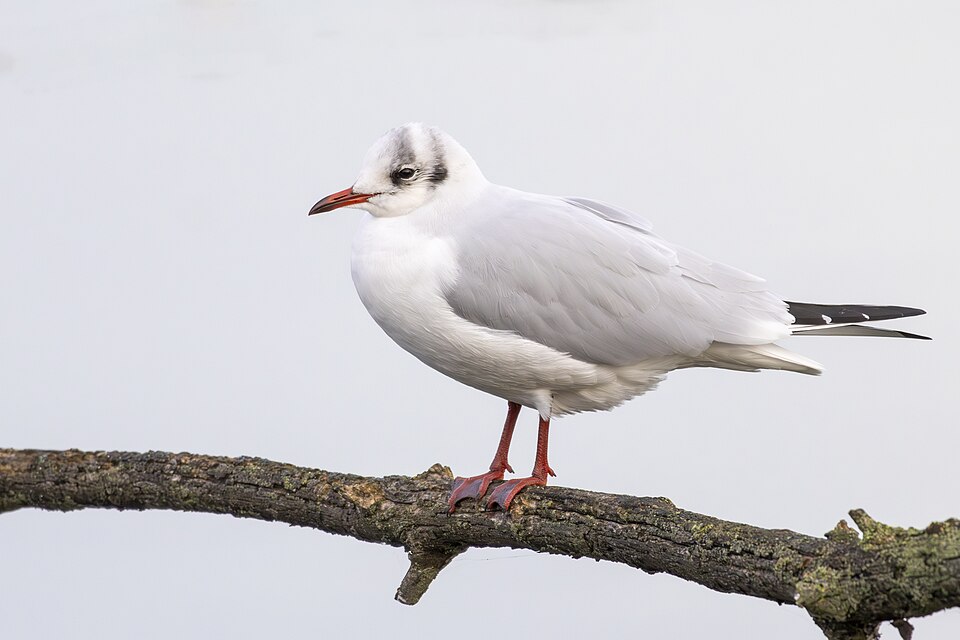
Black-headed Gull, first-winter first-winter
Photo: Alexis Lours · CC BY

Bird 1 of 6

Black-headed Gull

Chroicocephalus ridibundus

How to recognise it

  • Pale grey mantle, but a brown band of wing feathers along the closed wing
  • White leading edge to the wing, black tips to the primaries, black band at the end of the tail
  • Orange-pink bill with a dark tip, and a smudgy ear spot on a white head
mantle The back of the bird and the upper side of the closed wing, the "saddle". Its shade of grey is the first thing to check.
primaries The long outer flight feathers that make the wing tip. Their pattern in black and white is a signature of every species.
ear spot A dark smudge behind the eye on a pale head, typical of small gulls in winter.

Where and when

UK, IE, NL, BE and DK: abundant all winter. DE, FR, SE and FI: common. NO: uncommon, mostly spring and summer. The most numerous gull of the ten countries, and every flock has first-winters from August onwards.

Call A harsh, grating “kree-ar” and a lot of chattering from a flock. Recording: Simon Elliott · xeno-canto

A first-winter Black-headed already shows the adult wing pattern with the white leading edge. By its first spring it has a brown hood but keeps the brown wing band.

Don’t confuse with: Common Gull (this week): rounder head, no ear spot, a darker and plainer grey back and white spots at the wing tip in adults.

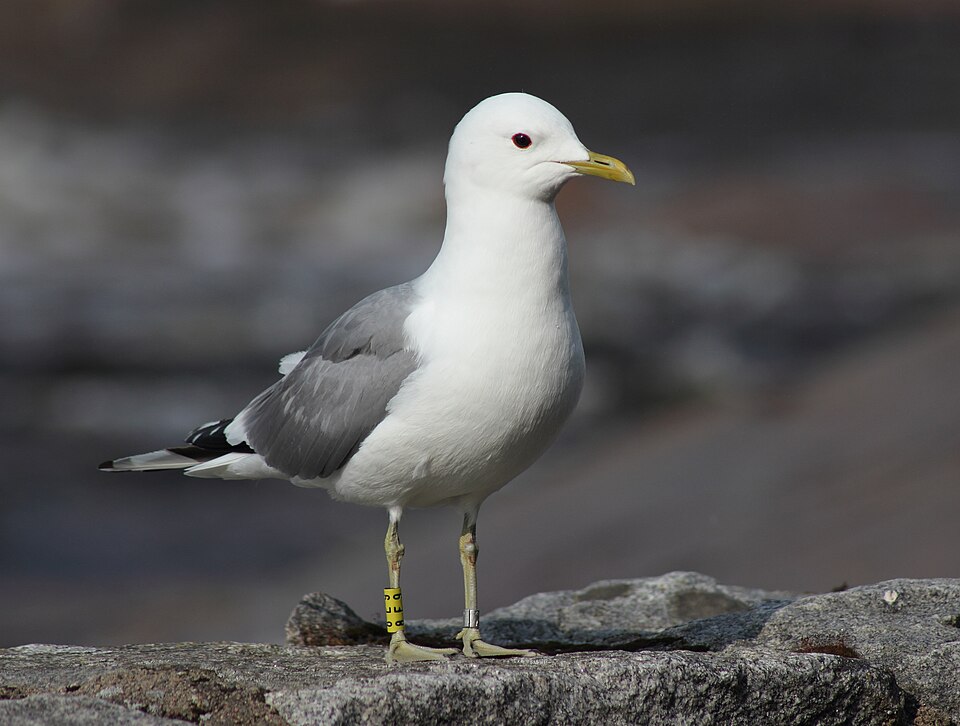
Common Gull, adult adult
Photo: Estormiz · CC0

Bird 2 of 6

Common Gull

Larus canus

How to recognise it

  • Round head, dark eye and a gentle face, with a thin yellow-green bill that has no spot
  • Medium-grey mantle and a black wing tip with two big white mirrors
  • Greenish-yellow legs; in winter the head is finely streaked by moult and wear
mantle The back of the bird and the upper side of the closed wing, the "saddle". Its shade of grey is the first thing to check.
mirror A white spot inside the black wing tip, on the outer primaries. Number and size differ per species.
moult The yearly swap of old feathers for new. Gulls moult in stages, so a bird can be half one plumage, half another.

Where and when

UK, IE, NL, BE, DK, NO and FI: common, with the biggest numbers on playing fields and shores in winter. DE and SE: fairly common (SE and NO breed inland). FR: scarce, mostly on the Channel coast in winter.

Call A high, laughing “kee-ya, kee-ya”, thinner and higher than a Herring Gull. Recording: Alex Lin-Moore · xeno-canto

Not so common as its name in the south. It is the gull of Scottish and Scandinavian lakes, and in winter it is the bird on the football pitch with a Black-headed Gull's size but a Herring Gull's shape.

Don’t confuse with: Herring Gull (this week): bigger and heavier, a pale eye, a red spot on a thick yellow bill and pink legs.

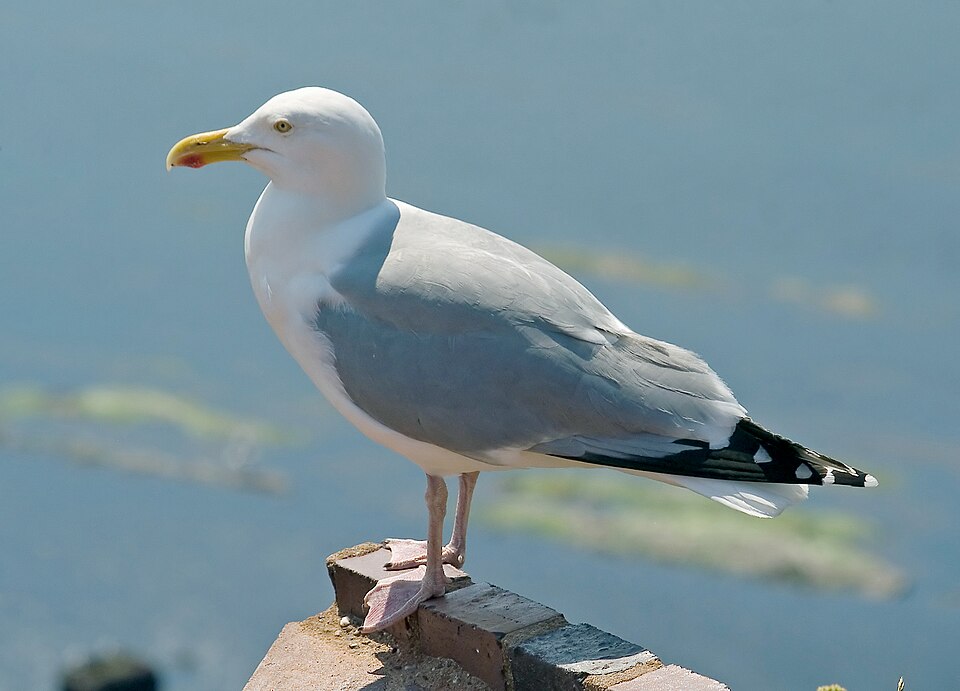
Herring Gull, adult adult
Photo: Kulac · CC BY-SA

Bird 3 of 6

Herring Gull

Larus argentatus

How to recognise it

  • Pale grey mantle, black wing tip with small white mirrors
  • Heavy yellow bill with a red spot at the gonys
  • Pale eye with a red-orange eye ring, and pink legs
mantle The back of the bird and the upper side of the closed wing, the "saddle". Its shade of grey is the first thing to check.
mirror A white spot inside the black wing tip, on the outer primaries. Number and size differ per species.
gonys The angle halfway along the lower bill. The red spot of the Herring Gull sits here.

Where and when

All ten countries, mostly on the coast. UK, IE, NL, BE, DK and NO: the standard big gull. DE and FR: coastal, with the Yellow-legged Gull taking over towards the south. SE and FI: along the coasts, with local inland birds. Many northern birds move south and west in autumn.

Call The classic seaside “kee-ow, kee-ow” and a laughing “ha-ha-ha-ha”. Recording: Colm Philpott · xeno-canto

Numbers are falling in several countries, and many of the gulls on rubbish tips and rooftops are Herring Gulls. Beware: the pink legs apply to the north-west European birds, and not all the Herring-like gulls you meet will have them.

Don’t confuse with: Yellow-legged and Caspian Gull (next week): a different leg colour, a different back shade and a different shape.

Common Gull or Herring Gull?

Common GullCommon Gull
Herring GullHerring Gull

Look at the face before the back. A Common Gull has a small round head, a dark eye, a thin bill with no red spot and greenish legs. A Herring Gull has a flat head, a pale eye, a thick bill with a red spot and pink legs. At the wing tip the Common Gull has two big white mirrors, the Herring Gull has small ones. If it looks like a Herring Gull that has been put on a diet, it is a Common Gull.

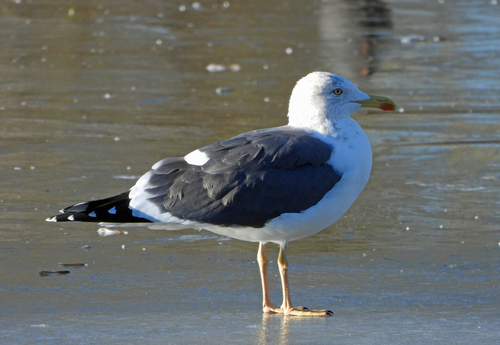
Lesser Black-backed Gull, adult adult
Photo: Paul Lewis · CC BY-NC

Bird 4 of 6

Lesser Black-backed Gull

Larus fuscus

How to recognise it

  • Dark slate-grey mantle, paler than the black wing tip
  • Yellow legs and a yellow bill with a red spot at the gonys
  • Long wings: the primaries reach well past the tail when it rests
mantle The back of the bird and the upper side of the closed wing, the "saddle". Its shade of grey is the first thing to check.
primaries The long outer flight feathers that make the wing tip. Their pattern in black and white is a signature of every species.
gonys The angle halfway along the lower bill. The red spot of the Herring Gull sits here.

Where and when

UK, NL, IE, BE and DK: common from March to October, on the coast and inland. FR, DE and NO: uncommon. SE and FI: scarce. Most spend the winter in Iberia and Africa, but more and more stay in the UK, IE, NL and BE.

Call A deep, barking “kow-kow-kow” and a lower laugh than a Herring Gull. Recording: david m · xeno-canto

The shade of the back changes with the origin: British and Irish birds are slate-grey, Scandinavian birds are almost black. Both have yellow legs, and that is the first thing to check.

Don’t confuse with: Great Black-backed Gull (this week): twice the weight, a huge bill, pink legs and a black back.

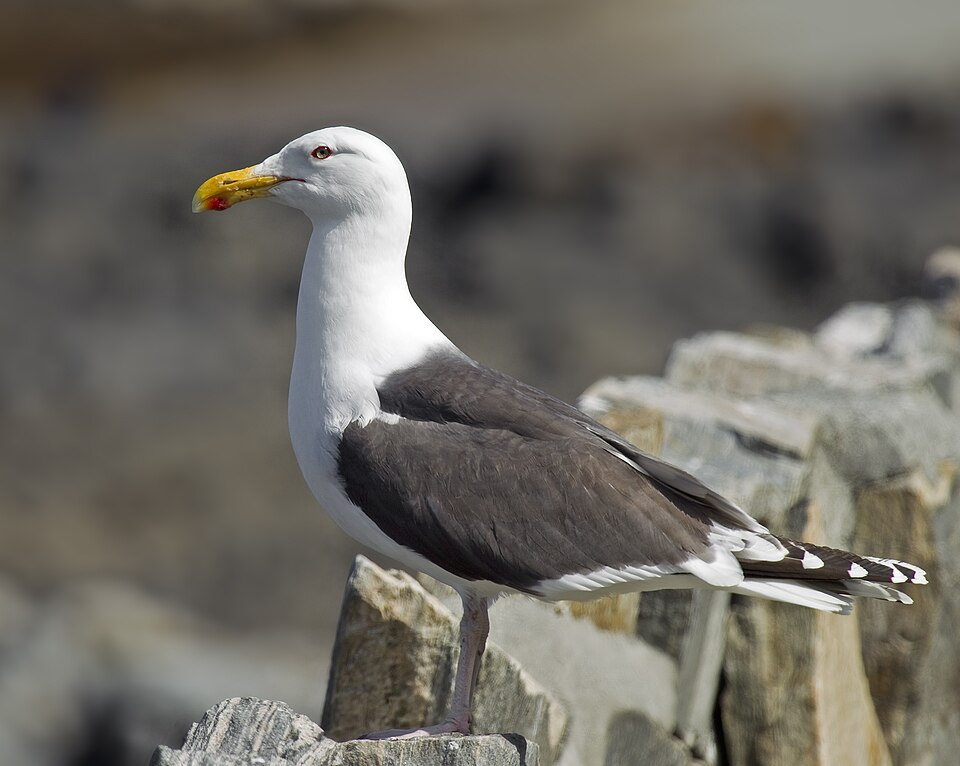
Great Black-backed Gull, adult adult
Photo: Andreas Trepte · CC BY-SA

Bird 5 of 6

Great Black-backed Gull

Larus marinus

How to recognise it

  • The biggest gull: huge, heavy bill, a barrel chest and a domineering look
  • Black mantle and a white band along the tips of the tertials and wing
  • Pale pink legs and a white head, even in winter
mantle The back of the bird and the upper side of the closed wing, the "saddle". Its shade of grey is the first thing to check.
tertials The short feathers on top of the folded wing, next to the back. In young gulls they are dark with pale edges.

Where and when

UK, IE, NO and DK: fairly common all year, on the coast and in harbours. NL: uncommon, mainly in winter. DE, SE, FI and FR: scarce, along the coast. BE: very rare.

Call A deep, throaty “owk-owk-owk”, slower and lower than any other gull. Recording: Stein Ø. Nilsen · xeno-canto

It eats other seabirds, including Puffins and Manx Shearwaters, and chases other gulls off their food. If a gull makes the others scatter, look for this one.

Don’t confuse with: Lesser Black-backed Gull (this week): smaller, slimmer, yellow legs, a dark grey rather than black back.

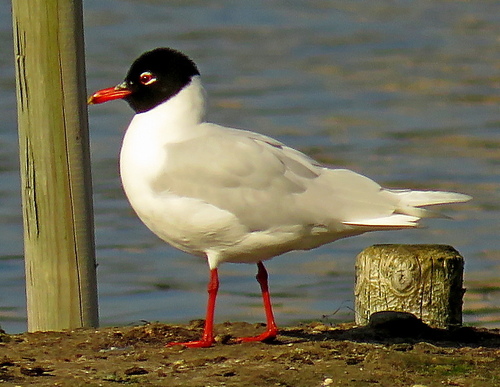
Mediterranean Gull, adult, non-breeding adult, non-breeding
Photo: jballam · CC BY

Bird 6 of 6

Mediterranean Gull

Ichthyaetus melanocephalus

How to recognise it

  • All-white wing tips, with no black at all, and a pale grey mantle
  • Thick, blunt red bill with a darker band near the tip, and dark red legs
  • Winter: the black hood is lost by moult, leaving a dark mask behind the eye
mantle The back of the bird and the upper side of the closed wing, the "saddle". Its shade of grey is the first thing to check.
moult The yearly swap of old feathers for new. Gulls moult in stages, so a bird can be half one plumage, half another.

Where and when

NL, FR: uncommon to fairly common and rising. UK and BE: scarce but regular all year, with a growing breeding colony on the south and east coasts. DE, DK, SE, NO and IE: rare to very rare, though more are seen each year. FI: very rare.

Call A nasal, mewing “yeaow” and a deeper “kow-kow”. Recording: David Darrell-Lambert · xeno-canto

A species on the move: a century ago it was a Black Sea bird. Look for the heavy bill and the bulky look first, the white wing tips second.

Don’t confuse with: Black-headed Gull (this week): smaller, thinner bill, black tips and a white leading edge to the wing.

Quiz

10 questions. Your answers decide when each bird comes back.

Out and about this week

Find a flock of gulls this week, on a pitch, a beach or a reservoir, and sit for twenty minutes. Without naming species, describe five birds out loud: age (brown, mixed, grey-backed, adult), the shade of the mantle, the colour of the legs, the bill. Then look up the ones you can name.