

ruffed grouse vs téu-téu-da-savana
Bonasa umbellus versus Hesperoburhinus bistriatus
Jogue um quiz com ruffed grouse e téu-téu-da-savana
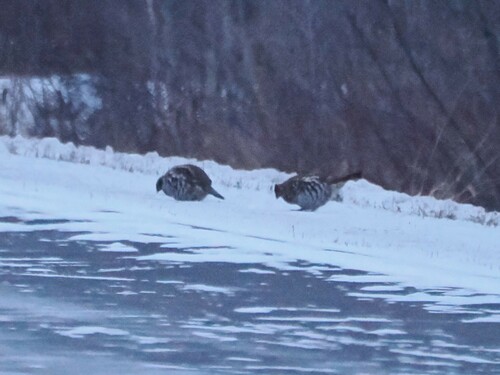 ruffed grouse
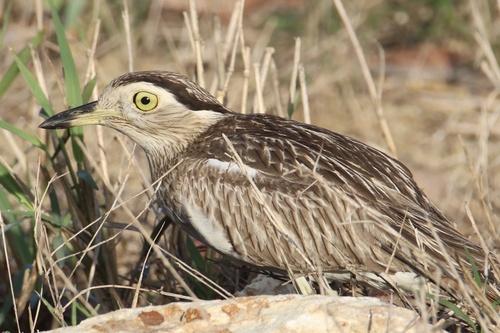 téu-téu-da-savana
Em resumo
The most reliable field mark to separate Ruffed Grouse from Double-striped Thick-knee is the thick-knee's striking white wing patch and white underwing with a black rear edge, visible in flight at all ages, versus the grouse's uniformly barred wings and broad black tail band. On the ground, thick-knees show long, greenish-grey legs and a bold black-and-white head pattern, while grouse are compact, short-legged, and cryptically barred or mottled. Grouse are strictly forest birds, often flushed from dense cover, while thick-knees favor open, arid grasslands. If you see a bird with a strong white supercilium and long legs standing in the open, it's the thick-knee; a chunky, short-tailed bird bursting noisily from the woods is the grouse.
Dicas de identificação
- In flight, look for bold white wing and underwing pattern: Double-striped Thick-knee (all ages) shows a white patch on the dark upperwing and a white underwing with a black rear edge; Ruffed Grouse never shows these, instead having uniformly barred wings and a broad black tail band.
- Leg length and posture: Thick-knee stands tall on long, greenish-grey legs, often upright and exposed; grouse is compact, with short, feathered legs, and crouches low to the ground.
- Head pattern: Thick-knee has a strong white supercilium bordered by a black stripe (the 'double stripe'), visible at all ages; grouse lacks any bold facial stripes, instead showing a cryptic, mottled face and sometimes a small crest.
- Bill color and shape: Thick-knee has a strong black and yellow bill; grouse has a short, dark, chicken-like bill.
- Tail pattern: Grouse shows a broad black subterminal tail band (often unbroken in males, sometimes broken in females); thick-knee's tail is not banded and is less conspicuous.
- Plumage tone: Grouse can be grey or brown morph, but always cryptically barred or mottled; thick-knee is finely streaked above with a paler neck and white belly, never as variegated as grouse.
- Sex differences: Grouse sexes are similar, but males tend to have unbroken tail bands; thick-knee sexes are alike.
- Juvenile confusion: Juvenile thick-knees are slightly darker above but retain the same wing pattern; juvenile grouse are like adults, with no white wing patches.
- Behavior when approached: Grouse explodes into flight with loud wingbeats from dense cover; thick-knee crouches or runs, flying only reluctantly and usually in open areas.
- Habitat context: Grouse is only in forests; thick-knee is only in open, arid or grassy habitats.
- Vocalization: Drumming (nonvocal, mechanical) is grouse; loud kee-kee-kee at night is thick-knee.
- Crest: Grouse may raise a small crest; thick-knee does not have a crest.
- Snow behavior: Grouse may burrow into snow in winter; thick-knee is never found in snowy or cold regions.
- Display: Grouse drums on logs or mounds; thick-knee displays are not described as drumming.
- Abundance and range: Grouse is widespread in North American forests; thick-knee is a Central/South American grassland bird, rarely a vagrant northward.
Tamanho
Both species are similar in overall length (40–50 cm for Ruffed Grouse, 46–50 cm for Double-striped Thick-knee), but the thick-knee is heavier (675–785 g vs. 450–750 g) and appears lankier due to its long legs and neck. Grouse are compact and rounded, with short, strong wings and a short tail, while thick-knees are more elongated, with long legs and a proportionally longer neck and bill. In hand, thick-knee feels heavier and more robust, but in the field, the difference is most obvious in leg length and posture.
Plumagem
- Juvenile/immature flight: Double-striped Thick-knee of all ages shows a bold white patch on the dark upperwing and a white underwing with a black rear edge in flight—this is never present in Ruffed Grouse, which has uniformly barred upperwings and no white panel or trailing edge. Juvenile thick-knees are slightly darker above but retain the same wing pattern as adults. Ruffed Grouse juveniles resemble adults, with cryptic barring and mottling, and lack any contrasting wing or underwing pattern.
- Perched/adult: Thick-knee adults have finely streaked grey-brown upperparts, a pale brown neck and breast, and a white belly. The head shows a strong white supercilium bordered by a black stripe (the 'double stripe'), and the bill is black and yellow. Ruffed Grouse adults are either grey or brown morphs, both with barred flanks and a broad black subterminal tail band. The grouse's throat is often paler, and the crest may be raised. Both sexes are similar, but females may have a broken tail band.
- Legs: Thick-knee's long, greenish-grey legs are always obvious; grouse legs are short and feathered, never exposed.
Comportamento
Ruffed Grouse is a secretive, ground-dwelling forest bird that flushes explosively with loud wingbeats when disturbed, often flying a short distance before dropping back into cover. It spends most of its time quietly on the ground or in low vegetation. In winter, it may burrow into snow for warmth. The male's drumming display is performed on a log or mound. Double-striped Thick-knee is largely nocturnal and crepuscular, relying on camouflage and crouching to avoid detection, and is reluctant to fly. When it does fly, the wing pattern is striking. It often stands upright in open areas and may be semi-domesticated around pastures. Thick-knees are more likely to be seen standing still in the open than grouse.
Habitat
Ruffed Grouse is strictly a bird of dense forests across North America, especially in the northern and Appalachian regions. It is never found in open country or arid grasslands. Double-striped Thick-knee prefers arid grassland, savanna, and other dry, open habitats from southern Mexico to northern South America, and is absent from dense forests. If you find a bird in thick woods, it is almost certainly a grouse; in open, dry fields or pastures, it is likely a thick-knee.
Voz
Ruffed Grouse does not have a typical song; instead, the male produces a nonvocal drumming display by rapidly beating its wings, creating a low-frequency thumping sound that accelerates. This can be heard up to 400 m away in the woods. Double-striped Thick-knee gives a loud, repeated kee-kee-kee call at night. If you hear drumming from a log, it's a grouse; if you hear a loud, repeated call at night in open country, it's likely a thick-knee.