

purple-crowned fairy vs green thorntail
Heliothryx barroti versus Discosura conversii
Jogue um quiz com purple-crowned fairy e green thorntail
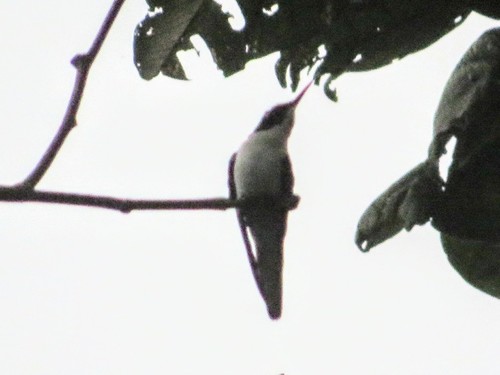 purple-crowned fairy
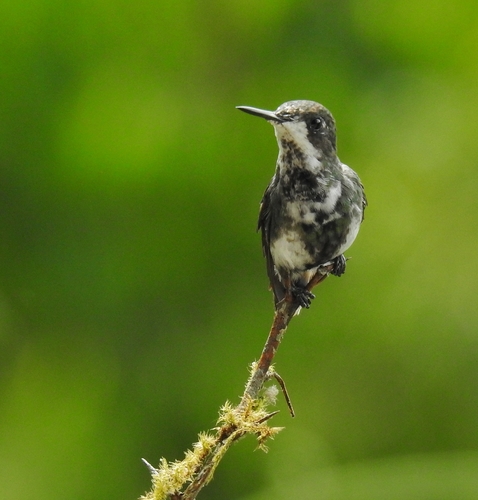 green thorntail
Em resumo
A marca de campo mais confiável para separar a purple-crowned fairy do green thorntail é a forma e o padrão da cauda: os machos adultos de green thorntail têm uma cauda profundamente bifurcada e muito estreita, enquanto a purple-crowned fairy de todas as idades e sexos tem uma cauda longa e pontuda com penas centrais azul-negras e penas externas brancas. As purple-crowned fairies imaturas mostram franjas canela nas partes superiores e manchas escuras esparsas nas partes inferiores, que nunca estão presentes no green thorntail. As fêmeas de green thorntail têm uma ampla mancha branca na bochecha e uma cauda recortada (não bifurcada), enquanto as fêmeas de purple-crowned fairy não têm a mancha na bochecha e possuem uma coroa verde. Ambas as espécies são beija-flores pequenos e esguios, mas o green thorntail é visivelmente mais leve e, nos machos, mais compacto com um bico mais curto. Em voo ou empoleiradas, concentre-se na forma da cauda, no padrão da bochecha e na coloração das partes inferiores para a separação mais rápida.
Dicas de identificação
- Forma e estrutura da cauda (todas as idades/sexes): O macho green thorntail tem uma cauda profundamente bifurcada e extremamente estreita—quase semelhante a um fio—enquanto a purple-crowned fairy (ambos os sexos, todas as idades) tem uma cauda longa e pontuda com penas centrais azul-negras e penas externas brancas. A fêmea de green thorntail tem uma cauda recortada, não bifurcada, com um padrão de cores complexo; a cauda da fêmea de purple-crowned fairy é longa, pontuda e não possui a aparência recortada/bifurcada.
- Marcas de juvenil/imatura: A imatura purple-crowned fairy mostra franjas canela nas partes superiores e manchas escuras esparsas na garganta e no peito—nunca vistas no green thorntail de qualquer idade. Os juvenis de green thorntail diferem dos adultos apenas por um queixo branco acinzentado.
- Coroa e face (machos adultos): O macho purple-crowned fairy tem uma coroa metálica violeta e uma mancha ocular preta com uma mancha violeta e verde abaixo; o macho green thorntail tem uma coroa verde escura sem manchas violetas ou faciais.
- Coroa e face (fêmeas adultas): A fêmea purple-crowned fairy tem uma coroa verde e menos preto no rosto, sem qualquer mancha branca na bochecha. A fêmea green thorntail tem uma ampla mancha branca na bochecha e um queixo preto opaco com manchas brancas.
- Partes inferiores: A purple-crowned fairy (todas as idades/sexes) tem partes inferiores brancas puras; o macho green thorntail tem partes inferiores verde metálico e azul-esverdeadas, a fêmea tem peito/barriga preto opaco com flancos verde opaco e uma mancha branca.
- Rabo e costas: O macho green thorntail tem um rabo bronzeado com uma faixa branca ousada—muito distintiva em boa luz. A purple-crowned fairy tem partes superiores verde esmeralda brilhante, mas sem faixa branca no rabo ou tons bronzeados.
- Bico: A purple-crowned fairy tem um bico curto, reto e preto. O bico do green thorntail também é curto e reto, mas o pássaro, no geral, é mais compacto e leve.
- Tamanho e estrutura: A purple-crowned fairy é maior e mais pesada, parecendo mais alongada. O green thorntail é visivelmente mais leve e, nos machos, mais compacto com um bico proporcionalmente mais curto e uma cauda muito estreita.
- Comportamento alimentar: O green thorntail frequentemente paira com sua cauda levantada em um ângulo reto e é mais estritamente um especialista do dossel. A purple-crowned fairy forrageia em várias alturas e é agressiva em relação a outros beija-flores, mas menos aérea em seu estilo de alimentação.
- Contexto de habitat: Na Costa Rica e no Panamá, o green thorntail está quase sempre no dossel ou em árvores floridas em clareiras, enquanto a purple-crowned fairy pode ser encontrada mais baixa ou nas bordas da floresta.
- Diferenças sexuais: O macho green thorntail tem uma cauda bifurcada mais dramaticamente e é metálico abaixo; a fêmea é menos assim, mas ainda mostra a mancha branca na bochecha e a cauda recortada. Os machos e fêmeas da purple-crowned fairy diferem principalmente na cor da coroa e no padrão facial, mas ambos têm a mesma estrutura de cauda.
- Armadilhas de plumagem: Cuidado com a iluminação: os metálicos do green thorntail podem parecer escuros ou acinzentados na sombra, mas a faixa branca no rabo e a mancha na bochecha (fêmea) são confiáveis. As partes inferiores brancas e o padrão da cauda da purple-crowned fairy são consistentes em todas as luzes.
- Voo: O voo do green thorntail é mais agitado e errático, com a cauda frequentemente aberta ou levantada; a purple-crowned fairy é mais direta e esguia em voo.
- Voz: Não é diagnóstica a partir das notas disponíveis.
- Zonas de sobreposição: Em áreas onde ambas ocorrem, concentre-se primeiro na forma da cauda e na cor das partes inferiores, depois verifique a mancha branca na bochecha (fêmea do thorntail) ou a coroa violeta (macho da fairy).
Tamanho
A purple-crowned fairy é maior e mais pesada: 9–13 cm de comprimento, cerca de 5,5 g. Os machos de green thorntail têm 9,5–10,2 cm, mas são muito mais leves (média de 3,0 g), e as fêmeas são ainda menores (6,6–7,5 cm). A fairy parece mais alongada e esguia, enquanto o thorntail, especialmente o macho, é compacto com um bico proporcionalmente mais curto e uma cauda muito estreita e profundamente bifurcada. No campo, o green thorntail muitas vezes parece mais delicado e leve, especialmente quando empoleirado.
Plumagem
- Juvenis/imaturas: As imaturas da purple-crowned fairy têm franjas canela nas partes superiores e manchas escuras esparsas na garganta e no peito. Os juvenis de green thorntail são semelhantes aos adultos, mas têm um queixo branco acinzentado, sem franjas canela ou manchas escuras.
- Machos adultos: Os machos da purple-crowned fairy têm uma coroa metálica violeta, partes superiores verde esmeralda, partes inferiores brancas puras e uma cauda longa e pontuda com penas centrais azul-negras e penas externas brancas. Os machos de green thorntail têm uma coroa verde escura, costas verde metálico, rabo bronzeado com azul escuro, uma faixa branca ousada no rabo e uma cauda profundamente bifurcada e muito estreita de azul escuro. Sua garganta é verde metálico brilhante, com o peito e a barriga principalmente de verde mais escuro e um centro azul-esverdeado metálico.
- Fêmeas adultas: As fêmeas da purple-crowned fairy têm uma coroa verde, menos preto no rosto e não têm as manchas faciais violetas e verdes dos machos. Sua cauda é longa e pontuda, com padrão semelhante ao do macho. As fêmeas de green thorntail têm uma ampla mancha branca na bochecha, uma cauda recortada (não bifurcada) e um queixo preto opaco com manchas brancas. Suas partes inferiores são pretas opacas com flancos verdes opacos e uma mancha branca, e o padrão da cauda é complexo: todas, exceto o par mais externo de penas da cauda, são azul-escuras com bases verdes escuras; as mais externas têm bases brancas, meio azul-negras e pontas brancas.
Comportamento
A purple-crowned fairy forrageia principalmente na parte média e no dossel, às vezes mais baixa nas bordas da floresta, e é agressiva em relação a outros beija-flores, mas não é fortemente territorial. Ela coleta aranhas e outros artrópodes da folhagem, raramente caçando insetos. O green thorntail forrageia quase exclusivamente no dossel, preferindo árvores floridas e frequentemente pairando com sua cauda levantada em um ângulo agudo. Ele também caça insetos de um poleiro, e os machos se exibem em galhos altos e nus. No campo, o estilo de alimentação do green thorntail é mais aéreo e sua cauda é frequentemente mantida em um ângulo reto em relação ao corpo.
Habitat
A purple-crowned fairy vai do sudeste do México ao norte do Peru, principalmente em florestas úmidas de planície e encosta, forrageando da parte média ao dossel e às vezes nas bordas. O green thorntail é encontrado da Costa Rica ao Equador, principalmente em florestas perenes úmidas montanhosas e de planície, mas é mais estritamente um especialista do dossel e das bordas, geralmente a 300–1.400 m de altitude. Em zonas de sobreposição (Costa Rica, Panamá), o green thorntail é mais provável de estar alto no dossel em árvores floridas, enquanto a purple-crowned fairy é mais versátil em altura de forrageio vertical.
purple-crowned fairy · green thorntail · Minhas aves difíceis