

Motmot

orange river francolin vs red-faced mousebird

Scleroptila gutturalis versus Urocolius indicus

Jogue um quiz com orange river francolin e red-faced mousebird
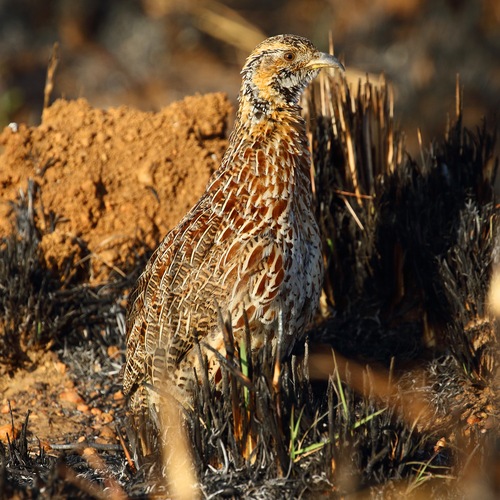
orange river francolin (Scleroptila gutturalis) orange river francolin
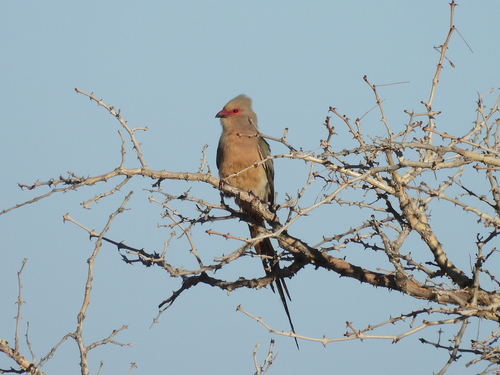
red-faced mousebird (Urocolius indicus) red-faced mousebird

Mídia

Carregando…

Em resumo

The most reliable way to separate Orange River Francolin from Red-faced Mousebird is by overall structure and head pattern: the francolin is a compact, ground-dwelling gamebird with a short tail and strong legs, while the mousebird is a slim, long-tailed, arboreal species with a prominent crest and a striking red face. Juvenile mousebirds lack the crest and red mask, but still show a much longer tail and different proportions than any francolin. In flight, the mousebird’s long, narrow tail and direct, fast movement contrast with the francolin’s rounded wings and short tail. Plumage differences are also strong, especially the mousebird’s blue-grey upperparts and red facial mask versus the francolin’s earth-toned, streaked body and patterned neck-line.

Dicas de identificação

  1. Tail length and shape: Red-faced Mousebird has a tail about as long as its body, very narrow and pointed, while Orange River Francolin has a short, rounded tail. This is the quickest separation at any age.
  2. Head and face pattern: Adult mousebirds show a bright red mask and bill, and a pale cinnamon crest; juveniles lack the crest and mask but still have a plain face. Francolins have no red on the face and show a patterned neck-line (reaching the eye in southern birds, not in northern birds).
  3. Body structure: Francolin is chunky, with strong legs and a horizontal, ground-dwelling posture. Mousebird is slim, long-tailed, and perches upright or clambers in foliage.
  4. Plumage color: Francolin is earth-toned, streaked, and patterned, with buff or whitish belly depending on region. Mousebird is blue-grey above, pale cinnamon on head and breast, and whitish below.
  5. Crest: Mousebird adults have a prominent crest; juveniles lack it but still show the long tail and blue-grey upperparts. Francolins never show a crest.
  6. Flight style: Mousebirds fly fast and directly in groups, with long tails trailing behind. Francolins flush with a burst of rounded wings and short tail, flying only short distances.
  7. Group behavior: Mousebirds are highly social, often in groups of 6–15, feeding and roosting together. Francolins are usually solitary or in pairs.
  8. Habitat use: Francolins are always on the ground in open habitats; mousebirds are almost always in bushes, trees, or gardens, rarely on the ground.
  9. Voice: Mousebird gives a repeated 'tree-ree-ree' whistle, often in flight; francolin’s call is not described here, so a whistled call points to mousebird.
  10. Bill shape: Mousebird has a short, curved bill suited for fruit; francolin has a heavier, chicken-like bill for seeds and insects.
  11. Juvenile confusion: Juvenile mousebirds lack the red mask and crest but still have the long tail and blue-grey tones; francolin juveniles resemble adults in structure and ground-dwelling habits.
  12. Sex differences: Both species are similar between sexes; do not rely on sex for separation.
  13. Regional belly color in francolin: In southern range, francolin’s belly is buff and neck-line reaches eye; in northern range, belly is whitish and neck-line does not reach eye. Mousebird’s belly is always whitish.
  14. Feeding behavior: Mousebirds feed on fruit, berries, and leaves in trees; francolins forage on the ground for seeds and insects.
  15. Perched silhouette: Mousebird perches upright, often with tail hanging straight down; francolin sits horizontally, tail barely visible.

Tamanho

Red-faced Mousebird is lighter (about 56g) but appears much longer due to its extremely long tail, which makes up about half its 34 cm length. Orange River Francolin is more compact and robust, with a shorter tail and heavier build typical of ground-dwelling gamebirds. Even though the mousebird is lighter, its silhouette is much more elongated and slender, especially when perched or in flight.

Plumagem

No age-specific upperwing or flight pattern marks are noted for either species, but overall plumage is highly distinctive. Adult Orange River Francolin shows earth-toned, streaked plumage with a variable neck-line: in southern birds, the neck-line reaches the eye and the belly is buff; in northern birds, the neck-line stops short of the eye and the belly is whitish. The Red-faced Mousebird, adult, is pale cinnamon on the head and breast, with a conspicuous red bill and eye mask, blue-grey upperparts and tail, and a whitish belly. Juvenile mousebirds lack the crest and red mask, but still have the blue-grey upperparts and long tail. Sexes are similar in both species, so sex is not a useful field mark. The mousebird’s overall coloration is much colder and greyer, with a unique facial pattern, while the francolin is warmer and more patterned, lacking any red on the face.

Comportamento

Orange River Francolin is a terrestrial, ground-foraging bird, usually seen walking or running in grassland or woodland, often singly or in pairs. It rarely perches in trees and flushes with a whirring flight when disturbed. Red-faced Mousebird is highly arboreal and social, moving in small, tight groups, often feeding together in bushes or trees. Mousebirds are agile climbers, often seen hanging upside down or moving acrobatically through foliage. In flight, mousebirds move quickly and directly between feeding sites, usually as a group, while francolins fly only short distances when flushed and otherwise remain on the ground.

Habitat

Orange River Francolin is found in grassland and woodland, typically in more open, terrestrial habitats. Red-faced Mousebird prefers savanna with thickets, fynbos scrub, open woodland, gardens, and orchards, always associated with dense vegetation and fruiting trees or shrubs. While both can occur in open woodland, the francolin is almost always on the ground, while the mousebird is almost always in or near vegetation above ground level.

Voz

Red-faced Mousebird gives a repeated 'tree-ree-ree' whistle, often in flight or while perched, and is quite vocal in groups. Orange River Francolin’s vocalizations are not described in the notes, so voice is only diagnostic for the mousebird: if you hear the distinctive whistled call, it is the mousebird.

Enviar uma descrição melhor

Use as mesmas seções da comparação. Seu texto é publicado na hora.

The most reliable way to separate Orange River Francolin from Red-faced Mousebird is by overall structure and head pattern: the francolin is a compact, ground-dwelling gamebird with a short tail and strong legs, while the mousebird is a slim, long-tailed, arboreal species with a prominent crest and a striking red face. Juvenile mousebirds lack the crest and red mask, but still show a much longer tail and different proportions than any francolin. In flight, the mousebird’s long, narrow tail and direct, fast movement contrast with the francolin’s rounded wings and short tail. Plumage differences are also strong, especially the mousebird’s blue-grey upperparts and red facial mask versus the francolin’s earth-toned, streaked body and patterned neck-line.

  1. Tail length and shape: Red-faced Mousebird has a tail about as long as its body, very narrow and pointed, while Orange River Francolin has a short, rounded tail. This is the quickest separation at any age.
  2. Head and face pattern: Adult mousebirds show a bright red mask and bill, and a pale cinnamon crest; juveniles lack the crest and mask but still have a plain face. Francolins have no red on the face and show a patterned neck-line (reaching the eye in southern birds, not in northern birds).
  3. Body structure: Francolin is chunky, with strong legs and a horizontal, ground-dwelling posture. Mousebird is slim, long-tailed, and perches upright or clambers in foliage.
  4. Plumage color: Francolin is earth-toned, streaked, and patterned, with buff or whitish belly depending on region. Mousebird is blue-grey above, pale cinnamon on head and breast, and whitish below.
  5. Crest: Mousebird adults have a prominent crest; juveniles lack it but still show the long tail and blue-grey upperparts. Francolins never show a crest.
  6. Flight style: Mousebirds fly fast and directly in groups, with long tails trailing behind. Francolins flush with a burst of rounded wings and short tail, flying only short distances.
  7. Group behavior: Mousebirds are highly social, often in groups of 6–15, feeding and roosting together. Francolins are usually solitary or in pairs.
  8. Habitat use: Francolins are always on the ground in open habitats; mousebirds are almost always in bushes, trees, or gardens, rarely on the ground.
  9. Voice: Mousebird gives a repeated 'tree-ree-ree' whistle, often in flight; francolin’s call is not described here, so a whistled call points to mousebird.
  10. Bill shape: Mousebird has a short, curved bill suited for fruit; francolin has a heavier, chicken-like bill for seeds and insects.
  11. Juvenile confusion: Juvenile mousebirds lack the red mask and crest but still have the long tail and blue-grey tones; francolin juveniles resemble adults in structure and ground-dwelling habits.
  12. Sex differences: Both species are similar between sexes; do not rely on sex for separation.
  13. Regional belly color in francolin: In southern range, francolin’s belly is buff and neck-line reaches eye; in northern range, belly is whitish and neck-line does not reach eye. Mousebird’s belly is always whitish.
  14. Feeding behavior: Mousebirds feed on fruit, berries, and leaves in trees; francolins forage on the ground for seeds and insects.
  15. Perched silhouette: Mousebird perches upright, often with tail hanging straight down; francolin sits horizontally, tail barely visible.

Red-faced Mousebird is lighter (about 56g) but appears much longer due to its extremely long tail, which makes up about half its 34 cm length. Orange River Francolin is more compact and robust, with a shorter tail and heavier build typical of ground-dwelling gamebirds. Even though the mousebird is lighter, its silhouette is much more elongated and slender, especially when perched or in flight.

No age-specific upperwing or flight pattern marks are noted for either species, but overall plumage is highly distinctive. Adult Orange River Francolin shows earth-toned, streaked plumage with a variable neck-line: in southern birds, the neck-line reaches the eye and the belly is buff; in northern birds, the neck-line stops short of the eye and the belly is whitish. The Red-faced Mousebird, adult, is pale cinnamon on the head and breast, with a conspicuous red bill and eye mask, blue-grey upperparts and tail, and a whitish belly. Juvenile mousebirds lack the crest and red mask, but still have the blue-grey upperparts and long tail. Sexes are similar in both species, so sex is not a useful field mark. The mousebird’s overall coloration is much colder and greyer, with a unique facial pattern, while the francolin is warmer and more patterned, lacking any red on the face.

Orange River Francolin is a terrestrial, ground-foraging bird, usually seen walking or running in grassland or woodland, often singly or in pairs. It rarely perches in trees and flushes with a whirring flight when disturbed. Red-faced Mousebird is highly arboreal and social, moving in small, tight groups, often feeding together in bushes or trees. Mousebirds are agile climbers, often seen hanging upside down or moving acrobatically through foliage. In flight, mousebirds move quickly and directly between feeding sites, usually as a group, while francolins fly only short distances when flushed and otherwise remain on the ground.

Orange River Francolin is found in grassland and woodland, typically in more open, terrestrial habitats. Red-faced Mousebird prefers savanna with thickets, fynbos scrub, open woodland, gardens, and orchards, always associated with dense vegetation and fruiting trees or shrubs. While both can occur in open woodland, the francolin is almost always on the ground, while the mousebird is almost always in or near vegetation above ground level.

Red-faced Mousebird gives a repeated 'tree-ree-ree' whistle, often in flight or while perched, and is quite vocal in groups. Orange River Francolin’s vocalizations are not described in the notes, so voice is only diagnostic for the mousebird: if you hear the distinctive whistled call, it is the mousebird.

Descartar as alterações?

Você tem edições não salvas. Se sair agora, elas serão perdidas.

orange river francolin · red-faced mousebird · Minhas aves difíceis