

arrabio vs marrequinha
Anas acuta versus Anas crecca
Jogue um quiz com arrabio e marrequinha
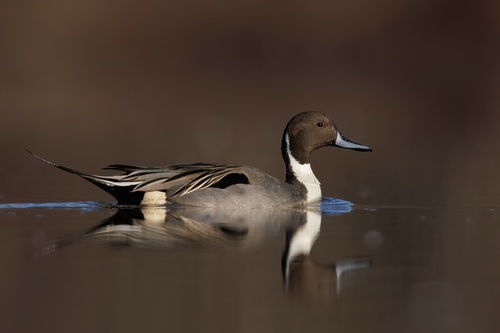 arrabio
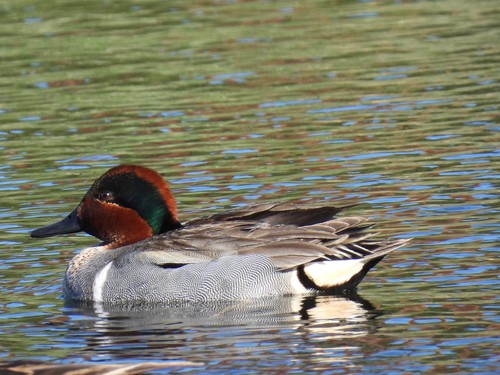 marrequinha
Em resumo
The most reliable way to separate Northern Pintail from Eurasian/Green-winged Teal is by size and structure: Pintail is a much larger, longer-necked duck with a slender body and, in males, a strikingly long, pointed tail. In flight or at rest, even immature or female pintails look slim and elongated compared to the compact, short-necked, and stubby-tailed teal. Plumage differences are also strong, especially in adult males, but beware that eclipse males and juveniles of both species are more subdued and can be confusing. When viewing birds in flight, look for the pintail's longer wings and neck, and the teal's small, fast, compact shape with a proportionally large head.
Dicas de identificação
- Size is the first check: If the duck is small and compact, think teal; if it is long-necked, slender, and nearly goose-sized, it's a pintail. This holds for all ages and sexes.
- Neck and body shape: Pintail always looks elongated, with a long neck and slim body. Teal is short-necked, round-bodied, and looks 'cute' or 'dumpy' by comparison.
- Tail shape: Male pintail has extremely long, pointed central tail feathers in breeding plumage (up to 10 cm), but even females and juveniles have a noticeably pointed tail. Teal's tail is short and rounded in all ages and sexes.
- Bill color: Pintail of both sexes have blue-grey bills; teal males have a dark grey bill, and females/immatures have a pinkish or yellowish base, darkening with age.
- Male breeding plumage: Pintail drake: chocolate-brown head, white neck stripe, white underparts, long tail. Teal drake: chestnut head, bold green eye patch, white vertical side stripe, yellowish tail patch.
- Female and juvenile confusion: Both are mottled brown, but pintail is larger, longer-necked, and has a more uniform grey-brown head. Teal is smaller, rounder, and more densely patterned.
- Upperwing in flight (all ages): Pintail: males show black speculum with white rear border, females dark brown speculum with prominent white rear border. Teal: both sexes show an iridescent green speculum with white tips and yellowish-white tips to upperwing coverts.
- Resting flock structure: Teal often gather in tight, dense flocks; pintails are more spread out and upright.
- Swimming posture: Pintail leans forward, neck extended nearly flush with water; teal sits higher, more compact.
- Flight style: Pintail flies fast with swept-back wings and long neck; teal is rapid, with short, stiff wingbeats and compact shape.
- Vocalizations: Teal are much more vocal, especially males with whistled calls; pintails are generally quieter, but listen for flute-like whistles from drakes.
- Habitat context: In large, open marshes with scattered ducks, look for pintail; in small, vegetated pools with tight flocks, expect teal, though both can overlap.
- Eclipse males: Pintail eclipse males keep the long neck and tail; teal eclipse males lose most facial pattern but remain compact.
- Speculum color: In flight or at rest, check for the green (teal) vs. black/brown (pintail) speculum and the pattern of white borders.
- When in doubt: Use a combination of size, neck length, and tail shape before relying on plumage, especially with females and juveniles.
Tamanho
Northern Pintail is dramatically larger than Eurasian/Green-winged Teal. Pintail averages about 945.5 g in mass [wikidata], with males reaching up to 76 cm in length and a wingspan of 80–95 cm. Eurasian Teal is one of the smallest dabbling ducks, with males averaging 360 g and a length of 34–43 cm, wingspan 53–59 cm. In the field, this means a teal can look less than half the size of a pintail, and the difference is obvious even at a distance or in mixed flocks.
Plumagem
- Juvenile and female plumage: Both species' females and juveniles are mottled brown, but pintail females/juveniles are larger, longer-necked, and have a more uniform grey-brown head with a longer, more pointed tail. Juvenile pintails have less neat scalloping and a duller brown speculum with a narrower trailing edge, while teal juveniles are more densely patterned and compact, with a proportionally larger head and a yellowish-white belly center.
- Adult male breeding plumage: Pintail drakes are unmistakable with a chocolate-brown head, long white neck stripe, white underparts, and long central tail feathers. Teal drakes have a chestnut head with a bold iridescent green patch behind the eye, a white vertical stripe on the side, and a yellowish patch at the tail base. Pintail's bill is bluish; teal's is dark grey.
- Eclipse (non-breeding) males: Both species' males resemble their females in eclipse, but pintail males retain the long neck, pointed tail, and male upperwing pattern; teal eclipse males are more uniform and compact, with only vestigial facial markings.
- Wing pattern in flight: Pintail males show a black speculum with a white rear border and pale rufous at the front; females have a dark brown speculum with a prominent white rear border. Teal of both sexes show an iridescent green speculum with white tips and yellowish-white tips to the upperwing coverts, visible in flight and at rest.
Comportamento
Northern Pintail walks well on land, often appearing upright and elegant, and swims with a forward-leaning posture, neck extended and base of neck close to the water. Its flight is fast, with wings swept slightly back. Eurasian Teal is more compact and buoyant, with a quick, direct flight and rapid wingbeats. Teal often gather in tight flocks and are more likely to flush suddenly in a tight group, while pintails are more graceful and elongated in all movements.
Habitat
Both species share a broad range across Eurasia and can occur together in migration and winter, especially in shallow wetlands, lakes, and flooded fields. Pintail breeds farther north and is more likely in open, exposed marshes and larger water bodies, while teal can be found in smaller wetlands and more vegetated edges. In mixed flocks, teal often stick together in tight groups, while pintails may be more dispersed.
Voz
Teal are notably more vocal than pintails. Male teal give a distinctive whistled 'cryc' or 'creelycc', and females quack with a sharp 'keh' or 'neeh.' Pintail drakes have a flute-like whistle, and females give a rough quack, but both are generally quieter and less conspicuous than teal, especially in mixed flocks.