

tordoveia vs melro
Turdus viscivorus versus Turdus merula
Jogue um quiz com tordoveia e melro
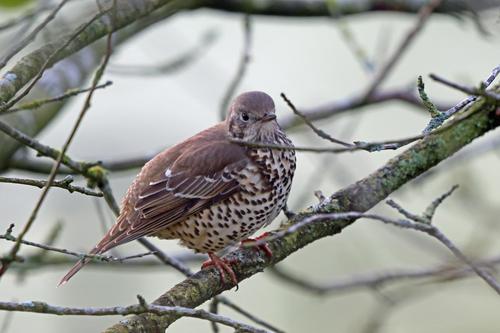 tordoveia
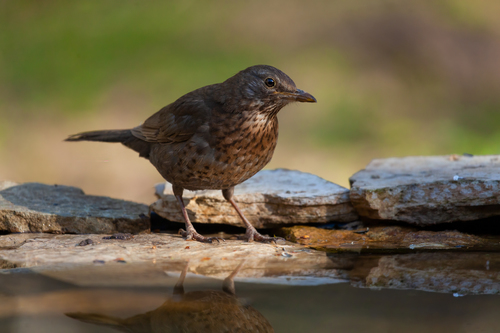 melro
Em resumo
The most reliable field mark between Mistle Thrush and Eurasian Blackbird is overall coloration and pattern: adult male Blackbirds are entirely glossy black with a yellow bill, while Mistle Thrushes are pale grey-brown above and heavily spotted below, with a stocky, upright stance. Female and juvenile Blackbirds are brownish and can be confused with Mistle Thrush at a distance, but Mistle Thrush always shows bold, round black spots on a pale yellowish or buff background, and is much larger and paler overall. In flight, Mistle Thrush is bulkier, longer-tailed, and shows white outer tail tips and white underwing coverts, unlike the uniformly dark Blackbird. Juvenile Mistle Thrushes have smaller spots and paler upperparts than adults, but never show the uniform brown of young Blackbirds.
Dicas de identificação
- Adult male Blackbird is all black with a yellow bill and eye-ring: No other confusion possible with Mistle Thrush. If you see a truly black thrush, it's a male Blackbird.
- Adult female and juvenile Blackbirds are brownish, not spotted: Females are sooty-brown with faint mottling, and juveniles have pale spots on upperparts and a speckled breast, but never the bold, round black spots of Mistle Thrush. If the bird is brown and lacks strong spotting below, it's likely a Blackbird.
- Mistle Thrush always shows bold, round, irregular black spots on pale yellowish or buff underparts: This is true for all ages, though juveniles have smaller spots. The spotting is denser on the lower chest. Blackbirds never show this pattern.
- Size and structure: Mistle Thrush is much larger and bulkier, with a longer tail and a more upright stance. Blackbird is smaller, sleeker, and more horizontal in posture.
- Tail pattern in flight: Mistle Thrush shows white tips to the outer tail feathers and white underwing coverts, visible in flight. Blackbird's tail is uniformly dark and lacks white.
- Upperwing and underwing in flight: Mistle Thrush has pale underwing coverts and a paler, more contrasting wing pattern. Blackbird's wings are uniformly dark brown or blackish, with no pale panels or covert contrast.
- Juvenile Mistle Thrush vs. juvenile Blackbird: Juvenile Mistle Thrush has paler upperparts with creamy teardrop centers and smaller but still distinct spots below. Juvenile Blackbird is brown overall, with only faint speckling and no bold spots.
- Bill color: Adult male Blackbird has a bright yellow to orange-yellow bill. Female and juvenile Blackbirds have a duller, brownish bill. Mistle Thrush has a blackish bill with a yellowish base, never as bright as adult male Blackbird.
- Posture and jizz: Mistle Thrush stands tall and upright, often in open areas. Blackbird is more likely to be seen low to the ground, moving with a crouched, horizontal posture.
- Habitat context: Mistle Thrush is more likely in open fields, parks, and woodland edges. Blackbird prefers gardens, dense shrubs, and urban areas.
- Group behavior: Mistle Thrush may be seen in small flocks, especially in late summer and autumn. Blackbird is usually solitary or in pairs, except during migration.
- Flight style: Mistle Thrush has a bounding, undulating flight with glides. Blackbird's flight is more direct and agile, with bursts of rapid wingbeats.
- No strong sexual dimorphism in Mistle Thrush: Both sexes look alike, unlike Blackbird where males and females are quite different.
- Seasonal molt: Mistle Thrush adults have a full molt after breeding, juveniles have a partial molt. Blackbird first-year males resemble adults but have a dark bill and weaker eye-ring; their wings are brown, not black.
- When in doubt, look for spotting and overall color: If the bird is pale below with bold, round black spots, it's a Mistle Thrush. If it's uniform brown or black, with no strong spots, it's a Blackbird.
Tamanho
Mistle Thrush is significantly larger and heavier than Eurasian Blackbird. Mistle Thrush averages 27–28 cm in length with a 45 cm wingspan and weighs about 130 g, while Blackbird is 23.5–29 cm long (overlap at the upper end), but is lighter at 80–125 g. In the field, Mistle Thrush appears bulkier, with a longer tail and a more upright, robust posture compared to the sleeker, more horizontal Blackbird.
Plumagem
Adult male Blackbird is unmistakable: glossy black all over, with a yellow to orange-yellow bill and eye-ring. Adult female Blackbird is sooty-brown, with a duller bill and some weak mottling on the breast, but lacks the bold, round spots of Mistle Thrush. Juvenile Blackbirds are similar to females but have pale spots on the upperparts and a speckled breast, never the strong, round spotting of Mistle Thrush. Mistle Thrush adults and juveniles are pale grey-brown above, with a yellowish-buff breast and off-white belly, both marked with round, irregular black spots (denser on the lower chest). Juvenile Mistle Thrushes have paler upperparts with creamy 'teardrop' centers and smaller spots below, but still show a spotted pattern unlike the streaky or plain look of young Blackbirds. In flight, Mistle Thrush shows white outer tail tips and white underwing coverts, while Blackbird is uniformly dark below and lacks white in the tail.
Comportamento
Mistle Thrush often stands very upright and appears alert, especially when foraging on open ground. It hops with its head held high and may flick wings and tail when excited. Blackbird tends to move with a more horizontal posture, often skulking in cover or running and pausing. Mistle Thrushes are more likely to be seen in small groups or loose flocks in late summer and autumn, while Blackbirds are usually solitary or in pairs, except during migration when they may form loose feeding groups. In flight, Mistle Thrush has a bounding, undulating flight with glides, while Blackbird's flight is more direct and agile, with bursts of rapid wingbeats.
Habitat
Both species are widespread across Europe, western Asia, and North Africa, but Mistle Thrush favors open woodlands, parks, and fields, often seen foraging in the open. Blackbird is more often found in gardens, dense shrubbery, woodland edges, and urban areas, preferring more cover. Mistle Thrush is more likely to be seen in open spaces, while Blackbird is common in both rural and urban settings, often close to human habitation.