

himalayan swiftlet vs asian palm swift
Aerodramus brevirostris versus Cypsiurus balasiensis
Jogue um quiz com himalayan swiftlet e asian palm swift
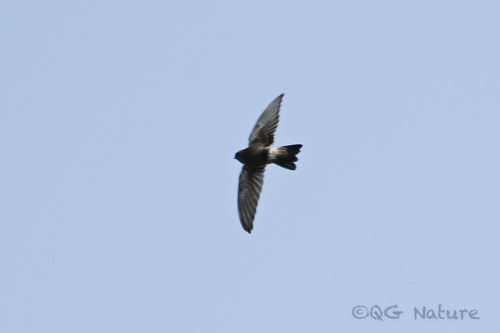 himalayan swiftlet
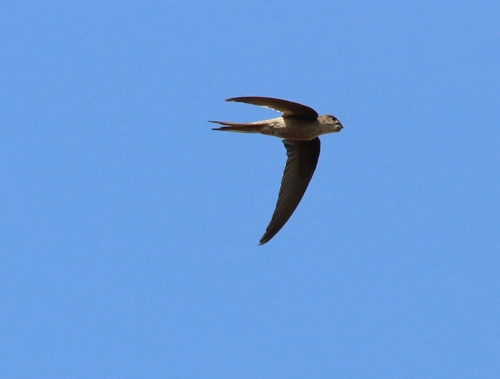 asian palm swift
Em resumo
The most reliable field mark between Himalayan Swiftlet and Asian Palm Swift is the rump: Himalayan Swiftlet shows a pale grey or pale-toned rump (less distinct in juveniles), while Asian Palm Swift is uniformly pale brown without a contrasting rump. Both are small, slender swifts with swept-back wings and deeply forked tails, but Asian Palm Swift's tail is longer and more deeply forked, though often held closed. Himalayan Swiftlet is typically found in upland or montane areas, often near caves, while Asian Palm Swift is closely tied to open lowland country and palms. In flight, the swiftlet often glides, while the palm swift is more fluttery and agile. Voice and context can help: palm swifts give a shrill scream, swiftlets a twittering or clicking call, sometimes used for echolocation inside caves.
Dicas de identificação
- Pale rump (Himalayan Swiftlet): Look for a pale grey or pale-toned rump contrasting with the darker back, best seen in good light from above or behind. This mark is present in all ages but is less distinct in juveniles.
- Uniform back (Asian Palm Swift): Asian Palm Swift is uniformly pale brown above, with no pale rump or contrasting patch at any age.
- Tail shape and length: Asian Palm Swift has a long, deeply forked tail, often held closed in flight so the fork is not always obvious. Himalayan Swiftlet's tail is shorter and less deeply forked.
- Flight style: Himalayan Swiftlet often glides for long periods, with less rapid wingbeats. Asian Palm Swift is more fluttery, with rapid, agile flight and less gliding.
- Bill and face: Himalayan Swiftlet has a pale patch above and behind the bill; Asian Palm Swift lacks this feature.
- Juvenile tail: Juvenile Asian Palm Swifts have shorter tails than adults, but still lack any pale rump.
- Habitat: Himalayan Swiftlet is most often seen over upland forests, valleys, or near caves and cliffs; Asian Palm Swift is almost always near palms in open lowland country or cultivation.
- Nesting context: Swiftlets nest in caves on vertical rock walls; palm swifts glue their nests to the underside of palm leaves.
- Voice: A chorus of shrill screams indicates palm swift; twittering or clicking calls, especially near caves, point to swiftlet.
- Group size: Himalayan Swiftlet often forms large flocks (50–300), especially near breeding sites; palm swifts are usually in smaller, looser groups.
- Echolocation (swiftlet only): If you hear audible clicking, especially inside caves, this is diagnostic for Himalayan Swiftlet.
- Feeding height: Palm swifts often feed low over open ground; swiftlets are more often high over valleys or forest edges, but may descend in bad weather.
- Perching: Both species rarely perch, but palm swifts may be seen clinging to palm leaves, while swiftlets cling to cave walls.
- Sexes similar: Do not rely on sex differences for either species; both are sexually monomorphic.
- Seasonal movement: Himalayan Swiftlet may move to lower elevations in winter or bad weather, but is rarely found in lowland palm habitats.
Tamanho
Both species are similar in length (13–14 cm), but Asian Palm Swift is slightly lighter at 9.2g [wikidata]. Structure is more telling than mass: Asian Palm Swift has a longer, more deeply forked tail and a more attenuated silhouette, while Himalayan Swiftlet is compact with a shorter forked tail. In the field, size alone is not a reliable separator.
Plumagem
- Juvenile/immature plumage: Himalayan Swiftlet juveniles have a less distinct pale rump than adults, but still show some contrast; Asian Palm Swift juveniles mainly differ from adults in having a shorter tail, not in color or rump pattern.
- Adults: Himalayan Swiftlet is grey-brown above with a paler brown below and a pale grey or pale-toned rump (degree varies by subspecies, but always paler than back except in the darkest races). Asian Palm Swift is uniformly pale brown above and below, lacking any pale rump or contrasting patch. Both have swept-back wings, but only the swiftlet shows a pale patch above and behind the bill. Both sexes are similar in both species.
Comportamento
Himalayan Swiftlet is a highland species, often breeding and roosting in caves on vertical rock faces, and is highly gregarious, forming flocks of 50–300 birds. Its flight is mainly gliding, with long primary feathers and less rapid wingbeats. Asian Palm Swift is strongly associated with palms in open country and cultivation, rarely in uplands, and is almost always seen in fast, fluttery flight, often near the ground or over open areas. Palm swifts are rarely seen perching except clinging to palm leaves, while swiftlets are more likely to be seen near cave entrances or high over valleys.
Habitat
Himalayan Swiftlet breeds and roosts in upland and montane areas, especially near caves or cliffs, from the Himalayas to Southeast Asia, and is often seen over forested river valleys or descending to lowlands in bad weather. Asian Palm Swift is a lowland species, closely tied to open country, cultivation, and especially oil palms, from India to the Philippines. It nests under palm leaves, never in caves, and is rarely found far from suitable palms.
Voz
Himalayan Swiftlet gives a twittering 'chit-chit' call and a piercing 'teeree-teeree-teeree', and some populations use audible clicking calls for echolocation inside caves. Asian Palm Swift gives a loud, shrill scream, lacking the twittering or clicking calls of swiftlets. In the field, a chorus of shrill screams over palms points to palm swift, while twittering or clicking near caves is swiftlet.
himalayan swiftlet · asian palm swift · Minhas aves difíceis