

gavião-caranguejeiro-negro vs gavião-preto
Buteogallus anthracinus versus Buteogallus urubitinga
Jogue um quiz com gavião-caranguejeiro-negro e gavião-preto
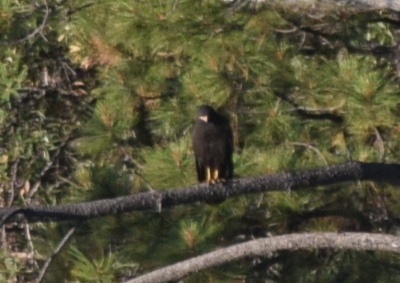 gavião-caranguejeiro-negro
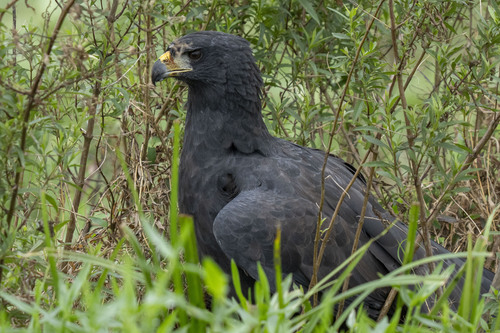 gavião-preto
Em resumo
The most reliable field mark between Common Black Hawk and Great Black Hawk is the tail pattern in adults: Common Black Hawk shows a black tail with a single broad white band and a white tip, while Great Black Hawk has a white tail with a broad black tip. Immature birds of both species are similar, but the tail banding and overall size help: Great Black Hawk is distinctly larger and heavier, with a longer body and broader wings. Both species are mainly black as adults with yellow legs and cere, but the tail pattern is the fastest way to separate them in the field. Immature birds require extra care, but size and tail pattern remain the best clues.
Dicas de identificação
- Adult tail pattern is key: Common Black Hawk has a black tail with a single broad white band and a white tip; Great Black Hawk has a white tail with a broad black tip. This is the fastest and most reliable field mark for adults, whether perched or in flight.
- Immature tail banding: Both immatures have multiple black and white (or dusky) bars, but Great Black Hawk's tail tends to look paler overall with a dark tip, while Common Black Hawk's is darker with a more obvious broad white band. Use this with caution, as variation exists.
- Size and bulk: Great Black Hawk is significantly larger and heavier than Common Black Hawk. If the bird looks especially large and bulky for a black hawk, Great Black Hawk is favored. This is most useful when you have a reference or experience with both species.
- Wing structure: Both species have very broad wings, but Great Black Hawk's wings are proportionally broader and longer, matching its larger size. In flight, this can give Great Black Hawk a more imposing, eagle-like look.
- Leg and cere color: Both have yellow legs and cere, so this is not a useful separation mark.
- Bill color: Both have black bills; not a separation point.
- Plumage color (adults): Both are mainly black, but Common Black Hawk can appear slightly more sooty or dark gray; this is subtle and unreliable in the field.
- Perched posture: Both species perch upright, but Great Black Hawk may look heavier-bodied and longer-legged due to its size.
- Voice: If you hear a distinctive, piping 'ooo-wheeeeee' call, it points to Great Black Hawk. Common Black Hawk's call is not described here, but the difference is noted as diagnostic.
- Sexes similar: In both species, males and females look alike, so do not rely on sex for identification.
- Juvenile/immature confusion: Both species' immatures are brown above with streaks and buffy underparts with dark spots. Focus on tail pattern and size for separation; beware that plumage can be variable at this age.
- Flight vs perched: Tail pattern is visible in both perched and flying birds, but is often easiest to see in flight when the tail is fanned.
- Habitat and context: Not diagnostic based on the notes provided; both can occur in similar habitats.
- Pitfalls: Immature birds are the most likely to be confused due to similar streaked brown plumage and banded tails. Always check tail pattern and overall size before deciding.
- When marks fail: If tail pattern is obscured or the bird is distant, use size and bulk as secondary clues, but beware overlap with other large raptors.
Tamanho
Great Black Hawk is notably larger than Common Black Hawk. Great Black Hawk measures 56–64 cm in length and weighs about 1.1 kg, while Common Black Hawk is 43–53 cm and averages 996 g. In the field, Great Black Hawk looks bulkier and longer-winged, with a more imposing presence. Both have broad wings, but the size difference is usually apparent when seen side by side or with experience.
Plumagem
Adult Common Black Hawk is mainly black or dark gray with a short black tail featuring a single broad white band and a white tip. Adult Great Black Hawk is also mainly black, but its short tail is white with a broad black tip—a reversal of the Common Black Hawk's pattern. Both species have yellow legs and cere, and a black bill. Immature birds of both species are dark brown above with spotting and streaks, and their underparts are buff to whitish with dark blotches or spots. The immature tail in both species shows multiple black and white (or dusky) bars, but the overall impression is that Great Black Hawk's tail is paler with a dark tip, while Common Black Hawk's is darker with a single bold white band. In flight, both show broad wings, but the tail pattern remains the most reliable mark at all ages.
Voz
Great Black Hawk has a distinctive piping call described as 'ooo-wheeeeee.' The Common Black Hawk's call is not detailed in the notes, but the difference in vocalizations is mentioned as a field separation point. If you hear a drawn-out, piping call, it favors Great Black Hawk.
gavião-caranguejeiro-negro · gavião-preto · Minhas aves difíceis