

christmas shearwater vs newell's shearwater
Puffinus nativitatis versus Puffinus newelli
Jogue um quiz com christmas shearwater e newell's shearwater
 christmas shearwater
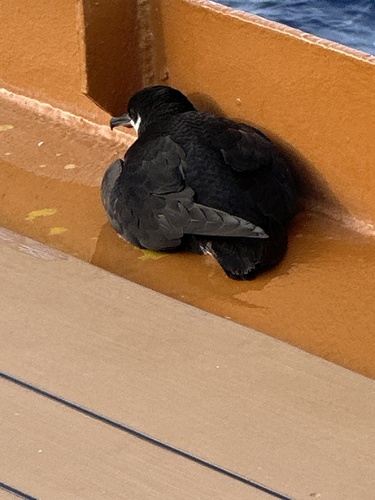 newell's shearwater
Em resumo
The most reliable field mark to separate Christmas Shearwater from Newell's Shearwater is the underwing pattern: Christmas Shearwater is uniformly dark below, while Newell's Shearwater shows mostly white underwings with a dark border. In all ages and light conditions, Christmas Shearwater appears overall dark brownish-black with only subtle pale fringes, whereas Newell's is sharply black above and white below, with a crisp division on the face and a distinctive white flank patch. Structural differences are subtle, but Christmas Shearwater is slightly larger and more slender, with a pointed tail in flight. If you see a small, dark shearwater with no obvious white on the underparts or underwings, it's Christmas; if you see strong black-and-white contrast and white underwings, it's Newell's.
Dicas de identificação
- Underwing pattern (all ages): Christmas Shearwater always shows uniformly dark brown underwings; Newell's Shearwater has mostly white underwings with a dark border. This is the single most reliable mark in flight.
- Underparts color: Christmas Shearwater is dark below (only slightly paler than above), while Newell's is clean white below with a sharp contrast to the dark upperparts.
- Facial contrast: Newell's Shearwater shows a sharp division between the dark face (extending below the eye) and white throat; Christmas Shearwater's face is uniformly dark with only a faint pale chin edge at best.
- Flank and rump patch: Newell's has a white patch on the flanks and sides of the rump, often visible in flight or when banking; Christmas lacks any such white patch.
- Tail shape and projection: Christmas Shearwater's tail usually appears pointed in flight, accentuated by the feet projecting beyond the tail tip. Newell's tail is shorter and less pointed, with no obvious foot projection.
- Upperwing coverts: Christmas Shearwater may show pale fringes to the upperwing coverts, but these are subtle and do not form a panel; Newell's lacks any pale panel above.
- Leg and foot color: Newell's has mainly pale pink legs and feet; Christmas has brown-grey feet. This is rarely visible at sea but may help with close views or photos.
- Bill and head shape: Christmas Shearwater has a bulbous head and thin, long bill typical of small Puffinus; Newell's bill is also dark but the head appears less bulbous. This is subtle and not usually diagnostic in the field.
- Flight style: Christmas Shearwater may appear more leisurely, sometimes petrel-like, with slow wingbeats; Newell's alternates rapid flapping with short glides, flying low over the water.
- Overall impression: Christmas Shearwater is uniformly dark and blends into the sea; Newell's is strikingly black-and-white, standing out in mixed flocks.
- Age/sex differences: Both species are similar across sexes and ages after fledging; no seasonal or sexual dimorphism is useful for separation.
- Habitat context: If seen near Hawaiian breeding colonies, Newell's is much more likely; Christmas Shearwater is found on remote Pacific islands. At sea, range overlap is minimal.
- Vocalizations: Only Newell's is known for a braying call at breeding sites; Christmas Shearwater's voice is not described and is not a field mark at sea.
- Common pitfalls: Do not confuse a Christmas Shearwater's slightly paler belly for white; it never approaches the clean white of Newell's. Beware of lighting: strong sun can make Newell's upperparts look browner, but the white underparts and underwings remain obvious.
- When in doubt: Focus on the underwing pattern and underparts color in flight; these are the most consistent and visible differences in all conditions.
Tamanho
Christmas Shearwater is marginally larger (about 36 cm long, 75 cm wingspan, ~350 g) than Newell's Shearwater (33 cm long, wing 223–249 mm, tail 79–89 mm, 340–425 g). The difference is slight and not always apparent in the field, but Christmas Shearwater may look a bit more elongated and slender-bodied, with a proportionally longer wingspan. Both are small shearwaters, but Newell's can appear more compact, especially due to its shorter tail.
Plumagem
- Juvenile/immature/adult Christmas Shearwater: All ages after fledging are dark overall, with blackish-grey to rusty-brown tones, slightly paler below, and only faint pale fringes to upperwing coverts. The underwings are uniformly dark brown, lacking any white panels or strong contrast. Some birds show a tiny white edge under the chin, but this is subtle and not visible at distance.
- Juvenile/immature/adult Newell's Shearwater: All ages show a sharp black-and-white contrast: black above with a brown tinge, white below, and a crisp demarcation on the face below the eye. The underwings are mostly white with a dark border, and the undertail-coverts are patterned black and white but appear white in the field. A white patch on the flanks extends onto the sides of the rump, which is visible in flight and at rest. No age or season produces a wholly dark bird.
- Key flight view: Christmas Shearwater always shows dark underwings; Newell's always shows white underwings with a dark edge.
Comportamento
Both species feed far from land and are highly pelagic, often associating with predatory fish like tuna. Christmas Shearwater may use a slower, more leisurely flight with slow wingbeats, sometimes resembling a petrel, and often flies with feet projecting beyond the tail. Newell's Shearwater flies low over the water on stiff wings, alternating short glides with rapid flapping. In mixed flocks, Newell's may appear more buoyant and showier due to its black-and-white pattern, while Christmas blends in as a uniformly dark bird.
Habitat
Both species are oceanic and rarely seen near land except at breeding colonies. Christmas Shearwater is restricted to the tropical Central Pacific, nesting on remote islands; Newell's Shearwater breeds in Hawaii and forages over deep water (at least 2000 meters). Overlap at sea is possible but unlikely except near Hawaii. Context is rarely diagnostic unless you are near a known colony.
Voz
Newell's Shearwater gives a distinctive donkey-like braying call around breeding areas. Christmas Shearwater's vocalizations are not described in the provided notes. At sea, both are generally silent, so voice is not a reliable field mark unless at a colony.
christmas shearwater · newell's shearwater · Minhas aves difíceis