

buff-rumped woodpecker vs common flameback
Meiglyptes grammithorax versus Dinopium javanense
Jogue um quiz com buff-rumped woodpecker e common flameback
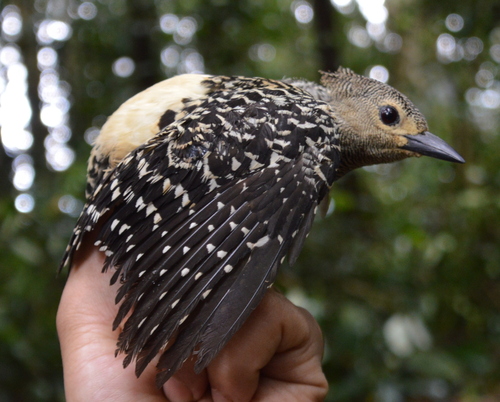 buff-rumped woodpecker
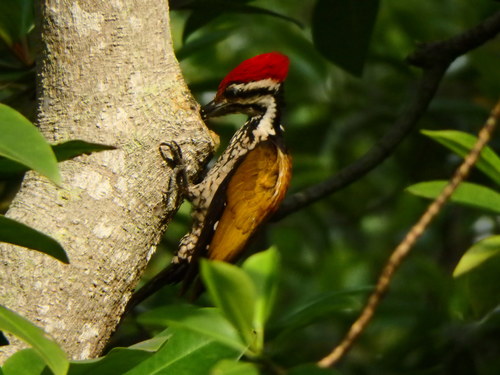 common flameback
Em resumo
A marca de campo mais confiável entre o buff-rumped woodpecker e o common flameback é a cor e a visibilidade do rabo: o buff-rumped mostra uma mancha de rabo branca e amarelada proeminente (embora nem sempre visível), enquanto o common flameback tem um rabo vermelho. Em vistas empoleiradas ou forrageiras, o buff-rumped é mais sutilmente marcado no geral, com finas listras abaixo e uma pequena crista, enquanto o common flameback é mais ousadamente padronizado com uma impressionante crista vermelha ou preta (dependente do sexo), listras faciais brancas e um dorso dourado. O juvenil buff-rumped woodpecker pode mostrar uma pena primária reduzida, mas isso é sutil e geralmente não visível em campo. Ambas as espécies são semelhantes em tamanho e compartilham alguma sobreposição de área no Sudeste Asiático, mas suas plumagens e padrões de cabeça são distintos quando vistos bem.
Dicas de identificação
- A cor do rabo é a principal marca de campo: O buff-rumped woodpecker mostra uma mancha de rabo branca e amarelada (quando visível), enquanto o common flameback tem um rabo vermelho. Sempre tente ter uma visão clara do rabo quando o pássaro estiver em voo ou batendo as asas.
- Cor da crista e sexo: O macho do common flameback tem uma crista vermelha brilhante; a fêmea tem uma crista preta com listras brancas. O buff-rumped woodpecker tem apenas uma pequena crista nucal e carece da cor de cabeça ousada do flameback.
- Padrão facial: O common flameback mostra um supercílios branco ousado, listras nas bochechas e na garganta, todos separados por listras pretas. O buff-rumped tem um rosto menos contrastante, com machos mostrando uma faixa vermelha de 'bigode', mas sem listras faciais fortes.
- Cor do dorso: O common flameback é dourado, dando uma aparência muito mais brilhante do que as asas mais suaves em preto e branco do buff-rumped.
- Partes inferiores: O buff-rumped tem finas listras na barriga; o common flameback tem um lado inferior manchado em preto e branco. Use isso quando o rabo estiver escondido.
- Características da asa juvenil: O juvenil buff-rumped woodpecker pode mostrar uma pena primária reduzida, mas isso é sutil e não é uma marca de campo prática, a menos que esteja manuseando o pássaro ou visualizando de uma distância extremamente próxima.
- Bico e estrutura: Nenhuma diferença significativa é descrita nas notas, mas o common flameback é notado em outros lugares como tendo um bico menor do que algumas espécies semelhantes (não especificamente comparado ao buff-rumped aqui).
- Voo vs empoleirado: Em voo, concentre-se na cor do rabo e no brilho geral. Empoleirado, verifique a cor da crista e as listras faciais.
- Voz: Se você ouvir uma série de chamadas 'kowp' ou 'rattle', ou a chamada de quatro segundos 'wicka', você provavelmente está ouvindo o common flameback. A voz do buff-rumped não é descrita, então o silêncio não ajuda a separá-los.
- Bater: O common flameback raramente bate, e quando o faz, é suave e não uma exibição; isso não é um separador forte, mas pode ajudar no contexto.
- Diferenças sexuais: Apenas o common flameback mostra um forte dimorfismo sexual na cor da crista; os machos do buff-rumped têm um bigode vermelho, mas ambos os sexos são de outra forma semelhantes.
- Contexto e confusão: Ambas as espécies ocorrem no Sudeste Asiático e podem sobrepor-se em área. Se você ver um pica-pau de dorso dourado com um rabo vermelho e listras faciais brancas ousadas, é o common flameback. Se o pássaro for mais suave, com um rabo amarelado e finas listras, é o buff-rumped.
- Armadilhas comuns: O rabo amarelado do buff-rumped woodpecker nem sempre é visível, especialmente quando empoleirado ou se o pássaro não estiver batendo as asas. O rabo vermelho do common flameback é geralmente óbvio em voo, mas pode estar escondido quando empoleirado.
- Idade e muda: Nenhuma marca de campo dependente da idade forte é descrita para qualquer uma das espécies em campo, além da sutil redução primária juvenil no buff-rumped.
- Quando em dúvida: Concentre-se na cor do rabo, no padrão da cabeça/crista e no brilho geral do dorso. Se estes não forem visíveis, use vocalizações ou espere por uma visão melhor.
Tamanho
Both species are small woodpeckers of similar overall length (Buff-rumped Woodpecker: size not specified in notes; Common Flameback: 28–30 cm [wikipedia]). In the field, size is not a reliable separator between these two, as they overlap considerably and both are described as small for their group.
Plumagem
- Juvenile/immature flight marks: Buff-rumped Woodpecker juveniles have a reduced first primary feather, but this is a subtle structural feature and not a bold wing pattern visible in flight. No distinctive age-specific upperwing pattern is described for either species in flight.
- Rump color: Buff-rumped Woodpecker has a prominent whitish-buff rump patch (not always visible, but diagnostic when seen). Common Flameback has a red rump, which is a strong separator from Buff-rumped.
- Head and crest: Buff-rumped has a small nuchal crest and males show a red 'mustache' stripe. Common Flameback males have a bright red crest, females a black crest with white streaks; both sexes show bold white supercilium, cheek stripe, and throat, separated by black stripes.
- Back and wings: Buff-rumped has black-and-white wings and fine barring on the belly, giving a more muted appearance. Common Flameback is golden-backed (hence the name), with a much brighter and more contrasting upperparts.
- Underparts: Buff-rumped shows fine barring on the belly; Common Flameback has a spotted black and white underside.
Comportamento
O common flameback raramente bate em madeira, confiando mais em vocalizações e batidas suaves no ninho; pode levantar sua crista em resposta a distúrbios. Os comportamentos de forrageamento e exibição do buff-rumped woodpecker não são detalhados nas notas, mas nada sugere uma diferença comportamental dramática em campo além da natureza relativamente silenciosa do flameback e do bater infrequente.
Voz
O common flameback é relativamente quieto para um pica-pau, mas quando vocal, dá uma variedade de chamadas: uma chamada 'wicka' de quatro segundos, notas 'kow' simples ou duplas, uma complexa 'chamada kowp' (geralmente em voo ou alarme) e uma rápida 'chamada rattle'. O bater é raro e suave. As vocalizações do buff-rumped woodpecker não são descritas nas notas, então a voz é mais útil para confirmar o common flameback se essas chamadas forem ouvidas.
buff-rumped woodpecker · common flameback · Minhas aves difíceis