

brown prinia vs rufescent prinia
Prinia polychroa versus Prinia rufescens
Jogue um quiz com brown prinia e rufescent prinia
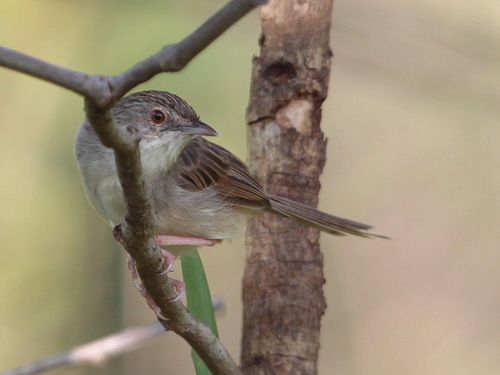 brown prinia
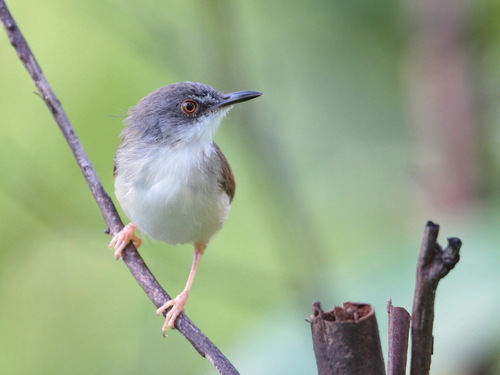 rufescent prinia
Em resumo
The most reliable field mark between Brown Prinia and Rufescent Prinia is size: Brown Prinia is more than twice as heavy as Rufescent Prinia, making it noticeably bulkier in the field. Both species are small, brownish warblers in the same family and can overlap in range, but Brown Prinia is distinctly heavier-bodied. When seen together, Rufescent Prinia appears much more delicate and lightly built. In the absence of direct comparison, structural differences and subtle plumage cues must be used, but size is the key separator.
Dicas de identificação
- Size is the most reliable separator: Brown Prinia is over twice as heavy as Rufescent Prinia. If a prinia appears especially small and delicate, suspect Rufescent Prinia.
- Bulk and structure: Brown Prinia looks more robust and heavy-bodied, while Rufescent Prinia is noticeably daintier. This is visible both perched and in flight.
- Overall coloration: Brown Prinia is generally more uniformly brown above, while Rufescent Prinia has a warmer, rufescent (reddish-brown) tone to the upperparts. This can be subtle and is best used in good light.
- No age-specific wing or tail pattern differences are documented: Juvenile and immature birds must be separated by size and general coloration, as there are no known diagnostic upperwing or tail marks for either species.
- Plumage pitfalls: Both species are brownish above and pale below, and worn or faded birds may look similar. In poor light, color differences may disappear.
- Habitat overlap: Both species can occur in Southeast Asia and may be found in similar habitats. Rufescent Prinia is more associated with dry forest, but this is not a definitive field mark.
- No documented voice differences: Vocalizations are not described in the available notes, so do not rely on song or call for separation.
- Direct comparison is best: If you see both species together, the size and bulk difference is obvious. When alone, use a combination of size, structure, and any hint of rufescent upperparts for Rufescent Prinia.
- Contextual clues: If the bird is in a typical dry forest setting, Rufescent Prinia may be more likely, but Brown Prinia cannot be ruled out on habitat alone.
- No sex-specific or seasonal plumage differences are described: Both sexes and all ages must be separated by structure and general color.
- Be cautious with single-observer records: Without a direct size comparison or clear view of coloration, misidentification is easy. Note the bird's proportions and any subtle color tones carefully.
- Do not rely on tail length or shape: No diagnostic differences are described in the available notes.
- No bill or primary projection differences are documented: Structure is best judged by overall bulk rather than specific features.
- If uncertain, document with photos: Size and color can be difficult to judge in the field, so photographic evidence can help confirm identification later.
- Err on the side of caution: If the bird does not clearly match the expected size and color for either species, consider leaving the record as Prinia sp.
Tamanho
Brown Prinia is substantially heavier, with an average body mass of 15.0g compared to Rufescent Prinia's 6.5g [wikidata]. This difference is significant and should be apparent even at a distance: Brown Prinia looks chunkier and more robust, while Rufescent Prinia is petite and lightly built. If you see both species in the same area, the contrast is striking. When alone, Brown Prinia may recall a small warbler, but Rufescent Prinia is among the smallest prinias and appears particularly dainty.
Plumagem
There are no detailed age-specific or upperwing pattern notes available for either species, so separation relies on overall coloration and structure. Both are brownish above and pale below, but Brown Prinia tends to have a more uniform brown upperpart, while Rufescent Prinia is described as rufescent (warm brown or reddish-brown) above. This difference may be subtle and unreliable in poor light or worn plumage. Without clear age-specific wing or tail pattern notes, observers should focus on overall tone and structure. No information is available on juvenile or immature-specific marks, so all ages must be separated by size and general coloration.
Comportamento
Behavior is not described as diagnostic between these two species in the available notes. Both are typical prinias: active, often seen flitting through low vegetation or making short flights. No mention of differences in tail movement, flight style, or foraging technique.
Habitat
Both species occur in Southeast Asia and can overlap in range. Rufescent Prinia is noted to prefer subtropical or tropical dry forest, while Brown Prinia's habitat is not specified beyond being a member of the same family. If encountered in dry forest, Rufescent Prinia may be more likely, but this is not a strong separator where ranges overlap.