

black-crowned antshrike vs slaty antwren
Thamnophilus atrinucha versus Myrmotherula schisticolor
Jogue um quiz com black-crowned antshrike e slaty antwren
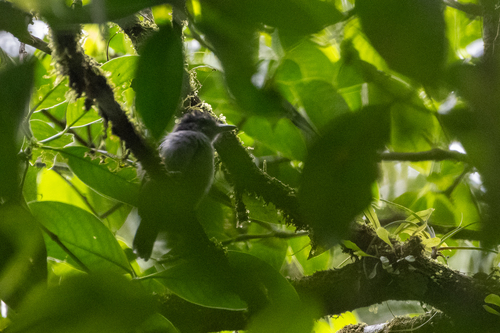 black-crowned antshrike
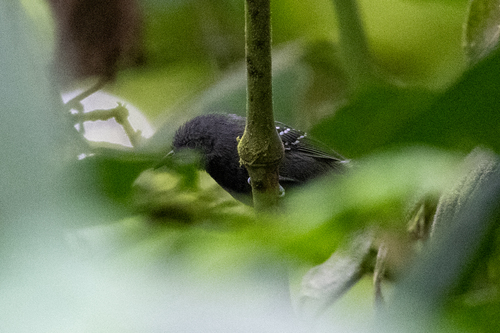 slaty antwren
Em resumo
The most reliable field mark is size and structure: Black-crowned Antshrike is much larger and bulkier than Slaty Antwren, with a heavy, hooked bill and a longer tail. If you see a small, short-tailed bird with a fine bill, it's the antwren; a big, thick-billed bird is the antshrike. Males of both can look slaty gray, but the antshrike has a distinctive black crown and nape, while the antwren male shows a black throat and upper breast. Females differ more: antshrike females are brownish above and below, while antwren females are grayish-olive above with cinnamon and yellowish-brown underparts. Juveniles are also separable by overall color and size. In flight or perched, the antshrike's size, bill, and strong tail contrast with the antwren's daintier jizz.
Dicas de identificação
- Size is the first check: If the bird is tiny, barely sparrow-sized, it's the Slaty Antwren. If it's noticeably larger and robust, it's the Black-crowned Antshrike. This works for all ages and sexes.
- Bill shape: Antshrike has a thick, hooked bill (shrike-like), obvious even at a distance. Antwren has a fine, straight bill. This is reliable for all ages.
- Tail length and shape: Antshrike has a long, broad tail with white spots at the tips of each feather (visible when fanned). Antwren has a short tail with thin white edges, not spots. Check this in perched or fanned-tail birds.
- Adult male head pattern: Antshrike males have a black crown and nape, contrasting with slaty gray back and face. Antwren males lack a black crown but have a black throat and upper breast. If you see black limited to the throat, it's the antwren; if the crown is black, it's the antshrike.
- Adult male underparts: Antshrike males are slaty gray below; antwren males have a black throat/upper breast and otherwise gray underparts. Look for the extent and location of black.
- Adult female color: Antshrike females are brown to buffy brown above and below, with little contrast. Antwren females are grayish olive above and show a pale cinnamon throat, olive-brown flanks, and yellowish-brown/tawny underparts. Cinnamon or yellowish tones below point to antwren.
- Juvenile color: Juvenile antshrikes are dull cinnamon-brown above, grayish white below, and much larger than any antwren. If you see a small, brownish juvenile, check size and bill carefully.
- Wing pattern: Both have white-tipped wing coverts, but the antshrike's wings are black with white tips and white/gray edges on flight feathers; antwren's are dark gray with white-tipped coverts and, in females, rufous edges. In flight, the antshrike's wing pattern is bolder.
- Hidden scapular/shoulder patch: Both adult males have a hidden white patch between the scapulars/shoulders, but this is rarely visible in the field and not reliable for separation.
- Iris color: Both have brownish to chocolate-brown irises, not useful for separation.
- Leg and foot color: Both have medium to dark gray legs and feet; not diagnostic.
- Behavior: Antwren is fast, active, and often in mixed-species flocks, usually in dense foliage; antshrike is slower, more deliberate, and often perches in the open or at edges.
- Habitat context: If the bird is in a dense flock in thick undergrowth, lean toward antwren; a lone or paired bird at edge or in more open woodland is more likely antshrike.
- Sexual dimorphism: Both species show strong sexual dimorphism, but the difference is more dramatic in antshrike (black-crowned male vs. brownish female) than in antwren (gray male vs. cinnamon/yellowish female).
- Subspecies variation: Some regional variation exists, but the main contrasts above are consistent throughout their ranges.
Tamanho
Black-crowned Antshrike is substantially larger (14–15 cm, 20–28.5 g) than Slaty Antwren (9–12 cm, 8.5–10 g) [wikipedia][wikidata]. The antshrike is a robust, largish antbird with a thick, hooked bill and a proportionally long tail. In contrast, the antwren is a tiny, short-tailed bird with a fine bill. Even at a distance or in mixed flocks, the antshrike stands out as much bulkier and heavier-bodied.
Plumagem
-
Juveniles: Black-crowned Antshrike juveniles are dull cinnamon-brown above and grayish white below, already larger and bulkier than any antwren. Slaty Antwren juveniles are not described in detail, but would be much smaller and lack the antshrike's cinnamon tones.
-
Adult males: Both can look slaty gray, but the antshrike male has a black crown and nape (often obvious even in poor light), a grizzled gray face, and a hidden white scapular patch. Its wings are black with white-tipped coverts and white/gray edges on flight feathers; tail is black with a white spot at the end of each feather. The antwren male is dark gray overall, with a black throat and upper breast (not crown), a hidden white shoulder patch, dark gray tail with thin white edges, and white-tipped coverts. The antwren's black is confined to the throat and uppermost breast, not the head.
-
Adult females: Antshrike females are brown to buffy brown above, with fuscous-black wings edged brown and white-tipped flight feathers, and buffy brown to grayish brown below. Antwren females are grayish olive above with a browner tail, browner wings with rufous-edged coverts, pale cinnamon throat, olive-brown sides/flanks, and tawny to yellowish brown underparts. The antshrike female is overall browner and less contrasting than the antwren female, which shows more cinnamon and yellowish tones below.
-
Subspecies variation: Both species have some subspecific variation, but the main contrasts above hold throughout their ranges.
Comportamento
Slaty Antwren is highly active, foraging in dense vegetation, often in mixed-species flocks, and typically moves quickly through foliage from near ground level up to mid-canopy. It gleans insects from leaves and makes short sallies. Black-crowned Antshrike is more deliberate, often perching in the open or at forest edges, and may be seen singly or in pairs. Its movements are slower and more purposeful, befitting its larger size and heavier build.
Habitat
Both species overlap broadly in range and can be found from Mexico through Central America to northern South America. Both occur in forested habitats, but Slaty Antwren is more often found in dense undergrowth and midstory, frequently joining mixed-species flocks. Black-crowned Antshrike is more likely at forest edges, second growth, and sometimes more open woodland, and is less likely to join mixed flocks. If you see a slaty antbird in a dense flock, it's more likely the antwren; a lone or paired bird at the edge is more likely the antshrike.
black-crowned antshrike · slaty antwren · Minhas aves difíceis