

black bustard vs garçote-comum
Afrotis afra versus Botaurus minutus
Jogue um quiz com black bustard e garçote-comum
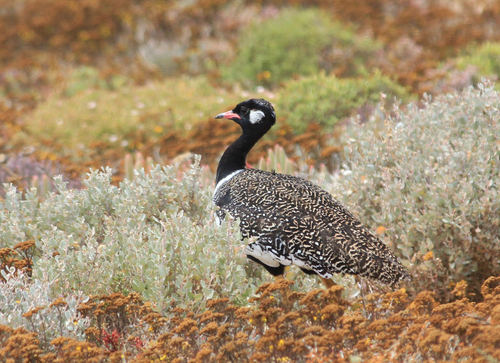 black bustard
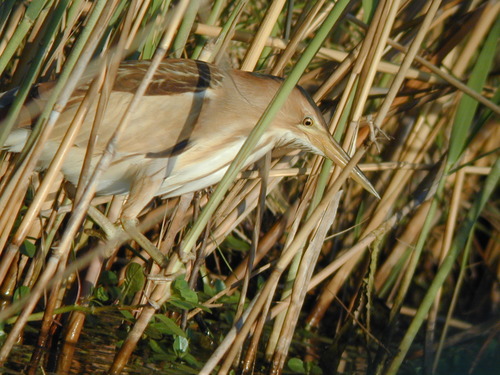 garçote-comum
Em resumo
The most reliable field mark to separate Black Bustard (Afrotis afra) from Little Bittern (Botaurus minutus) is overall structure and habitat: Black Bustard is a ground-dwelling, long-legged bustard of dry open country, while Little Bittern is a small, short-legged heron found in dense wetland vegetation. In flight or perched, Black Bustard males show bold black-and-white checkered plumage and yellow legs, while Little Bitterns are much more slender, with a long pointed bill and a distinctive pale wing panel (especially in males). Juvenile Little Bitterns are heavily streaked above and below, unlike any Black Bustard. If you see a small bustard striding in open grassland, it's Black Bustard; if you see a tiny, streaky heron clambering through reeds, it's Little Bittern.
Dicas de identificação
- Juvenile plumage: Juvenile Little Bitterns are heavily streaked above and below, including the wing coverts, and are more rufous overall; Black Bustard juveniles never show this pattern—females and immatures are checkered brown and white without streaking.
- Adult male plumage: Male Black Bustard is boldly checkered black and white above, with a black neck and underparts, and white on the underwing, cheeks, and eye stripes; male Little Bittern is black above with a faint green sheen, pale buff below, and a distinct pinkish-buff oval wing panel.
- Female/immature confusion: Female Black Bustard is checkered brown and white overall, with the head, neck, and breast matching the body; female Little Bittern is browner above with paler feather margins, streaked underparts, and a less obvious pale wing panel.
- Leg color: Both sexes of Black Bustard have bright yellow legs, which are long and obvious; Little Bittern has much shorter legs, usually greenish or yellowish, but not as striking or long.
- Bill shape and color: Black Bustard has a stout, reddish bill with a black tip; Little Bittern has a long, slender, pointed bill, yellowish in color—very different in profile.
- Body shape and jizz: Black Bustard is upright, robust, and long-legged, often seen striding or standing in open areas; Little Bittern is small, compact, and crouched, often clambering or freezing among reeds.
- Flight pattern: Little Bittern flies rapidly and directly with short, rounded wings, usually low over water or reeds; Black Bustard's flight is more labored and direct, sometimes high during display, with more obvious white on the underwing (male).
- Wing panel: In flight or at rest, Little Bittern (especially males) shows a pale, pinkish-buff oval panel on the wing, contrasting with black; Black Bustard never shows this feature.
- Habitat: Black Bustard is found in dry, open grasslands and shrublands; Little Bittern is strictly a wetland bird, in dense reeds or marshes.
- Perching behavior: Little Bittern may be seen clambering among reeds or perched on stems; Black Bustard is almost never seen off the ground.
- Underwing color: Little Bittern has whitish underwings; Black Bustard (male) shows some white on the underwing, but the rest of the plumage is much more contrasting.
- Context and range: Black Bustard is endemic to southwestern South Africa; Little Bittern is a widespread migrant in Europe and Africa, but always tied to wetlands.
- Sexual dimorphism: Both species show some sexual dimorphism, but in Black Bustard it is more pronounced (males with black neck and underparts, females brown and white checkered); in Little Bittern, males are blacker above and cleaner below, females browner and streakier.
- Size impression: Despite similar weights, Black Bustard appears much larger and more robust, with longer legs and neck; Little Bittern is tiny, delicate, and heron-like.
- Feeding behavior: Black Bustard feeds by walking and picking on the ground; Little Bittern stalks prey in shallow water or among reeds.
Tamanho
Little Bittern is slightly heavier (adult mass ~147 g [wikidata]), but appears much smaller and more delicate than Black Bustard due to its compact, heron-like build and much shorter legs. Black Bustard is a small bustard but still has a noticeably more robust, upright posture, longer legs, and a stouter body. Little Bittern's wingspan (52–58 cm) is much greater than Black Bustard's (male 27–28 cm, female 25–26 cm), but this is due to the difference in wing shape and body plan: Little Bittern is built for short flights through reeds, while Black Bustard is adapted for walking and running on the ground.
Plumagem
Juvenile Little Bitterns are heavily streaked above and below, including the wing coverts, and are more rufous overall—this streakiness is never seen in Black Bustard of any age. Adult male Black Bustard is boldly checkered black and white above, with a black neck and underparts, and white on the underwing, cheeks, and eye stripes; females are checkered brown and white with no black. Both sexes have bright yellow legs. Little Bittern males are mostly black above with a greenish sheen, pale buff underparts, and a distinct pinkish-buff oval wing panel contrasting with black wings; females are browner above with paler feather margins and streaked underparts, and the pale wing panel is less obvious. In flight, Little Bitterns show pale whitish underwings, while Black Bustard shows white only on the underwing and otherwise much more contrasting body and wing pattern. The bill of Little Bittern is long, pointed, and yellowish, while Black Bustard's is shorter, reddish with a black tip.
Comportamento
Black Bustard is almost always seen walking or running on the ground in open country, often standing upright and displaying. It rarely perches above ground level. Little Bittern is secretive, moving slowly and stealthily through dense reeds or waterside vegetation, often clambering among stems or freezing with bill pointed upward. In flight, Little Bittern is fast and direct with rapid wingbeats, usually low over water or reeds; Black Bustard's flight is more labored and direct, sometimes used in display. Black Bustard is omnivorous, feeding on insects and seeds on the ground; Little Bittern is a specialist predator of small aquatic animals.
Habitat
Black Bustard is strictly a bird of open, semi-arid grasslands, shrublands, and savannas in southwestern South Africa, never found in wetlands. Little Bittern is always associated with wetlands, especially dense reedbeds, marshes, and waterside vegetation, and is absent from dry open country. If you see the bird in a reedbed or marsh, it is almost certainly Little Bittern; if in open, dry grassland, it is Black Bustard.