

Zappeyvliegenvanger vs Azuurvliegenvanger
Cyanoptila cumatilis versus Eumyias thalassinus
Speel een quiz met Zappeyvliegenvanger en Azuurvliegenvanger
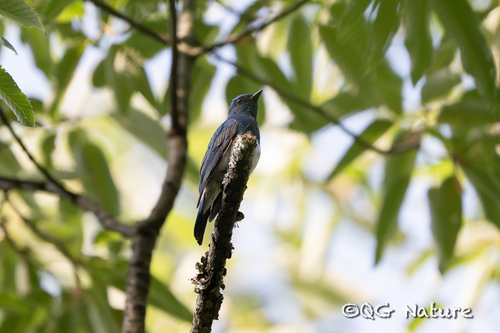 Zappeyvliegenvanger
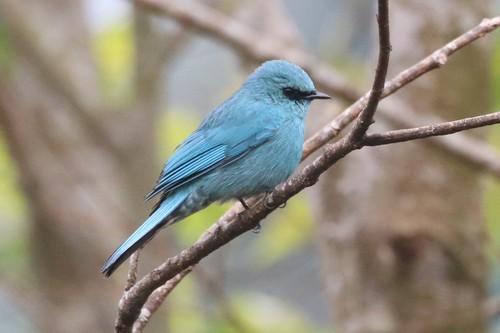 Azuurvliegenvanger
Kort gezegd
The most reliable field mark between Zappey's Flycatcher and Verditer Flycatcher is the overall shade and distribution of blue in adult males: Zappey's is a greener, turquoise-blue with a white underside, while Verditer is an intense, uniform blue with a distinctive black lores/forehead patch. Immature Zappey's males show a mix of blue wings and tail with a brownish head and mantle, unlike any Verditer. In all plumages, Verditer Flycatcher stands out for its all-over blue coloration (even in females), and its black facial patch, which Zappey's never shows. Both species can appear similar at a distance, especially in poor light or when seen perched high, but careful attention to the blue tone, underpart color, and face pattern will separate them.
Herkenningstips
- Adult male blue tone: Zappey's Flycatcher is turquoise or greenish-blue above, while Verditer Flycatcher is a more uniform, intense copper-sulphate blue. This is most obvious in good light.
- Face pattern: Verditer always shows a blackish patch between the eyes and above the bill base (lores/forehead), which Zappey's never has. This is a key mark at all ages and sexes.
- Underparts color: Zappey's has pure white underparts with only faint grey on the flanks; Verditer is blue or blue-grey below, never pure white.
- Tail base patches: Zappey's shows two small white patches at the base of the tail (visible from the side or from below), absent in Verditer.
- Female/immature upperparts: Female and immature Zappey's are grey-brown above with a white throat, while Verditer females and immatures are pale blue all over, never brownish.
- Immature male Zappey's: Look for a mix of blue wings, rump, and tail with a brownish head and mantle and white throat—this combination does not occur in Verditer.
- Bill and legs: Both have dark bills and legs; not a useful separator.
- Perching behavior: Verditer often perches on exposed treetops or wires, sometimes above the canopy, while Zappey's is more typical of forest flycatchers.
- Jizz in flight: No distinctive flight or wing pattern differences are noted; separation relies on perched views and plumage.
- Sexual dimorphism: Both species show sexual dimorphism, but Verditer females are still blue (though paler), while Zappey's females are brownish.
- White throat: Female and immature Zappey's have a white throat, which is never seen in Verditer.
- Flank color: Zappey's flanks may be faintly greyish, but the rest of the underparts are pure white; Verditer is blue or blue-grey throughout.
- Habitat context: If seen foraging above the canopy or on wires, Verditer is more likely, but use this only as supporting evidence.
- Range overlap: In areas where both species occur, rely on plumage and face pattern, not range or habitat alone.
- Lighting pitfalls: In poor light, Zappey's blue can look darker and Verditer can look less vibrant; always check for the black face patch and underpart color to confirm.
Grootte
Both species are similar in size, but Zappey's Flycatcher is slightly larger (about 17 cm long, no mass given), while Verditer Flycatcher averages 18.1 g in mass. In the field, size is not a reliable separator between these two, as their proportions and overall jizz are quite alike.
Verenkleed
-
Immature/First-year birds: Immature male Zappey's Flycatcher shows blue wings, rump, and tail, but retains a grey-brown head and mantle and a white throat, resembling the female but with blue highlights. Verditer Flycatcher immatures and females are lighter blue overall, but never show the brownish upperparts or white throat of immature Zappey's.
-
Adult males: Zappey's is turquoise-blue above with a greenish cast, greenish-black face and upper breast, and pure white underparts (flanks may be faintly greyish). The tail matches the back, with small white patches at the tail base. Verditer is a striking, even copper-sulphate blue all over, except for a black patch between the eyes and above the bill, and a grey vent. Verditer lacks the white underparts and white tail base patches of Zappey's.
-
Adult females: Both are duller, but Zappey's female is greyish-brown above (not blue), with a white throat and underparts. Verditer female is pale blue all over, lacking any brown tones or white throat.
-
Face pattern: Verditer Flycatcher always shows a dark (blackish) patch between the eyes and above the bill base, which is absent in Zappey's at all ages and sexes.
Gedrag
Verditer Flycatcher often perches conspicuously on exposed treetops or wires, and forages above the canopy, which is unusual for flycatchers. Zappey's Flycatcher does not have a noted preference for such exposed perches and is more typical of forest flycatchers in behavior. This difference can help in context, but is not always diagnostic.
Habitat
Both species can occur in overlapping regions during migration or winter, but Zappey's breeds in central China and winters further south, while Verditer is found from the Himalayas through Southeast Asia to Sumatra. Verditer is more likely in open, high, or edge habitats where it perches on wires or treetops, while Zappey's is more typical of forested areas. However, range and habitat alone are not sufficient for separation where both occur.
Zappeyvliegenvanger · Azuurvliegenvanger · Mijn lastige vogels