

Paarskroonkoketkolibrie vs Violetkapbosnimf
Stephanoxis loddigesii versus Thalurania glaucopis
Speel een quiz met Paarskroonkoketkolibrie en Violetkapbosnimf
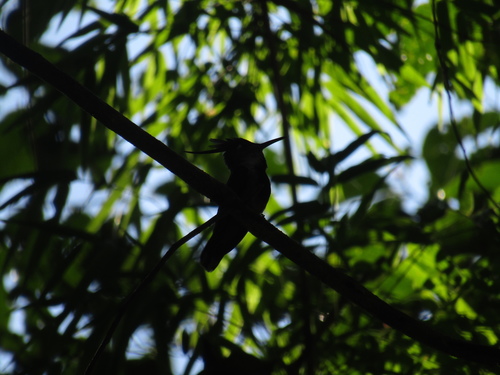 Paarskroonkoketkolibrie
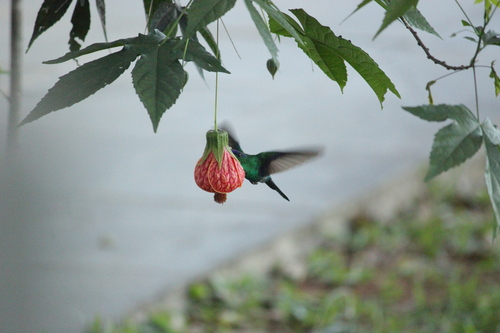 Violetkapbosnimf
Kort gezegd
The most reliable field mark to separate Purple-crowned Plovercrest from Violet-capped Woodnymph is the presence of a shaggy violet-blue crest on adult male plovercrests, which is never shown by woodnymphs of any age or sex. In contrast, male Violet-capped Woodnymphs have a glittering violet-blue crown but lack any crest, and females of both species have much reduced or no crest. Tail shape and color also help: plovercrests have a less forked tail with green and blackish bands, while woodnymphs show a forked, steel-blue tail. Females and immatures are trickier, but underpart color and tail pattern remain useful. Both species overlap in range and habitat, so careful attention to head and tail features is essential.
Herkenningstips
- Crest presence (adult males): Purple-crowned Plovercrest males have a prominent, shaggy violet-blue crest—unique among these two species. If you see a crest, it's a plovercrest; woodnymphs never show a crest at any age or sex.
- Crown color (adult males): Violet-capped Woodnymph males have a glittering violet-blue crown (forehead and crown) but no crest. The color is similar, but the lack of a crest is key.
- Head pattern (females and immatures): Female and juvenile plovercrests may show a small crest, while woodnymphs never do. This is subtle but can be seen in good views.
- Face and throat (adult males): Plovercrest males have a brownish face, chin, and throat with a white spot behind the eye; woodnymph males have a more uniform green face without the white post-ocular spot.
- Underparts (adult males): Plovercrest males have a blackish violet-blue lower throat to upper belly and gray lower underparts; woodnymph males are brilliant green below with greenish to bluish undertail coverts.
- Underparts (females): Female woodnymphs are green above and dirty white to pale buff below; female plovercrests are yellowish-green above and gray below. The difference is subtle but useful in good light.
- Tail shape: Woodnymphs have a steel-blue, distinctly forked tail (more pronounced in males), while plovercrests have a less forked tail with green central feathers and outer feathers showing a blackish band and whitish tips.
- Tail color and pattern: Look for the steel-blue color and strong fork in woodnymphs; plovercrests show more green and a blackish subterminal band with whitish tips on the outer feathers.
- Juvenile/subadult woodnymphs: Subadult male woodnymphs have a turquoise-blue crown and whitish bars on the throat—never shown by plovercrests of any age.
- Bill: Both species have a straight, blackish bill of similar length and shape; bill color is not useful for separation.
- Size: Woodnymphs are slightly larger and heavier, but this is only apparent with direct comparison or in the hand.
- Sexual dimorphism: Both species show strong sexual dimorphism, but the crest in plovercrests is the most reliable mark for males; females are best separated by tail pattern and subtle underpart differences.
- Range and habitat: Both species overlap in much of their range and habitat, so do not rely on location alone for identification.
- Flight views: In flight, focus on the presence or absence of a crest, tail shape (forked vs less forked), and any flash of steel-blue (woodnymph) or green with blackish band (plovercrest) in the tail.
- Pitfalls: Immature and female birds are the most likely to be confused; always check for even a small crest, tail pattern, and underpart color before making an ID.
Grootte
Violet-capped Woodnymph is generally larger and heavier: males are 8–11 cm long and weigh 4–6.1 g, while Purple-crowned Plovercrest males are 8.5–9.5 cm and about 3.7 g. Females of both species are similar in length, but woodnymphs are noticeably bulkier. In the field, this difference is subtle, but woodnymphs may appear slightly longer and more robust, especially in direct comparison.
Verenkleed
Juveniles and females of both species lack the full adult male head coloration, making separation more challenging. For adult males, the Purple-crowned Plovercrest shows a distinctive shaggy violet-blue crest, brownish face and throat with a white post-ocular spot, yellowish-green upperparts, and a tail with green central feathers and outer feathers tipped whitish with a blackish subterminal band. The Violet-capped Woodnymph male has a glittering violet-blue crown (not a crest), dark golden-green upperparts, brilliant green underparts, and a steel-blue forked tail. Females and juveniles of both species are green above and grayish or dirty white below, but woodnymph females have a more uniform green upperpart and a slightly forked tail with steel-blue and white-tipped outer feathers, while plovercrest females have a smaller crest and a less forked tail with a blackish band. Subadult male woodnymphs show turquoise-blue crowns and whitish throat barring, which is never seen in plovercrests.
Gedrag
Both species are active, fast-moving hummingbirds, often seen darting between flowers. No distinctive behavioral differences are noted in the sources that would reliably separate them in the field. Both perch frequently and may hover to feed, but these behaviors are typical for hummingbirds in general.
Habitat
Both species occur in overlapping regions of Argentina, Brazil, and Paraguay, with Violet-capped Woodnymph also found in Uruguay. Habitat preferences are not diagnostic for field separation, as both can be found in similar environments within their shared range.
Paarskroonkoketkolibrie · Violetkapbosnimf · Mijn lastige vogels