

Motmot

Bonte baardkoekoek vs Kleine trappist

Notharchus tectus versus Micromonacha lanceolata

Speel een quiz met Bonte baardkoekoek en Kleine trappist
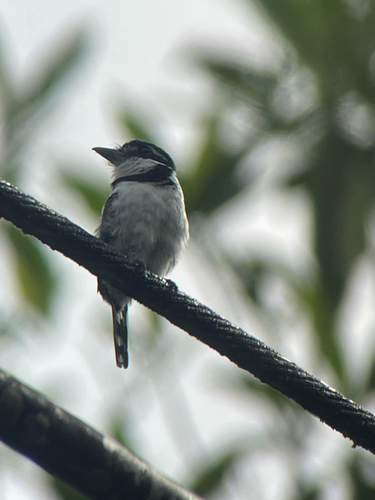
Bonte baardkoekoek (Notharchus tectus) Bonte baardkoekoek
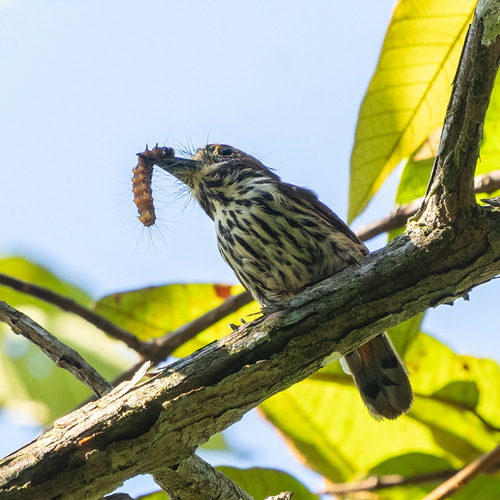
Kleine trappist (Micromonacha lanceolata) Kleine trappist

Media

Laden…

Kort gezegd

The most reliable field mark to separate Pied Puffbird from Lanceolated Monklet is overall plumage contrast: Pied Puffbird is strikingly black-and-white with a bold breast band and white facial markings, while Lanceolated Monklet is a warm brown bird with heavy black streaking below and buffy scaling above. Pied Puffbird shows a broad black breast band and white barring on the flanks, which never appear on Lanceolated Monklet. In perched views, Pied Puffbird looks sharply patterned and glossy, while Lanceolated Monklet appears much more muted and finely marked. Both are small, short-tailed puffbirds, but Pied Puffbird is slightly larger and bulkier. Juvenile/immature-specific wing or flight marks are not described for either species, so focus on perched plumage and head pattern.

Herkenningstips

  1. Breast band (all ages): Pied Puffbird always shows a bold, broad black band across the upper breast, sharply dividing the white throat from the white belly. Lanceolated Monklet never shows a breast band; instead, its underparts are white with heavy black streaks.
  2. Flank pattern (all ages): Pied Puffbird has black-and-white barred flanks, which are absent in Monklet. Monklet's flanks are streaked, not barred, and may be grayer with less white in some subspecies.
  3. Upperparts color (all ages): Pied Puffbird is glossy black above with white markings, while Monklet is warm brown with buffy scaling. The difference is obvious in good light.
  4. Head pattern (all ages): Pied Puffbird has a bold white line from bill through the eye (supercilium), white speckling on the crown, and a large white scapular spot. Monklet has white bristles and 'whiskers' at the bill base, a white lore and half-eye ring, but lacks the strong supercilium and crown speckling.
  5. Tail pattern (all ages): Pied Puffbird shows white near the tail base and tip; Monklet's tail is dark brown above, gray below, without white spots.
  6. Bill and face structure: Both have large bills, but Monklet's white bristles and feather tufts around the bill are distinctive at close range. Pied Puffbird's bill appears cleaner and the face more sharply patterned.
  7. Underparts streaking vs. banding: Monklet's underparts are heavily streaked black on white, except for the plain belly center and ochre-tinged vent. Pied Puffbird is clean white below the breast band, with barred flanks.
  8. Size and jizz: Pied Puffbird is slightly larger and bulkier, but size overlap is considerable. Use only as a supporting mark.
  9. Vocalization: If heard, Pied Puffbird's high-pitched, whistled series is distinctive. Monklet's voice is not described here, so absence of this song may suggest Monklet.
  10. Subspecies variation: Pied Puffbird subspecies may show less white on the tail (N. t. picatus) or a narrower breast band and grayer flanks (N. t. subtectus), but the overall black-and-white pattern and breast band remain diagnostic.
  11. No age-specific flight marks: Neither species has described juvenile or immature upperwing or flight marks, so do not rely on in-flight pattern for separation.
  12. Perched views are best: Both species are most reliably identified when perched, as their subtle differences are hard to see in flight.
  13. Habitat overlap: Both can occur in the same regions and similar habitats, so do not use location alone for ID.
  14. Sexes similar: No sexual dimorphism is described for either species, so all marks apply to both sexes.
  15. Pitfalls: In poor light, Monklet's streaked underparts may look banded, but the lack of a clean breast band and the overall brown coloration should prevent confusion. Always check for the combination of breast band, flank barring, and head pattern.

Grootte

Pied Puffbird is slightly larger and heavier: 14–17 cm long, 21–40 g, compared to Lanceolated Monklet's 13–15 cm and 19–22 g. In the field, this difference is subtle, but Pied Puffbird may look a bit more robust and broad-headed, while Lanceolated Monklet is more petite and slender. Size overlap is significant, so do not rely on this alone.

Verenkleed

No distinctive juvenile or immature upperwing or flight marks are described for either species, so all ages must be separated by overall plumage and pattern. Adult Pied Puffbird is glossy black above with white below, a bold white supercilium, white speckling on the crown, a large white scapular spot, and a broad black breast band. The flanks are barred black and white, and the tail has white at the base and tip. Lanceolated Monklet is entirely warm brown above with buffy, scale-like markings, and has white bristles and 'whiskers' around the bill. Its underparts are white with heavy black streaks (except the belly center, which is plain), and the vent is ochre-tinged. The face has a white lore and half-eye ring, but lacks the bold supercilium and crown speckling of Pied Puffbird. Monklet's wings and tail are dark brown above, tail gray below. Subspecies variation in Pied Puffbird affects the amount of white and the width of the breast band, but the strong black-and-white contrast is always present. Monklet never shows a breast band or barred flanks.

Gedrag

Both species are typically seen perched quietly, often on exposed branches. No distinctive behavioral differences are noted in the sources. Both can appear motionless and upright, typical of puffbirds.

Habitat

Both species occur in overlapping regions of Central and South America, including Bolivia, Brazil, Colombia, Costa Rica, Ecuador, and Peru. Habitat preferences are not described in detail in the sources, so do not use habitat alone for separation.

Geluid

Pied Puffbird's song is a thin, loud, high-pitched series of whistles, described as 'tee-oo' or 'pweee pweee pweee' in various patterns. Subspecies N. t. subtectus gives a higher-pitched, more piping, less modulated version. Lanceolated Monklet's vocalizations are not described in the provided notes, so use Pied Puffbird's distinctive high-pitched whistles as a supporting mark if heard.

Stuur een betere beschrijving

Gebruik dezelfde onderdelen als de vergelijking. Je tekst staat meteen live.

The most reliable field mark to separate Pied Puffbird from Lanceolated Monklet is overall plumage contrast: Pied Puffbird is strikingly black-and-white with a bold breast band and white facial markings, while Lanceolated Monklet is a warm brown bird with heavy black streaking below and buffy scaling above. Pied Puffbird shows a broad black breast band and white barring on the flanks, which never appear on Lanceolated Monklet. In perched views, Pied Puffbird looks sharply patterned and glossy, while Lanceolated Monklet appears much more muted and finely marked. Both are small, short-tailed puffbirds, but Pied Puffbird is slightly larger and bulkier. Juvenile/immature-specific wing or flight marks are not described for either species, so focus on perched plumage and head pattern.

  1. Breast band (all ages): Pied Puffbird always shows a bold, broad black band across the upper breast, sharply dividing the white throat from the white belly. Lanceolated Monklet never shows a breast band; instead, its underparts are white with heavy black streaks.
  2. Flank pattern (all ages): Pied Puffbird has black-and-white barred flanks, which are absent in Monklet. Monklet's flanks are streaked, not barred, and may be grayer with less white in some subspecies.
  3. Upperparts color (all ages): Pied Puffbird is glossy black above with white markings, while Monklet is warm brown with buffy scaling. The difference is obvious in good light.
  4. Head pattern (all ages): Pied Puffbird has a bold white line from bill through the eye (supercilium), white speckling on the crown, and a large white scapular spot. Monklet has white bristles and 'whiskers' at the bill base, a white lore and half-eye ring, but lacks the strong supercilium and crown speckling.
  5. Tail pattern (all ages): Pied Puffbird shows white near the tail base and tip; Monklet's tail is dark brown above, gray below, without white spots.
  6. Bill and face structure: Both have large bills, but Monklet's white bristles and feather tufts around the bill are distinctive at close range. Pied Puffbird's bill appears cleaner and the face more sharply patterned.
  7. Underparts streaking vs. banding: Monklet's underparts are heavily streaked black on white, except for the plain belly center and ochre-tinged vent. Pied Puffbird is clean white below the breast band, with barred flanks.
  8. Size and jizz: Pied Puffbird is slightly larger and bulkier, but size overlap is considerable. Use only as a supporting mark.
  9. Vocalization: If heard, Pied Puffbird's high-pitched, whistled series is distinctive. Monklet's voice is not described here, so absence of this song may suggest Monklet.
  10. Subspecies variation: Pied Puffbird subspecies may show less white on the tail (N. t. picatus) or a narrower breast band and grayer flanks (N. t. subtectus), but the overall black-and-white pattern and breast band remain diagnostic.
  11. No age-specific flight marks: Neither species has described juvenile or immature upperwing or flight marks, so do not rely on in-flight pattern for separation.
  12. Perched views are best: Both species are most reliably identified when perched, as their subtle differences are hard to see in flight.
  13. Habitat overlap: Both can occur in the same regions and similar habitats, so do not use location alone for ID.
  14. Sexes similar: No sexual dimorphism is described for either species, so all marks apply to both sexes.
  15. Pitfalls: In poor light, Monklet's streaked underparts may look banded, but the lack of a clean breast band and the overall brown coloration should prevent confusion. Always check for the combination of breast band, flank barring, and head pattern.

Pied Puffbird is slightly larger and heavier: 14–17 cm long, 21–40 g, compared to Lanceolated Monklet's 13–15 cm and 19–22 g. In the field, this difference is subtle, but Pied Puffbird may look a bit more robust and broad-headed, while Lanceolated Monklet is more petite and slender. Size overlap is significant, so do not rely on this alone.

No distinctive juvenile or immature upperwing or flight marks are described for either species, so all ages must be separated by overall plumage and pattern. Adult Pied Puffbird is glossy black above with white below, a bold white supercilium, white speckling on the crown, a large white scapular spot, and a broad black breast band. The flanks are barred black and white, and the tail has white at the base and tip. Lanceolated Monklet is entirely warm brown above with buffy, scale-like markings, and has white bristles and 'whiskers' around the bill. Its underparts are white with heavy black streaks (except the belly center, which is plain), and the vent is ochre-tinged. The face has a white lore and half-eye ring, but lacks the bold supercilium and crown speckling of Pied Puffbird. Monklet's wings and tail are dark brown above, tail gray below. Subspecies variation in Pied Puffbird affects the amount of white and the width of the breast band, but the strong black-and-white contrast is always present. Monklet never shows a breast band or barred flanks.

Both species are typically seen perched quietly, often on exposed branches. No distinctive behavioral differences are noted in the sources. Both can appear motionless and upright, typical of puffbirds.

Both species occur in overlapping regions of Central and South America, including Bolivia, Brazil, Colombia, Costa Rica, Ecuador, and Peru. Habitat preferences are not described in detail in the sources, so do not use habitat alone for separation.

Pied Puffbird's song is a thin, loud, high-pitched series of whistles, described as 'tee-oo' or 'pweee pweee pweee' in various patterns. Subspecies N. t. subtectus gives a higher-pitched, more piping, less modulated version. Lanceolated Monklet's vocalizations are not described in the provided notes, so use Pied Puffbird's distinctive high-pitched whistles as a supporting mark if heard.

Wijzigingen weggooien?

Je hebt niet-opgeslagen wijzigingen. Als je nu weggaat, gaan die verloren.

Bonte baardkoekoek · Kleine trappist · Mijn lastige vogels