

Zwartkeelbaardkolibrie vs Witsnorheremietkolibrie
Threnetes leucurus versus Phaethornis yaruqui
Speel een quiz met Zwartkeelbaardkolibrie en Witsnorheremietkolibrie
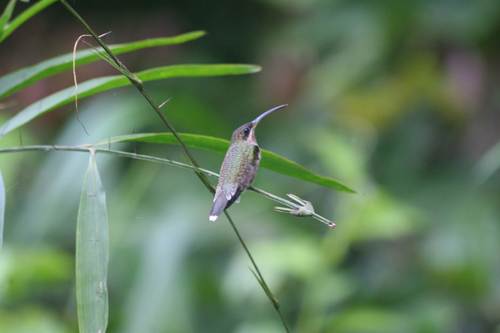 Zwartkeelbaardkolibrie
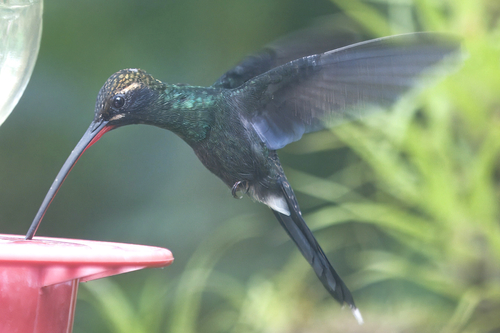 Witsnorheremietkolibrie
Kort gezegd
The most reliable field mark to separate Pale-tailed Barbthroat from White-whiskered Hermit is the facial pattern: Pale-tailed Barbthroat shows a dark ear patch and a pale malar stripe, while White-whiskered Hermit has a strong black facial mask with a buffy supercilium and a bold white gular (whisker) stripe. The Hermit is also notably longer-tailed and slightly larger overall, with a more iridescent bluish-green upperpart and a straighter bill in males. Both species are similar in size and weight, but their face patterns and tail structure are the quickest ways to distinguish them in the field, especially when perched. Immature plumages are not described as highly distinctive for either species, so focus on adult face and tail features.
Herkenningstips
- Face pattern is the best field mark: White-whiskered Hermit has a bold black mask, buffy supercilium, and a prominent white whisker (gular stripe). Pale-tailed Barbthroat has a dark ear patch and a pale malar stripe, but lacks the Hermit's strong facial contrast. This works for all ages and sexes.
- Tail structure and length: The Hermit, especially females, has a longer tail than the Barbthroat. In perched birds, compare tail length relative to the body; Hermit tails often extend well beyond the wingtips.
- Upperparts color: Hermit upperparts are iridescent bluish-green, while Barbthroat is bronze-green. In good light, this can be a useful supporting mark.
- Underparts: Barbthroat has a grayish belly with ochre tones; Hermit underparts are green to dark gray, with females being more grayish. This is subtle and may be hard to judge in poor light.
- Bill shape: Both species have nearly straight bills in males, but Hermit females have a shorter, gently decurved bill, while Barbthroat females have a more noticeably decurved bill. Bill shape is subtle and best used in combination with other marks.
- Sexual dimorphism: Hermit females have a longer tail and more grayish underparts than males; Barbthroat sexes are similar but females are slightly duller and have a more decurved bill.
- Juvenile/immature birds: Young Barbthroats have ochraceous feather edges but otherwise resemble adults; Hermit immatures are not distinctly described in the field. Do not rely on age-specific marks for separation.
- Vocalizations: If you hear a continuous harsh 'kree-u' or 'seek' notes with tail-wagging, you are likely hearing White-whiskered Hermit. Barbthroat vocalizations are not described.
- Behavior: Hermits may be seen tail-wagging at leks; Barbthroat behavior is less distinctive but similar in foraging style.
- Range and habitat: Outside Colombia and Ecuador, Pale-tailed Barbthroat is much more likely. In those countries, check habitat and use facial pattern for confirmation.
- Tail color: Barbthroat has a dark tail with variable pale coloring on outer feathers; Hermit tail pattern is not described as distinctive.
- Plumage contrast: Barbthroat males have more contrast between throat, breast, and belly; Hermit has a more uniform underpart color, especially in females.
- Lighting conditions: Iridescence (Hermit) vs bronze (Barbthroat) is most apparent in good light; in shade, rely on face pattern and tail length.
- Subspecies variation: Barbthroat subspecies differ in tail and belly color, but these are subtle and rarely diagnostic in the field; stick to face and tail structure.
- Overlap: In areas of range overlap, always confirm with facial pattern and tail length, as both can occur in similar forested habitats.
Grootte
White-whiskered Hermit is slightly larger, averaging about 13 cm in length, compared to Pale-tailed Barbthroat's 10–12.2 cm. Both species overlap in weight (males 4–7 g, females 4–6.5 g), so mass is not a useful field mark. The Hermit also has a proportionally longer tail, especially in females. In the field, the Hermit may appear more elongated and slender due to its longer tail and slightly larger frame.
Verenkleed
-
Juvenile/Immature plumage: Neither species is described as having a distinctive upperwing or flight pattern in juvenile or immature plumage. Young Pale-tailed Barbthroats resemble adults but with ochraceous feather edges; immature White-whiskered Hermits were once described as a separate subspecies but are not noted as being distinct in the field.
-
Adult plumage:
- Pale-tailed Barbthroat: Bronze-green upperparts and breast, dark ear patch, pale malar stripe, reddish patch below the throat, grayish-ochre belly, and a dark tail with variable pale coloring on the outer feathers. Sexes are similar, but females have a slightly more decurved bill and less contrast between throat, breast, and belly.
-
White-whiskered Hermit: Bronzy crown, iridescent bluish-green upperparts, underparts green to dark gray, black facial mask with a buffy supercilium and a bold white gular (whisker) stripe. Males have an almost straight bill; females have a shorter, gently decurved bill, shorter wings, more grayish underparts, and a longer tail.
-
Key differences: The Hermit's face pattern is much more striking and contrasting, with a clear white whisker and supercilium, while the Barbthroat's face is plainer with a dark ear patch and pale malar stripe. The Hermit's upperparts are more iridescent and bluish-green, while the Barbthroat is bronze-green. Tail color and pattern are variable in Barbthroat but not as diagnostic as the facial pattern.
Gedrag
Both species are typical hermit hummingbirds, often seen hovering at flowers or perching low in the understory. The White-whiskered Hermit is noted for tail-wagging displays at leks, sometimes accompanied by vocalizations. The Barbthroat's behavior is less described but is likely similar in foraging and perching habits. In flight, the Hermit's longer tail may be more noticeable, especially in females.
Habitat
Pale-tailed Barbthroat is widespread in the Amazon Basin, occupying open and semi-open spaces within humid lowland and tropical forests, including gallery, várzea, and igapó forests, as well as plantations. It ranges from sea level up to 1,800 m depending on locality. White-whiskered Hermit is more restricted, found in Colombia and Ecuador, and is not described as using the same range of habitats as the Barbthroat. If seen outside Colombia/Ecuador, Barbthroat is much more likely; in those countries, both are possible in suitable forested habitats.
Geluid
White-whiskered Hermit has a distinctive song: a continuous series of harsh 'kree-u' notes, and also gives 'seek' notes while wagging its tail at leks. No vocal description is provided for Pale-tailed Barbthroat, so song is only useful for positively identifying the Hermit.
Zwartkeelbaardkolibrie · Witsnorheremietkolibrie · Mijn lastige vogels