

Noordelijke kokako vs Zuidelijke kokako
Callaeas wilsoni versus Callaeas cinereus
Speel een quiz met Noordelijke kokako en Zuidelijke kokako
 Noordelijke kokako
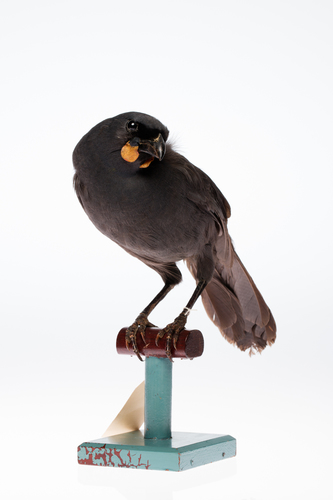 Zuidelijke kokako
Kort gezegd
The most reliable way to separate North Island Kōkako from South Island Kōkako is by the color of their wattles: North Island birds have vivid blue wattles (juveniles start with pink or lilac), while South Island birds show mostly orange wattles with a dark blue base. Both species are slate-grey, long-tailed, and have a small black facial mask, but South Island Kōkako is slightly paler overall and has a reputation for being a better flier and more terrestrial. Juvenile wattle color is also helpful: pink/lilac in North Island, pale in South Island. In the field, range is crucial—North Island Kōkako is restricted to the North Island, while any claim of South Island Kōkako is extraordinary and requires strong evidence, as the latter is possibly extinct.
Herkenningstips
- Wattle color is the single most diagnostic feature: North Island Kōkako adults have blue wattles (cobalt to ultramarine), while South Island Kōkako adults have orange wattles with a blue base. This is visible even at a distance if the bird is facing you.
- Juvenile wattles differ: North Island juveniles start with pink or lilac wattles, turning blue as they mature. South Island juveniles have much paler wattles (likely pale orange or yellowish), becoming orange with a blue base in adults.
- Facial mask: Both have a small black mask around the eyes and bill. This is not a reliable separator but can help confirm you are looking at a kōkako.
- Overall plumage: Both are slate-grey, but South Island Kōkako is slightly paler. This difference is subtle and unreliable unless birds are side by side.
- Tail and wings: Both species have long, rounded, dark tails and slightly darker wings. No unique flight or upperwing pattern is described for either species or age.
- Bill structure: Both have a short, slightly downcurved, black bill. Not a separator.
- Leg color: Both have strong, bluish-grey to black legs and feet. Not diagnostic.
- Flight and movement: North Island Kōkako is a poor flier, usually seen climbing or leaping in the canopy. South Island Kōkako was more terrestrial and a better flier; if you see a kōkako foraging on the ground or making longer flights, consider South Island (but this is moot given its rarity).
- Range is critical: North Island Kōkako is only found in the North Island. South Island Kōkako, if extant, would only be in the South Island or Stewart Island. Any kōkako outside its known range is almost certainly a misidentification.
- Habitat: Both prefer mature native forest, but South Island Kōkako was found in a wider range of forest types, including more open or subalpine forests.
- Voice: Both have rich, flute-like duets. South Island Kōkako's song is described as especially mellow, but this is not a practical field separator.
- Sexual dimorphism: Both species show little to no sexual dimorphism; males are slightly larger but not reliably separable in the field.
- Seasonal variation: No seasonal plumage differences are described for either species.
- Pitfalls: Immature wattles can be confusing—pink/lilac in North Island, pale in South Island. Rarely, adult North Island birds may show orange in the wattles, overlapping with South Island, so always consider range and context.
- Documentation: Any claim of South Island Kōkako requires photographic or audio evidence and expert verification, as the species is possibly extinct.
Grootte
Both species are medium-sized, long-tailed birds with similar proportions. North Island Kōkako is about 38–40 cm in length, with males slightly larger than females. South Island Kōkako averages 230g in weight, but no direct length comparison is available. Any size difference is subtle and not reliable in the field.
Verenkleed
- Juveniles: North Island Kōkako juveniles have pink or lilac wattles, turning blue with age; South Island Kōkako juveniles have much lighter (presumably pale orange or yellowish) wattles that become orange with a blue base in adults.
- Adults: North Island Kōkako is soft slate-grey to smoky blue all over, with blue wattles and a black facial mask. South Island Kōkako is also slate-grey but slightly paler, with orange wattles (blue at the base) and a similar black mask. Both have dark, broad tails and slightly darker wings and tail compared to the body. No age-specific upperwing or flight pattern differences are described for either species.
Gedrag
North Island Kōkako is a weak flier, mostly moving by climbing and leaping through trees. South Island Kōkako was considered a better flier and spent more time on the ground, possibly due to its foraging and nesting habits. Both are adapted for agility in dense forest, but South Island birds may flush more readily or be seen on the ground more often (if encountered at all).
Habitat
North Island Kōkako is restricted to mature native forests of the North Island, often in areas with intensive predator control. South Island Kōkako formerly inhabited a wide range of South Island and Stewart Island forests, from lowland to subalpine, but is now possibly extinct. Any sighting outside the North Island is highly suspect for North Island Kōkako and vice versa.
Geluid
Both species have rich, organ- and flute-like duetting calls. South Island Kōkako's notes were described as few but exceptionally mellow and sweet. There is no detailed, diagnostic difference in song structure or call for field separation, especially as South Island Kōkako's voice is known only from historical accounts.
Noordelijke kokako · Zuidelijke kokako · Mijn lastige vogels