

Kleine topper vs Eider
Aythya affinis versus Somateria mollissima
Speel een quiz met Kleine topper en Eider
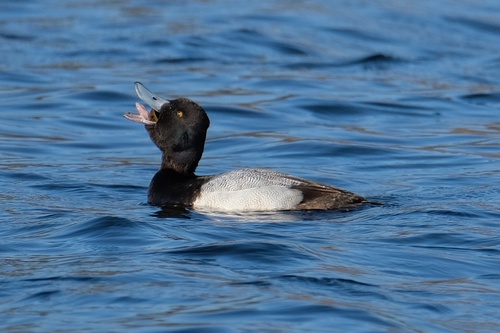 Kleine topper
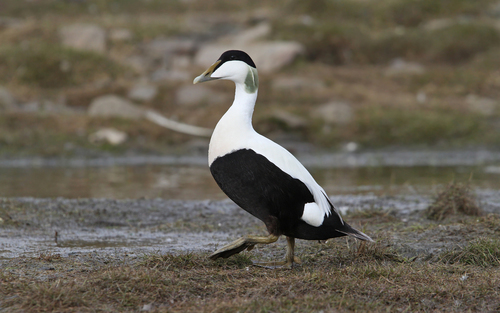 Eider
Kort gezegd
The most reliable field mark to separate Lesser Scaup from Common Eider is overall size and structure: Common Eider is much larger and bulkier, with a massive wedge-shaped bill, while Lesser Scaup is a compact diving duck with a much smaller, straighter bill. In flight, Lesser Scaup of all ages show a white wing stripe limited to the secondaries, while Common Eider (especially females and immatures) lacks this contrasting white panel. Female and immature plumages can be confusing at a distance, but the eider's sheer bulk and head shape are distinctive. Bill shape and head profile are key at rest, while habitat context (freshwater vs. marine) can also help.
Herkenningstips
- Size is the first check: Common Eider is over twice the mass of Lesser Scaup and appears much larger and bulkier in all contexts. If the bird looks goose-sized or dwarfs nearby ducks, it's an eider.
- Bill shape: Lesser Scaup has a small, straight, blue-grey bill with a narrow profile; Common Eider has a huge, wedge-shaped bill that extends up the face, giving a unique profile. This is visible at all ages and sexes.
- Head shape: Resting Lesser Scaup shows a rounded head with a small crest at the rear, giving an angular or peaked nape. Eider has a sloping forehead and a massive, blocky head with a long, sloping profile.
- Wing pattern in flight: All ages of Lesser Scaup show a white wing stripe on the secondaries only; the white does not reach the primaries. Eider lacks this feature, with a more uniform, dark upperwing (especially in females and immatures).
- Adult male plumage: Breeding male Lesser Scaup has a black head and breast, pale back, and white underparts; male Common Eider is boldly black and white with a green nape and huge bill, unmistakable if seen well.
- Female/immature confusion: Female Lesser Scaup is dark brown with a white band at the bill base (variable); female eider is also brown but much larger and bulkier, with a massive bill and barred flanks. Immature scaup are duller versions of the female, while immature eiders are always large and heavy-billed.
- Habitat context: Scaup are found on freshwater lakes and rivers; eiders are almost always on saltwater coasts. A brown duck on a lake is almost never an eider.
- Group composition: Lesser Scaup often occur in mixed flocks with other diving ducks; eiders form large, dense rafts on the sea, often with only other eiders.
- Behavior: Scaup are active divers, often diving in quick succession; eiders may appear more sluggish, floating low and diving less frequently.
- Voice: Eider's 'ah-ooo' call is distinctive if heard; scaup are generally quiet, but females may give a harsh 'scaup' call.
- Bill nail: The dark nail at the tip of the bill is broader in eider, but this is subtle and rarely diagnostic at a distance.
- Head sheen (male): Lesser Scaup males may show a purple sheen; this is unreliable due to lighting and distance and should not be used as a primary mark.
- Direct comparison: If you have both species together, the size and bill shape differences become obvious; without direct comparison, rely on structure and habitat.
- Pitfalls: Female and immature scaup can look superficially like small brown eiders at a distance, but always check size, bill, and habitat.
- Seasonal context: Eiders are coastal year-round; scaup move inland in migration and winter. Out-of-range eiders are extremely rare on freshwater.
Grootte
Common Eider is dramatically heavier (average adult mass ~2066.5g) than Lesser Scaup (~786.5g), and is also longer (50–71 cm vs. 38–48 cm). Eider has a wingspan of 80–110 cm, compared to the scaup's 68–78 cm. In the field, eiders appear much bulkier and longer-necked, easily dwarfing any scaup nearby. Lesser Scaup is a small, compact duck with a short neck and less imposing presence.
Verenkleed
For all ages in flight, Lesser Scaup shows a white wing stripe that is confined to the secondaries and does not extend onto the primaries, creating a sharp cutoff before the wingtip. Common Eider lacks this scaup-like white wing panel; females and immatures especially show a more uniform, dark upperwing in flight. Adult male Lesser Scaup in breeding plumage has a black head (with variable purple sheen), black breast, whitish-grey back, and white underparts, while female is dark brown with a white band at the bill base. Male Common Eider is strikingly patterned with black and white plumage and a green nape, while female is a large, brown, barred duck, but always with a much more massive head and bill than any scaup. Juvenile and immature scaup resemble adult females but are duller, with little or no white at the bill base; eider immatures are always much larger and bulkier, with a different head and bill shape.
Gedrag
Lesser Scaup is a diving duck, often seen in tight flocks on freshwater lakes or rivers, diving frequently for food. Common Eider is also a diver but is almost always found in coastal marine habitats, often in large rafts on the sea. Eiders may appear more sluggish and float low in the water, while scaup are more active and compact. In flight, eiders are heavy and direct, while scaup are quicker and more agile.
Habitat
Lesser Scaup is primarily a freshwater species, found on lakes, reservoirs, and rivers, especially inland during migration and winter. Common Eider is a strictly marine duck, found along northern coastlines, estuaries, and offshore waters, rarely venturing far inland except in rare cases (e.g., some European lakes with invasive mussels). If you see a duck on a freshwater lake, it's almost certainly not a Common Eider.
Geluid
Male Common Eider gives an odd, almost human-like 'ah-ooo' display call, while the female utters hoarse quacks. Lesser Scaup is generally quiet, with females giving a discordant 'scaup' call. Vocalizations are not usually the primary field mark for separation, but the eider's calls are more distinctive if heard.