

Kleine fregatvogel vs Indische dwergaalscholver
Fregata ariel versus Microcarbo niger
Speel een quiz met Kleine fregatvogel en Indische dwergaalscholver
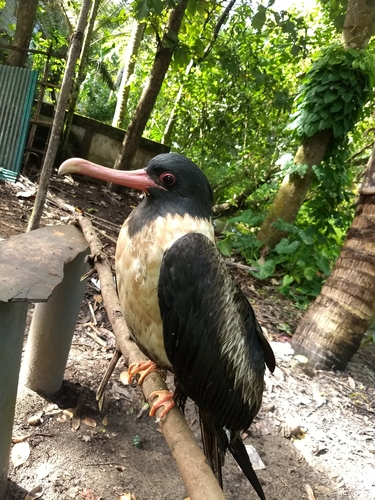 Kleine fregatvogel
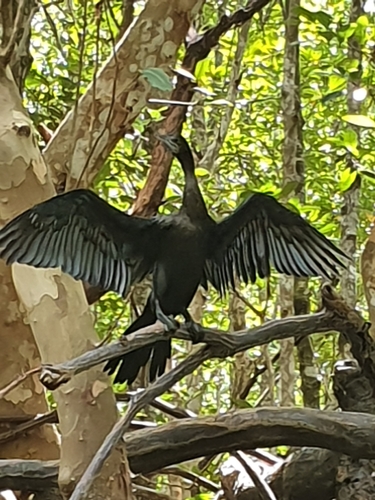 Indische dwergaalscholver
Kort gezegd
The most reliable way to separate Lesser Frigatebird from Little Cormorant is by overall structure and flight style: Lesser Frigatebird is a long-winged, deeply forked-tailed aerial specialist, while Little Cormorant is compact, short-tailed, and usually seen perched or swimming. Immature Lesser Frigatebirds show diagnostic white 'spurs' in the underwing 'armpits', a feature never present on Little Cormorant of any age. In all plumages, Lesser Frigatebird is built for soaring with extremely long, narrow wings and a deeply forked tail, while Little Cormorant is a squat, short-necked diver with a straight, stubby bill. Even at a distance, the jizz and flight style are utterly different.
Herkenningstips
- Underwing pattern in immatures: Juvenile and immature Lesser Frigatebirds show diagnostic white 'spurs' or patches in the underwing coverts (armpits) in flight; Little Cormorant never shows this feature at any age.
- Tail shape: Lesser Frigatebird has a long, deeply forked tail, especially obvious in flight; Little Cormorant has a short, rounded tail.
- Wing shape and length: Frigatebird wings are extremely long, narrow, and pointed, giving a scythe-like silhouette; cormorant wings are short and broad, with rounded tips.
- Flight style: Frigatebirds soar effortlessly, rarely flapping, often high above water; cormorants fly with steady, rapid wingbeats, low over water, or swim/diving.
- Perched posture: Frigatebirds rarely perch except at colonies, and when they do, appear long-winged and awkward; cormorants perch upright, often with wings spread to dry.
- Bill shape: Frigatebird has a long, slender, hooked bill; cormorant's bill is shorter, stouter, and less strongly hooked.
- Adult male plumage: Male Lesser Frigatebird is all black with a white flank patch and a red gular sac (inflated in display); Little Cormorant male is all black with possible white facial spots, never with a red throat sac.
- Adult female plumage: Female Lesser Frigatebird has a white breast and belly, black head/neck, and a white collar; female cormorant is similar to male, lacking any white below or collar.
- Juvenile plumage: Juvenile cormorant is brownish with a small white throat patch, never with white on underwing or flanks; juvenile frigatebird is darker above with white underparts and underwing spurs.
- Size and proportions: Frigatebird is much larger in wingspan and longer-tailed, but appears lighter and more graceful; cormorant is compact, short-necked, and heavy-bodied.
- Habitat: Frigatebird is pelagic, seen over open sea or remote islands; cormorant is found on inland waters, lakes, and rivers, rarely far from land.
- Behavior: Frigatebird never swims or dives; cormorant regularly swims and dives for fish.
- Gular/throat color: Frigatebird males have a red gular sac; cormorant gular skin is dark or fleshy, never red.
- Crest: Little Cormorant may show a short crest in breeding plumage; Lesser Frigatebird never shows a crest.
- Voice: Cormorant may be heard giving low calls at colonies; frigatebird is mostly silent away from breeding sites.
- Context: If seen soaring high over open ocean, especially with a deeply forked tail, it is almost certainly a frigatebird; if seen perched or swimming on a lake or river, it is a cormorant.
Grootte
Lesser Frigatebird is substantially larger and lighter-built, with a body mass around 800 g and a length of 66–81 cm, but its wingspan is enormous (155–193 cm) and the tail is long and deeply forked. Little Cormorant is much smaller and more compact, about 50 cm in length, with a much shorter wingspan and tail. The cormorant appears chunky and short-necked, lacking the long, elegant proportions of the frigatebird.
Verenkleed
Juvenile and immature Lesser Frigatebirds are best identified by the white 'spurs' or patches in the underwing coverts (armpits), visible in flight—these are absent in Little Cormorant of any age. Adult male Lesser Frigatebirds are all black with a white flank patch and a pale bar on the upperwing, plus a red gular sac (inflated in display). Females have a white breast and belly, black head and neck, and a white collar, with a narrow red eye-ring. Little Cormorant adults in breeding plumage are all black with some white spots and a short crest; non-breeding and juveniles are brownish with a small white throat patch, but never show any white on the underwing or flanks. The cormorant's bill and gular skin are dark or fleshy, never red. Sexes are similar in cormorant, but males are slightly larger.
Gedrag
Lesser Frigatebird is almost always seen soaring high over the ocean or coast, rarely perching except at colonies, and never swimming or diving. It is a master of aerial flight, often harassing other seabirds for food. Little Cormorant, by contrast, is usually seen perched on branches or rocks near water, or swimming low in the water, often diving for fish. It rarely soars and is never seen high over open ocean. The cormorant often forages alone or in small groups, propelling itself underwater with its feet.
Habitat
Lesser Frigatebird is a pelagic species, found over tropical and subtropical seas, rarely coming to land except to breed on remote islands or occasionally roosting on coastal trees. Little Cormorant is a freshwater and coastal bird, widespread on lakes, rivers, wetlands, and estuaries, often in human-modified landscapes. It is not found far out to sea and is rarely seen over open ocean.
Geluid
Lesser Frigatebird is mostly silent away from breeding colonies; males may produce calls and bill rattling during courtship, but these are rarely heard in the field. Little Cormorant is more vocal near nests and roosts, giving low roaring sounds, grunts, groans, and 'kok-kok-kok' calls. However, voice is rarely a primary field mark for separation.
Kleine fregatvogel · Indische dwergaalscholver · Mijn lastige vogels