

Grijskopwouw vs Wurgarend
Leptodon cayanensis versus Morphnus guianensis
Speel een quiz met Grijskopwouw en Wurgarend
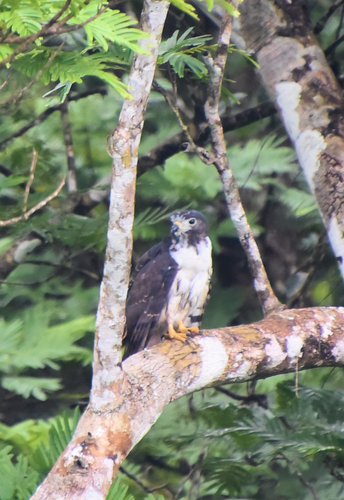 Grijskopwouw
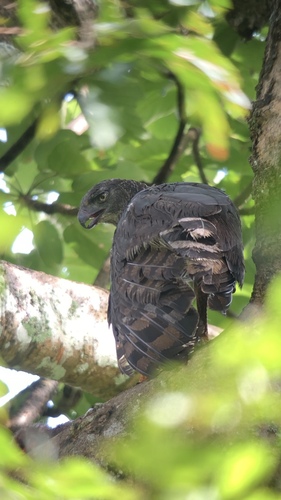 Wurgarend
Kort gezegd
The most reliable way to separate Grey-headed Kite from Crested Eagle is by size and structure: Crested Eagle is vastly larger, bulkier, and longer-winged, while Grey-headed Kite is a compact, small raptor. In flight, immature Grey-headed Kites show striking mimicry of other raptors, but never reach the bulk or massive proportions of a Crested Eagle. Adult Grey-headed Kites have a crisp grey head and black-and-white tail pattern, while Crested Eagles are much browner or grayer overall and have a prominent head crest. If you see a raptor with a truly massive wingspan, broad wings, and a long tail, you are looking at a Crested Eagle, not a kite.
Herkenningstips
- Size is the first check: If the bird looks eagle-sized, with a wingspan well over a meter, it is a Crested Eagle. Grey-headed Kite is much smaller, closer to a large hawk than an eagle; size alone rules out confusion in most binocular views.
- Structure in flight: Crested Eagle has broad, rounded wings and a very long tail, giving it a heavy, stretched look. Grey-headed Kite is compact, with shorter wings and tail, and a lighter, more buoyant flight.
- Head and crest: Crested Eagle has a large head with a prominent feathered crest, especially when raised. Grey-headed Kite has a smooth, rounded head with no obvious crest in adults; only rufous morph juveniles show a crest, and even then, it is not as massive as the eagle's.
- Tail pattern: Grey-headed Kite always shows a black tail with two or three bold white bars (all ages). Crested Eagle's tail is long but lacks such crisp barring and is more muted in color.
- Adult plumage: Adult Grey-headed Kite is sharply marked with a grey head, black upperparts, and white underparts. Crested Eagle adults are brownish- or sooty-gray above, with a white throat and dark mask, but never as crisply marked as the kite.
- Juvenile/immature confusion: Juvenile Grey-headed Kites can mimic other raptors, but their size is always much less than a Crested Eagle. Juvenile Crested Eagles are white-headed and chested, with marbled gray back and wings, and pale below except for the grayish chest; they never show the kite's bold tail barring.
- Leg and bill color: Grey-headed Kite adults have blue bills and grey legs; immatures have black bills and yellow legs. Crested Eagle's bare legs are large and robust, but color is less useful at distance.
- Flight style: Grey-headed Kite uses a deliberate flap-flap-glide, often at lower heights. Crested Eagle soars or glides with powerful, deep wingbeats, often high above the forest or maneuvering through the canopy.
- Habitat context: In open woodland or swamp forest, Grey-headed Kite is likely; in deep, undisturbed rainforest, Crested Eagle is possible. Habitat can be a strong clue.
- Perched posture: Crested Eagle perches upright, often with the crest raised, and appears massive and long-tailed. Grey-headed Kite perches more horizontally, looking compact and neat.
- Sex and season: Both species show little seasonal or sexual variation in plumage, but Crested Eagle females are larger than males (not easily judged in the field unless paired).
- Pitfalls: Juvenile Grey-headed Kite's mimicry can be confusing, but always check size, tail pattern, and structure. No Grey-headed Kite, of any age, will match the bulk or proportions of a Crested Eagle.
- Voice: Not diagnostic with available information; both are generally silent and rarely vocalize in the field.
- Community tip: If you are in doubt, compare the bird to nearby vultures or large raptors for scale—Crested Eagle will appear truly massive, while Grey-headed Kite will not stand out in size.
Grootte
Crested Eagle is dramatically larger: adults measure 71–89 cm in length and weigh 1.2–3 kg, with a wingspan of 138–176 cm [wikipedia, avonet]. Grey-headed Kite is much smaller, at 46–53 cm long and 410–605 g [wikipedia, avonet]. Even a juvenile Crested Eagle dwarfs an adult kite. In the field, Crested Eagle appears as a large, long-winged, long-tailed eagle, while Grey-headed Kite is a medium-sized, compact raptor with proportionally shorter wings and tail.
Verenkleed
-
Juveniles/immatures: Grey-headed Kite immatures are famous for their mimicry, with three morphs: light (white head/neck, black crown and eyestripe), rufous (reddish neck, white throat, black malar and crest), and dark (blackish head/upperparts, streaked buff underparts). These can resemble other raptors but never match the size or the heavy, crested look of a Crested Eagle. Juvenile Crested Eagles are white on the head and chest with marbled gray back/wings, turning sandy-gray in their second year; dark morph juveniles are dark brownish-gray from an early age. In flight, Crested Eagle juveniles are pale below except for the grayish chest, while Grey-headed Kite juveniles (light morph) show a white head and neck with black markings, and a tail with bold white bars.
-
Adults: Grey-headed Kite adults have a crisp grey head, black upperparts, white underparts, and a black tail with two or three white bars. Crested Eagle adults are brownish- or sooty-gray above, with a white throat, dark mask, and a prominent crest. Their underparts are pale with a grayish chest, but lack the sharp black-and-white tail pattern of the kite. The eagle's overall coloration is more muted and brown/gray, never as sharply marked as the kite.
Gedrag
Crested Eagle is almost always solitary or in pairs, soaring high or perched in the canopy of extensive forest. Its flight is powerful, with broad, rounded wings and a long tail, suited for maneuvering through dense forest. Grey-headed Kite is more likely to be seen in open woodland or swamp forest, often flying with a deliberate flap-flap-glide pattern. The kite is much less imposing in flight and perches more openly than the secretive eagle.
Habitat
Grey-headed Kite favors open woodland and swamp forests, often at forest edges or clearings. Crested Eagle is a specialist of large, undisturbed tropical forests, rarely venturing into open or fragmented habitats. If you are in dense, mature rainforest, Crested Eagle is possible; in more open or edge habitats, Grey-headed Kite is much more likely.