
Motmot

Grote rivierarend vs Madagaskarbuizerd

Icthyophaga ichthyaetus versus Buteo brachypterus

Speel een quiz met Grote rivierarend en Madagaskarbuizerd
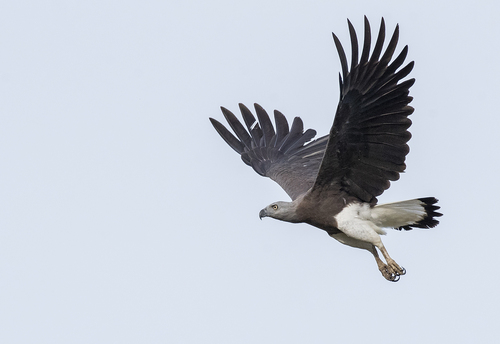
Grote rivierarend (Icthyophaga ichthyaetus) Grote rivierarend
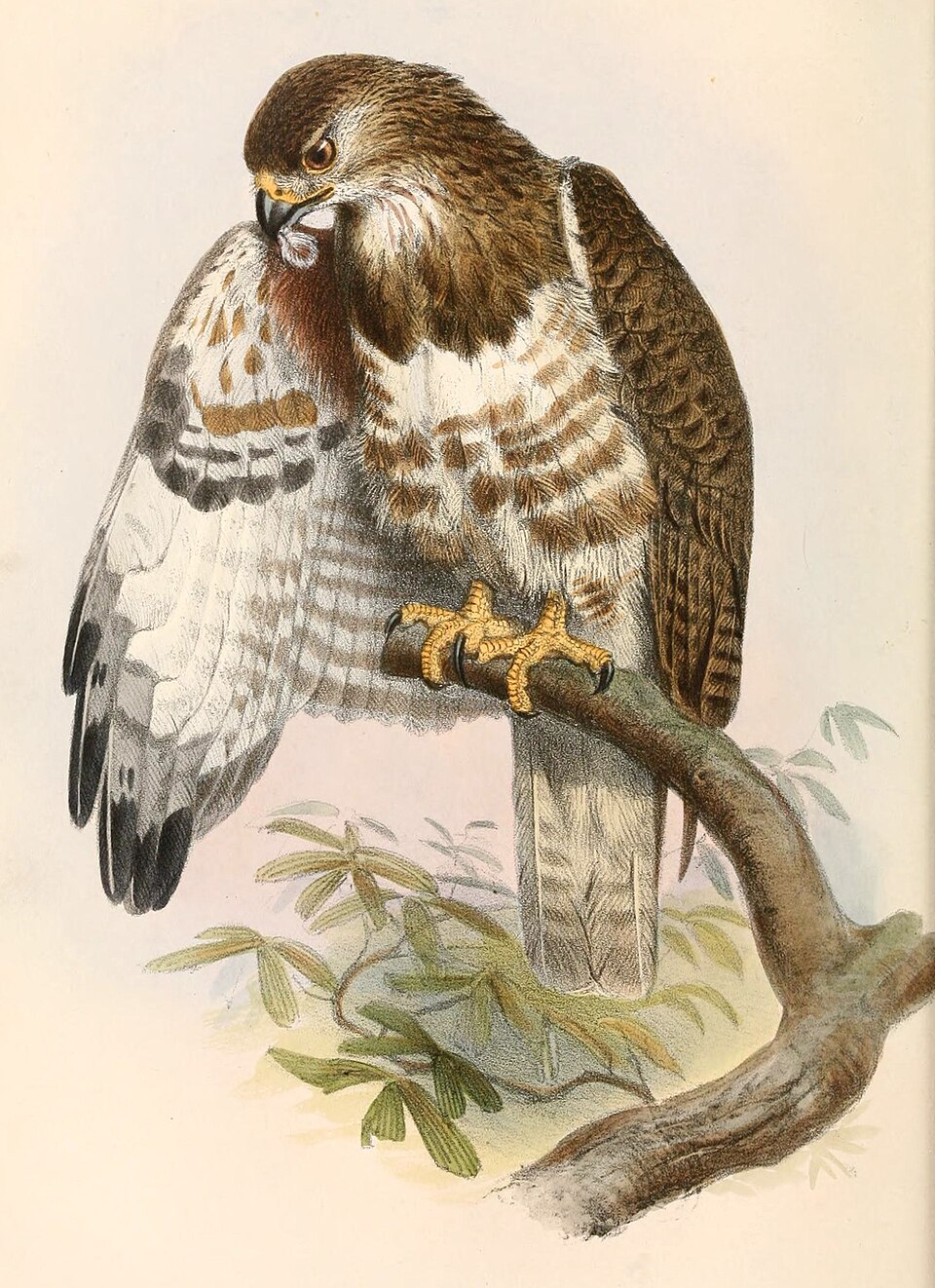
Madagaskarbuizerd (Buteo brachypterus) Madagaskarbuizerd

Media

Laden…

Kort gezegd

The most reliable field mark is the combination of structure and head color: Grey-headed Fish-Eagle is a large, heavy, long-necked raptor with a distinctly pale grey head and white belly and tail (with a bold black subterminal band), while Madagascar Buzzard is a smaller, more compact buzzard with a dark grey head, variable brownish body, and broad brownish-black tail bars. Juvenile Grey-headed Fish-Eagles are paler overall with streaked brown and white underparts, while Madagascar Buzzard juveniles show more typical buzzard-like patterning. In flight, the fish-eagle's short, broad wings and heavy, flat-winged flight contrast with the buzzard's more typical Buteo proportions and flight. Perched, the fish-eagle's long legs and upright stance are distinctive. Habitat can also help: fish-eagles are almost always near water, while buzzards are more generalist.

Herkenningstips

  1. Size and Structure: Grey-headed Fish-Eagle is much larger and bulkier than Madagascar Buzzard, with a long neck, small head, and long, unfeathered white legs. The buzzard is more compact, with shorter neck and feathered yellow legs. Size difference is obvious if seen together or with a reference.
  2. Head Color: Adult fish-eagle has a pale grey head sharply contrasting with brown upperparts and white underparts; Madagascar Buzzard has a dark grey head blending into the rest of the plumage.
  3. Tail Pattern (All Ages): Fish-eagle shows a white tail with a single, broad black subterminal band (adults) or a marbled black-and-white tail with a broad dark band and white tip (juveniles). Buzzard always shows a tail with several broad brownish-black bars, never a single bold band.
  4. Underparts: Fish-eagle has a clean white belly and thighs (all ages), with brown streaking only on the breast and flanks in juveniles. Buzzard has a white breast patch but brown-spotted vent and thighs, and overall more mottled or streaked underparts.
  5. Legs: Fish-eagle's legs are long, unfeathered, and white; buzzard's are shorter, feathered, and pale yellow.
  6. Bill and Cere: Fish-eagle has a small bill for its size; buzzard's bill is black with a greyish-blue cere.
  7. Flight Silhouette: Fish-eagle flies with heavy, flat wings and deep, full wingbeats; buzzard shows typical Buteo flight—broader wings, more flexible, often soaring.
  8. Perched Posture: Fish-eagle perches very upright, often on exposed branches over water, with long legs visible; buzzard perches in a more horizontal, hunched posture.
  9. Juvenile Plumage: Juvenile fish-eagles are paler, with brown and white streaked underparts and a marbled tail; juvenile buzzards resemble adults but may be paler or more streaked, always with barred tail.
  10. Habitat: Fish-eagle is almost always near water; buzzard is found in a wider range of habitats, rarely right at water's edge.
  11. Voice: Fish-eagle is vocal, with loud, far-carrying calls; buzzard's voice is not described here.
  12. Eye Color: Adult fish-eagle has pale iris; juveniles have darker eyes. Buzzard has yellow eyes in all plumages.
  13. Sexual Dimorphism: Only fish-eagle shows marked size difference between sexes; not apparent in field unless both sexes seen together.
  14. Pitfalls: At long range, a perched buzzard can look large and pale-headed in strong light, but will lack the fish-eagle's long legs, upright stance, and white tail with a single black band.
  15. Context: If the bird is actively fishing or perched over water, fish-eagle is far more likely; if soaring over forest or open country, especially away from water, buzzard is more probable.

Grootte

Grey-headed Fish-Eagle is substantially larger and bulkier, with a body length of 61–75 cm and a wingspan of 155–170 cm. Females can weigh up to 2.7 kg. Madagascar Buzzard is much smaller and lighter, typical of Buteo buzzards, and never approaches the fish-eagle in size or mass. The fish-eagle's long neck and legs, and relatively short tail, further emphasize its size and different proportions compared to the more compact, broad-tailed buzzard.

Verenkleed

Juvenile Grey-headed Fish-Eagles are pale brown above with grey edges and have a marbled black-and-white tail with a broad dark subterminal band and white tip; their head and neck are brown with buff supercilia and whitish streaks, and the underparts are white with brown streaks on the breast and flanks. As they mature, the head becomes greyer and loses streaking. Adults have a pale grey head, brown upperparts, white underparts, and a white tail with a bold black band near the tip. Madagascar Buzzard, in all plumages, shows a dark grey head, white breast patch, brownish-white vent and thighs with brown spots, and a tail with broad brownish-black bars (not a single subterminal band). The buzzard's plumage is variable but always lacks the fish-eagle's clean white belly and tail pattern. The fish-eagle's legs are white and unfeathered, while the buzzard's are pale yellow and feathered.

Gedrag

Grey-headed Fish-Eagle is often seen perched upright on bare branches over water, scanning for fish, and its flight is heavy and flat-winged with deep, full wingbeats. It is sedentary and usually solitary or in pairs. Madagascar Buzzard behaves like a typical Buteo: soaring on thermals, perching in a variety of habitats, and showing more buoyant, flexible flight. The fish-eagle's preference for water edges and its upright, long-legged stance are distinctive behavioral cues.

Habitat

Grey-headed Fish-Eagle is strongly tied to water—rivers, lakes, reservoirs, and wetlands—rarely straying far from aquatic habitats. Madagascar Buzzard is a habitat generalist within Madagascar, found in forests, open country, and even near human habitation, but not specifically tied to water. Thus, a large raptor perched over water is much more likely to be a fish-eagle.

Geluid

Grey-headed Fish-Eagle gives a variety of loud, far-carrying calls: gurgling 'awh-awhr', repeated 'chee-warr', owlish 'ooo-wok', and loud, high-pitched screams, often from a perch or in flight, especially during breeding season. Calls are described as starting low and subdued, becoming louder and more strident, and sometimes given at night. Madagascar Buzzard's vocalizations are not described in the provided notes, so are not diagnostic here.

Stuur een betere beschrijving

Gebruik dezelfde onderdelen als de vergelijking. Je tekst staat meteen live.

The most reliable field mark is the combination of structure and head color: Grey-headed Fish-Eagle is a large, heavy, long-necked raptor with a distinctly pale grey head and white belly and tail (with a bold black subterminal band), while Madagascar Buzzard is a smaller, more compact buzzard with a dark grey head, variable brownish body, and broad brownish-black tail bars. Juvenile Grey-headed Fish-Eagles are paler overall with streaked brown and white underparts, while Madagascar Buzzard juveniles show more typical buzzard-like patterning. In flight, the fish-eagle's short, broad wings and heavy, flat-winged flight contrast with the buzzard's more typical Buteo proportions and flight. Perched, the fish-eagle's long legs and upright stance are distinctive. Habitat can also help: fish-eagles are almost always near water, while buzzards are more generalist.

  1. Size and Structure: Grey-headed Fish-Eagle is much larger and bulkier than Madagascar Buzzard, with a long neck, small head, and long, unfeathered white legs. The buzzard is more compact, with shorter neck and feathered yellow legs. Size difference is obvious if seen together or with a reference.
  2. Head Color: Adult fish-eagle has a pale grey head sharply contrasting with brown upperparts and white underparts; Madagascar Buzzard has a dark grey head blending into the rest of the plumage.
  3. Tail Pattern (All Ages): Fish-eagle shows a white tail with a single, broad black subterminal band (adults) or a marbled black-and-white tail with a broad dark band and white tip (juveniles). Buzzard always shows a tail with several broad brownish-black bars, never a single bold band.
  4. Underparts: Fish-eagle has a clean white belly and thighs (all ages), with brown streaking only on the breast and flanks in juveniles. Buzzard has a white breast patch but brown-spotted vent and thighs, and overall more mottled or streaked underparts.
  5. Legs: Fish-eagle's legs are long, unfeathered, and white; buzzard's are shorter, feathered, and pale yellow.
  6. Bill and Cere: Fish-eagle has a small bill for its size; buzzard's bill is black with a greyish-blue cere.
  7. Flight Silhouette: Fish-eagle flies with heavy, flat wings and deep, full wingbeats; buzzard shows typical Buteo flight—broader wings, more flexible, often soaring.
  8. Perched Posture: Fish-eagle perches very upright, often on exposed branches over water, with long legs visible; buzzard perches in a more horizontal, hunched posture.
  9. Juvenile Plumage: Juvenile fish-eagles are paler, with brown and white streaked underparts and a marbled tail; juvenile buzzards resemble adults but may be paler or more streaked, always with barred tail.
  10. Habitat: Fish-eagle is almost always near water; buzzard is found in a wider range of habitats, rarely right at water's edge.
  11. Voice: Fish-eagle is vocal, with loud, far-carrying calls; buzzard's voice is not described here.
  12. Eye Color: Adult fish-eagle has pale iris; juveniles have darker eyes. Buzzard has yellow eyes in all plumages.
  13. Sexual Dimorphism: Only fish-eagle shows marked size difference between sexes; not apparent in field unless both sexes seen together.
  14. Pitfalls: At long range, a perched buzzard can look large and pale-headed in strong light, but will lack the fish-eagle's long legs, upright stance, and white tail with a single black band.
  15. Context: If the bird is actively fishing or perched over water, fish-eagle is far more likely; if soaring over forest or open country, especially away from water, buzzard is more probable.

Grey-headed Fish-Eagle is substantially larger and bulkier, with a body length of 61–75 cm and a wingspan of 155–170 cm. Females can weigh up to 2.7 kg. Madagascar Buzzard is much smaller and lighter, typical of Buteo buzzards, and never approaches the fish-eagle in size or mass. The fish-eagle's long neck and legs, and relatively short tail, further emphasize its size and different proportions compared to the more compact, broad-tailed buzzard.

Juvenile Grey-headed Fish-Eagles are pale brown above with grey edges and have a marbled black-and-white tail with a broad dark subterminal band and white tip; their head and neck are brown with buff supercilia and whitish streaks, and the underparts are white with brown streaks on the breast and flanks. As they mature, the head becomes greyer and loses streaking. Adults have a pale grey head, brown upperparts, white underparts, and a white tail with a bold black band near the tip. Madagascar Buzzard, in all plumages, shows a dark grey head, white breast patch, brownish-white vent and thighs with brown spots, and a tail with broad brownish-black bars (not a single subterminal band). The buzzard's plumage is variable but always lacks the fish-eagle's clean white belly and tail pattern. The fish-eagle's legs are white and unfeathered, while the buzzard's are pale yellow and feathered.

Grey-headed Fish-Eagle is often seen perched upright on bare branches over water, scanning for fish, and its flight is heavy and flat-winged with deep, full wingbeats. It is sedentary and usually solitary or in pairs. Madagascar Buzzard behaves like a typical Buteo: soaring on thermals, perching in a variety of habitats, and showing more buoyant, flexible flight. The fish-eagle's preference for water edges and its upright, long-legged stance are distinctive behavioral cues.

Grey-headed Fish-Eagle is strongly tied to water—rivers, lakes, reservoirs, and wetlands—rarely straying far from aquatic habitats. Madagascar Buzzard is a habitat generalist within Madagascar, found in forests, open country, and even near human habitation, but not specifically tied to water. Thus, a large raptor perched over water is much more likely to be a fish-eagle.

Grey-headed Fish-Eagle gives a variety of loud, far-carrying calls: gurgling 'awh-awhr', repeated 'chee-warr', owlish 'ooo-wok', and loud, high-pitched screams, often from a perch or in flight, especially during breeding season. Calls are described as starting low and subdued, becoming louder and more strident, and sometimes given at night. Madagascar Buzzard's vocalizations are not described in the provided notes, so are not diagnostic here.

Wijzigingen weggooien?

Je hebt niet-opgeslagen wijzigingen. Als je nu weggaat, gaan die verloren.

Grote rivierarend · Madagaskarbuizerd · Mijn lastige vogels