

Boskapokmees vs Acaciakapokmees
Anthoscopus flavifrons versus Anthoscopus caroli
Speel een quiz met Boskapokmees en Acaciakapokmees
 Boskapokmees
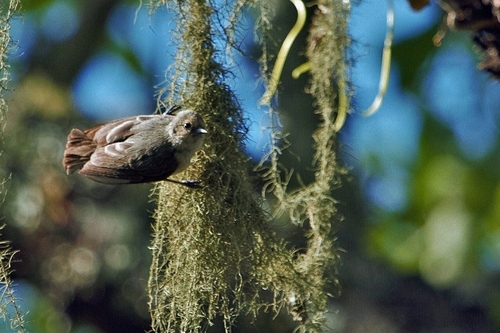 Acaciakapokmees
Kort gezegd
The most reliable way to separate Forest Penduline Tit from African Penduline Tit is by habitat: Forest Penduline Tit is restricted to African tropical rainforest, while African Penduline Tit is found in drier habitats such as dry forests and savannas. In areas where both could potentially occur, focus on context and subtle plumage differences, but be aware that field marks are subtle and overlap is possible. No distinctive age-specific wing or flight pattern marks are documented for either species, so separation relies on habitat and, to a lesser extent, overall coloration and structure.
Herkenningstips
- Habitat is key: Forest Penduline Tit is only found in African tropical rainforest. If you are not in dense, humid rainforest, you are almost certainly seeing African Penduline Tit.
- Avoid relying on plumage alone: No distinctive plumage or wing pattern differences are documented between these species, so do not attempt to separate them by subtle color or pattern differences in the field.
- Juvenile/immature confusion: There are no known age-specific upperwing or flight pattern differences to help with immature birds. Assume habitat is your best clue at all ages.
- Size is not helpful: Both species are extremely small, and the available mass data (8.0g for Forest Penduline Tit) does not provide a useful field separation from African Penduline Tit.
- Structure and jizz: Both species share a compact, short-tailed, active appearance typical of penduline tits. Structure is not a reliable separator.
- Geographic context: African Penduline Tit is widespread across much of sub-Saharan Africa, especially in dry and open habitats. Forest Penduline Tit is much more localized to rainforest zones.
- Perched vs. in flight: No documented differences in flight style or wing pattern. Both species are likely to be seen actively foraging in foliage.
- Voice: No vocal differences are described in the notes; do not rely on calls for separation.
- Season and sex: No seasonal or sexual dimorphism is mentioned for either species; assume all ages and sexes look similar within each species.
- Pitfalls: The main pitfall is assuming a penduline tit in open or dry habitat could be Forest Penduline Tit—this is highly unlikely. Conversely, do not expect African Penduline Tit in deep rainforest.
- Quiz context: If you are presented with a photo or description lacking clear habitat context, it may not be possible to separate these two species reliably.
- Field priority: Always record habitat and location when observing penduline tits in Africa, as this is often the only reliable separation point.
- Community tip: Local abundance on eBird supports African Penduline Tit as the default in most dry or open habitats; Forest Penduline Tit is much less frequently reported and only from rainforest regions.
- Summary: In the absence of clear plumage or structural differences, use habitat and range as your primary field marks for separating Forest and African Penduline Tits.
Grootte
Forest Penduline Tit has a documented body mass of 8.0g [wikidata], but no direct measurement is available for African Penduline Tit in the provided sources. Both species are among the smallest African passerines and are likely similar in size and structure, so size alone is not a reliable field mark.
Verenkleed
There are no detailed descriptions of age-specific plumage or wing pattern differences between Forest Penduline Tit and African Penduline Tit in the available sources. Both are tiny, compact birds in the Remizidae family. Any subtle differences in coloration or pattern are not specified in the notes. Thus, plumage is not a reliable field mark for separating immatures or adults in the field based on current information.
Gedrag
Behavior is not described in the provided notes for either species. Both are likely to show typical penduline tit behavior: active, acrobatic foraging in foliage, but this is not diagnostic for separation.
Habitat
Habitat is the most reliable separation point. Forest Penduline Tit is restricted to the African tropical rainforest [wikipedia], so it is only found in dense, humid, closed-canopy forest. African Penduline Tit occupies a much broader range, including subtropical or tropical dry forests, dry savanna, and moist savanna [wikipedia]. If you encounter a penduline tit in open woodland, savanna, or dry country, it is almost certainly African Penduline Tit. Only in dense, humid rainforest should Forest Penduline Tit be considered.