

Tiranmiervogel vs Mexicaanse mierlijster
Cercomacroides tyrannina versus Formicarius moniliger
Speel een quiz met Tiranmiervogel en Mexicaanse mierlijster
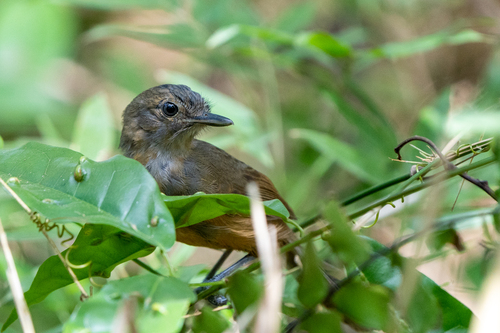 Tiranmiervogel
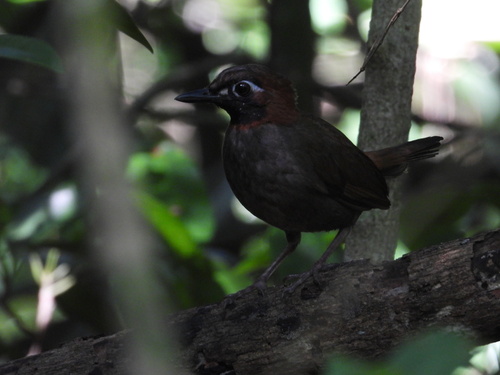 Mexicaanse mierlijster
Kort gezegd
The most reliable field mark between Dusky Antbird and Mayan Antthrush is overall structure and behavior: Dusky Antbird is a small, active, upright percher with a short tail and contrasting white wing/tail markings (especially in males), while Mayan Antthrush is a much larger, heavier, ground-walking bird with a uniform brown and gray plumage and a distinctive black face and throat. In the field, Dusky Antbird often reveals small white tips on the wing coverts and outer tail (especially in males), and is much slimmer and more arboreal. Mayan Antthrush is bulkier, almost thrush-like, with a unique combination of black face, rufous neck sides, and gray underparts, and is almost always seen walking on the forest floor. If you see a bird with a cocked tail and rail-like gait on the ground, it's the antthrush; if it's flitting through low vegetation with a flash of white in the wings or tail, it's the antbird.
Herkenningstips
- Size and bulk: Mayan Antthrush is much larger and heavier than Dusky Antbird. If the bird looks thrush-sized and chunky, it's the antthrush; if it's small and slim, it's the antbird. This is reliable at all ages and seasons.
- Behavior and posture: Antthrush is almost always on the ground, walking with a cocked tail and deliberate gait. Dusky Antbird is usually perched upright in low vegetation, flitting or hopping, rarely on the ground.
- White in wings/tail (Dusky Antbird): Adult male Dusky Antbird shows narrow white tips on wing coverts and outer tail feathers, sometimes visible as small flashes in flight or when perched. Females have cinnamon-edged coverts and a small white scapular patch. Mayan Antthrush never shows white in the wings or tail.
- Face pattern: Mayan Antthrush has a distinctive black face and throat, with rufous sides of the neck and a small white spot on the lores. Dusky Antbird has a plain face, lacking any black mask or throat, and no rufous on the neck.
- Underparts: Dusky Antbird males are pale gray below with a clay tinge; females are tawny-buff with olive flanks. Mayan Antthrush is uniform gray below with a brown wash on the flanks and dull brownish undertail coverts.
- Upperparts: Dusky Antbird males are slate gray above; females are olive-gray with cinnamon-edged coverts. Mayan Antthrush is brown above with a rufescent tinge on the rump and uppertail coverts.
- Iris color: Dusky Antbird has a rich chocolate-brown iris; Mayan Antthrush has a dark brown iris. This is subtle but can help in good light.
- Bare skin around eye: Mayan Antthrush shows bare bluish skin around the eye, a feature not present in Dusky Antbird.
- Bill and legs: Mayan Antthrush has a black bill and gray to bluish legs and feet; Dusky Antbird's bill and leg color is less distinctive in the field.
- Sexual dimorphism: Dusky Antbird is sexually dimorphic (males and females look different), while Mayan Antthrush sexes look alike.
- Flight style: Dusky Antbird is agile and quick in flight, often flicking wings and tail; Mayan Antthrush is heavy and reluctant to fly, usually running or walking away.
- Habitat context: If seen in dense low vegetation above the ground, favor Dusky Antbird; if on the forest floor in mature woodland, favor Mayan Antthrush.
- Geographic range: Outside the Yucatán and adjacent areas, Mayan Antthrush is unlikely; Dusky Antbird is widespread in Central and northern South America.
- Plumage pitfalls: Female Dusky Antbird's olive and tawny tones can be confused with the browns of Mayan Antthrush, but the antthrush always has a black face/throat and lacks any white in the wings/tail.
- Juvenile/immature birds: No distinctive age-specific wing or flight marks are described for either species, so rely on structure, behavior, and face pattern for young birds.
Grootte
Mayan Antthrush is dramatically larger and heavier: 15–19 cm and 56–64 g versus Dusky Antbird's 13–15 cm and 15–19 g. This means the antthrush is not only longer but also about three times as heavy as the antbird, giving it a much more robust, chunky appearance. Dusky Antbird is small and slim, typical of antbirds, while Mayan Antthrush is closer in size and mass to a small thrush, with a noticeably bulkier body and thicker legs.
Verenkleed
- Juvenile/immature wing and flight pattern: No specific juvenile or immature upperwing pattern is described for either species, so this is not a primary separator.
- Adult males Dusky Antbird: Slate gray overall, darker wings and tail, lighter underparts with a clay tinge, and a prominent white scapular patch. Narrow white tips on wing coverts and outer tail feathers are often visible. Females are olive-gray above with cinnamon-edged wing coverts, tawny-buff underparts, and a small white interscapular patch. Both sexes have a chocolate-brown iris.
- Mayan Antthrush (both sexes): Uniform dusky brown crown, black face and throat, rufous sides of neck, brown back and rump with a rufescent tinge, brown flight feathers with a cinnamon band at the base, and a blackish brown tail. Underparts are mostly uniform gray, with brown-washed flanks and dull brownish undertail coverts. Bare bluish skin around the eye and a small white spot on the lores are distinctive. No white in the wings or tail, and no sexual dimorphism in plumage.
- Key contrast: Dusky Antbird (especially males) shows white in the wings/tail and a much plainer, more uniform face; Mayan Antthrush has a striking black face/throat, rufous neck, and no white in the wings/tail.
Gedrag
Dusky Antbird is an active, upright bird that forages in low to mid-level vegetation, often flicking its tail and wings, and sometimes joining mixed flocks. It is rarely seen on the ground. Mayan Antthrush is almost exclusively terrestrial, walking slowly and deliberately with its tail cocked, reminiscent of a rail. The antthrush's movement is heavy and deliberate, while the antbird is quick, agile, and more likely to be seen perching or flitting through dense undergrowth.
Habitat
Dusky Antbird is found from Mexico through much of Central America and into northern South America, occupying a wide range of humid forest and edge habitats, usually in dense undergrowth or thickets. Mayan Antthrush has a more restricted range (Belize, Guatemala, Honduras, and Mexico), and is almost always found in mature forest on or near the ground. If you are in South America or outside the Yucatán region, you are almost certainly seeing Dusky Antbird. Within overlap zones, habitat preference (ground vs. low vegetation) is a strong clue.
Tiranmiervogel · Mexicaanse mierlijster · Mijn lastige vogels