
Havikarend vs Blauwe kiekendief
Aquila fasciata versus Circus cyaneus
Speel een quiz met Havikarend en Blauwe kiekendief
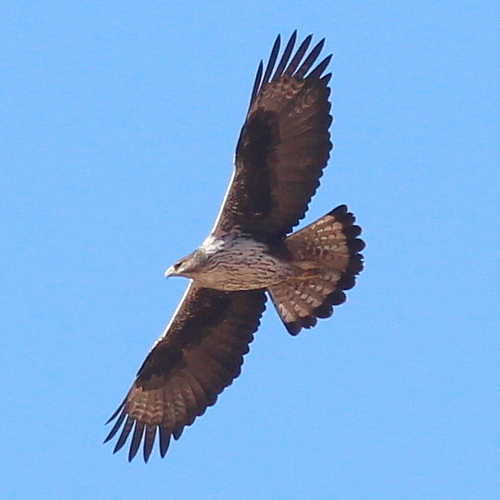 Havikarend
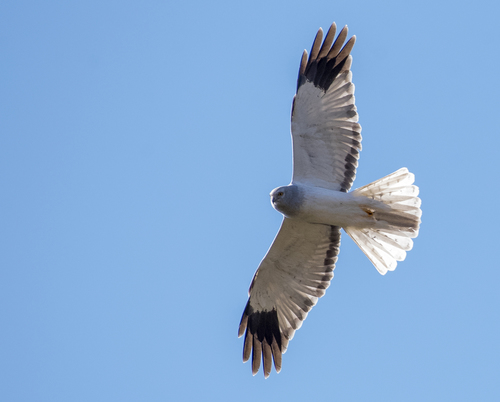 Blauwe kiekendief
Kort gezegd
The most reliable field mark to separate Bonelli's Eagle from Hen Harrier in the field is overall structure and flight style: Bonelli's Eagle is a much heavier, broader-winged raptor with a powerful, direct flight, while Hen Harrier is slender, long-winged, and buoyant, often gliding low with wings held in a shallow V. Juvenile Bonelli's Eagles are warm brown above and below with minimal streaking and lack the striking white rump of Hen Harrier 'ringtails' (females and juveniles). In adults, Bonelli's Eagle shows a dark brown upperwing with a variable white mantle patch and a broad, dark subterminal tail band, while adult male Hen Harrier is pale grey with black wingtips and white underparts. Hen Harrier is much smaller and lighter, and its distinctive hunting behavior—quartering low over open ground—contrasts with the eagle's more soaring, powerful flight. If you see a large raptor with a white rump patch, long tail, and low, buoyant flight, it's a Hen Harrier; a much bulkier bird with a dark upperwing and no white rump is Bonelli's Eagle.
Herkenningstips
- White rump patch: Hen Harrier of all ages and sexes shows a conspicuous white rump patch in flight and at rest; Bonelli's Eagle never shows a white rump at any age.
- Overall size and bulk: Bonelli's Eagle is much larger, heavier, and bulkier than Hen Harrier—if the bird looks eagle-sized, it's not a Hen Harrier.
- Flight style: Hen Harrier flies with long, loose wingbeats, glides low over the ground with wings in a shallow V, and often quarters fields; Bonelli's Eagle has a more powerful, direct flight, soars high, and rarely flies low over open ground.
- Wing shape in flight: Bonelli's Eagle has broad, somewhat square-ended wings with a projecting head; Hen Harrier's wings are long, narrow, and more pointed, giving a buoyant, gliding appearance.
- Tail shape and pattern: Bonelli's Eagle has a long, broad tail with faint barring and a broad, dark subterminal band with a white tip; Hen Harrier's tail is long and slim, with more distinct barring and a white rump above the tail.
- Juvenile plumage: Juvenile Bonelli's Eagle is warm rufous to buff below with minimal streaking, brown above with pale edges, and lacks a white rump; juvenile Hen Harrier is brown above with a white rump and buff underparts with less distinct barring than the female.
- Adult male Hen Harrier: Adult male Hen Harrier is pale grey above, white below, with black wingtips and a white rump—never matched by Bonelli's Eagle.
- Adult Bonelli's Eagle: Adult Bonelli's Eagle is dark brown above with pale feather edges, a variable white mantle patch, and a cream underside with variable dark streaks, especially on the breast; never shows the grey-and-white or brown-and-white pattern of Hen Harrier.
- Sexual dimorphism: Both species are sexually dimorphic, but only Hen Harrier shows a dramatic difference between the grey male and brown female; Bonelli's Eagle female is darker and more heavily marked than the male but both are brown.
- Perched birds: Perched Bonelli's Eagle looks massive, with a large head, thick legs, and a heavy bill; Hen Harrier is slim, long-legged, and lightly built.
- Habitat context: A large raptor soaring over rocky hills or cliffs is more likely Bonelli's Eagle; a medium-sized raptor hunting low over open fields or marshes is almost certainly Hen Harrier.
- Eye color: Adult Bonelli's Eagle has yellow to yellow-orange eyes; juveniles have hazel-brown eyes. Hen Harrier eye color is not described here but is not a primary field mark in this context.
- Vocalizations: Hen Harrier is much more likely to be heard, especially during breeding season and food passes; Bonelli's Eagle is generally silent in the field.
- Group behavior: Bonelli's Eagle often flies in pairs, especially outside the breeding season; Hen Harrier is usually solitary or in loose groups when hunting.
- Pitfalls: Juvenile Bonelli's Eagle may appear paler below and could be mistaken for a female or juvenile Hen Harrier at a distance, but always lacks the white rump and has a much bulkier structure.
Grootte
Bonelli's Eagle is dramatically larger and heavier than Hen Harrier: average body mass is about 2190 g for Bonelli's Eagle versus 436.5 g for Hen Harrier [wikidata]. Bonelli's Eagle is a true large eagle, with a broad, long tail and robust build, while Hen Harrier is a medium-sized raptor with a slim, long-winged, and long-tailed silhouette. Even the largest female Hen Harrier is dwarfed by Bonelli's Eagle. In the field, Bonelli's Eagle appears massive and powerful, while Hen Harrier is light and agile.
Verenkleed
Juvenile and female Hen Harriers ('ringtails') are brown above with a conspicuous white rump patch and buff underparts with brown barring; their underwings are pale with dark secondaries and a contrasting pattern. Juvenile Bonelli's Eagles are medium brown above with paler edges, sometimes a creamy patch on the back (not the mantle), and warm rufous to buff below with minimal streaking, usually only on the chest sides. Crucially, Bonelli's Eagle juveniles lack any white rump patch. Adult Bonelli's Eagles are dark brown above with pale feather edges and a variable white mantle patch; the tail is grey with faint barring and a broad dark subterminal band with a white tip. Adult male Hen Harrier is pale grey above, white below, with black wingtips and a white rump, while adult females remain brown above with the same white rump. In flight, Bonelli's Eagle shows a broad, square-ended wing with a projecting head and a long, broad tail; Hen Harrier's wings are long and narrow, with a more pointed hand and a long, slim tail. The white rump of Hen Harrier is visible at all ages and is never shown by Bonelli's Eagle.
Gedrag
Bonelli's Eagle typically soars or glides on flat or slightly raised wings, often in pairs, with powerful, loose wingbeats and a direct, purposeful flight. It rarely quarters low over the ground. In contrast, Hen Harrier is famous for its low, buoyant, and unhurried flight, gliding close to the ground with wings held in a shallow V, often tilting and banking as it hunts. Hen Harriers are much more likely to be seen hunting over open fields, moors, or marshes, while Bonelli's Eagle is more often seen soaring over hills or rocky terrain.
Habitat
Hen Harrier is a specialist of open habitats—marshes, grasslands, bogs, farmland, and moorland—where it hunts by flying low over the ground. Bonelli's Eagle, while not described in detail here, is generally associated with rocky hills, cliffs, and open woodlands, rarely venturing into the flat, open country preferred by Hen Harrier. Thus, a large raptor seen quartering low over a marsh or moor is almost certainly not Bonelli's Eagle.
Geluid
Hen Harrier is quite vocal, especially during display and food passes, with females giving a whistled 'piih-eh' and an alarm 'chit-it-it-it-it-et-it', while males have a 'chek-chek-chek' and a bouncing 'chuk-uk-uk-uk' in display. No vocalizations are described for Bonelli's Eagle in these notes, and in practice, Bonelli's Eagle is much less vocal and unlikely to be heard in typical field encounters.