

Zwartkoptrogon vs Koperstaarttrogon
Trogon melanocephalus versus Trogon elegans
Speel een quiz met Zwartkoptrogon en Koperstaarttrogon
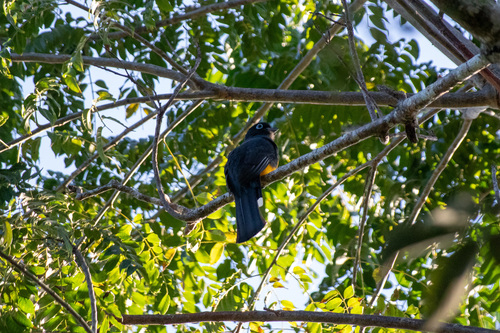 Zwartkoptrogon
 Koperstaarttrogon
Kort gezegd
The fastest way to separate Black-headed Trogon from Elegant Trogon is by underpart color: Black-headed Trogon always shows a bright yellow belly, while Elegant Trogon has a red-orange belly. Both have a dark head and a white chest band, but the tail and upperwing patterns differ, especially in immatures. Watch for the blue bare eye ring on Black-headed Trogon and the coppery or brownish tail of Elegant Trogon. Immature birds can be tricky, but tail and belly color remain reliable.
Herkenningstips
- Belly color is the most consistent field mark: Black-headed Trogon always shows a bright yellow belly (all ages, sexes), while Elegant Trogon has a red-orange belly (males) or duller reddish (females/immatures); never yellow.
- Eye ring color: Black-headed Trogon has a striking sky-blue bare eye ring (all ages), while Elegant Trogon females/immatures have a white eye ring; males lack a prominent colored eye ring.
- Tail pattern (perched or in flight): Black-headed Trogon adults have inner tail feathers metallic green with black tips, outer feathers black with wide white tips. Elegant Trogon shows a brown upper tail and a white undertail with black horizontal bars; no metallic green or extensive white tips.
- Immature tail and wing pattern: Immature Black-headed Trogons have a mostly black tail with limited white and more white on the wings than adults. Immature Elegant Trogons have a brownish tail, white and black-barred undertail, and lack the extensive white seen in Black-headed Trogon immatures.
- Chest band: Both species have a white band across the chest, so this is not a separator.
- Head and throat: Both have a dark (black/slate) head and throat, but Black-headed Trogon is always black/slate, while Elegant Trogon males are dark black and females/immatures are brownish-grey.
- Upperparts: Male Black-headed Trogon is metallic bluish-green to golden-green above; Elegant Trogon male is metallic deep green with a coppery rump. Females of both are duller, but Black-headed Trogon female is dark slate, Elegant Trogon female is brownish-grey.
- Upperwing color: Black-headed Trogon has slate-black wings with some white; Elegant Trogon has grey upperwings.
- Tail shape: Elegant Trogon has a long, square-tipped tail; Black-headed Trogon tail is also long but with a more complex pattern, especially in adults.
- Perched jizz: Both perch upright and motionless, so posture is not a separator.
- Flight: Both are reluctant fliers, but if you see the undertail, Elegant Trogon shows white with black bars, Black-headed Trogon shows black and white with metallic green.
- Vocalization: Elegant Trogon gives a croaking "co-ah co-ah co-ah"; Black-headed Trogon voice not described here, so use with caution.
- Range: If outside Central America, range may help (Elegant Trogon in US Southwest, Black-headed Trogon not).
- Sexual dimorphism: Both show some, but Elegant Trogon is more strongly dimorphic; males are brighter, females/immatures duller.
- Pitfall: Immature Black-headed Trogons can show more white in the wing than adults, which may confuse with Elegant Trogon, but the yellow belly and blue eye ring remain reliable.
Grootte
Both species are similar in length (27–30 cm), but Black-headed Trogon is usually heavier (74–95 g) compared to Elegant Trogon (60–78 g, average 67.3 g). In the field, this weight difference is subtle and not a reliable mark. Both appear as medium-sized, robust trogons.
Verenkleed
-
Immatures: Black-headed Trogon immatures have a mostly black tail with limited white and more white on the wings than adults. Immature females lack black tips on the inner tail feathers and have less white on the tail overall. Elegant Trogon immatures look like duller females, with a brownish-grey tone and a white eye ring; their tail is brown above with a white and black-barred undertail. Immature Elegant Trogons do not show the extensive white in the tail seen in Black-headed Trogon immatures, and their underparts are never yellow.
-
Adults: Black-headed Trogon adults of both sexes have a slate-black to black head, neck, and chest, a sky-blue bare eye ring, a thin white chest band, and a bright yellow belly. Their upperparts are metallic green (males) or dark slate (females), and the tail is complex: inner feathers metallic green with black tips, outer feathers black with wide white tips. Elegant Trogon males have a metallic deep green back, dark black face and throat, a white chest band, and a red-orange lower chest and belly. Their tail is brown above, white below with black horizontal stripes, and their upperwings are grey. Females and immatures are duller but keep the same basic pattern, with a white eye ring and brownish-grey tones. The coppery or brownish upper tail is unique to Elegant Trogon.
Gedrag
Both species perch upright and are reluctant to fly far, typical of trogons. Elegant Trogon is noted for tail-raising displays (dominance, alarm, or mating), and males are more vocal. Both species hunt by sallying from a perch for insects or fruit, and both may hover briefly to pluck berries. These behaviors are not reliably diagnostic between the two.
Habitat
Ranges overlap in Central America, but Black-headed Trogon is found from Mexico to Costa Rica, while Elegant Trogon is native to Central America and reaches the southwestern US. Both use forested habitats, so context is not a strong separator unless you are outside the overlap zone.
Geluid
Elegant Trogon gives a croaking "co-ah co-ah co-ah" and some chattering notes, with males more vocal. No distinctive vocalization is described for Black-headed Trogon in these notes, so voice is not a reliable separator here.