

オウゴンチョウ 対 キゴシオウゴンチョウ
Euplectes afer 対 Euplectes capensis
オウゴンチョウとキゴシオウゴンチョウのクイズ
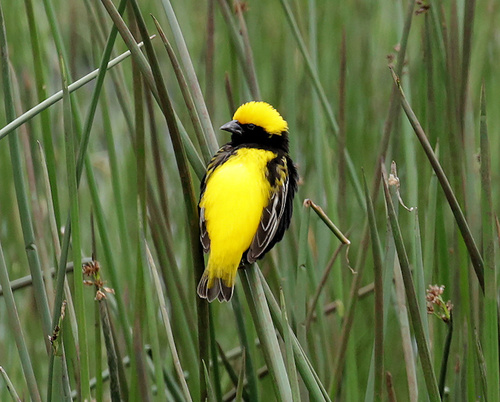 オウゴンチョウ
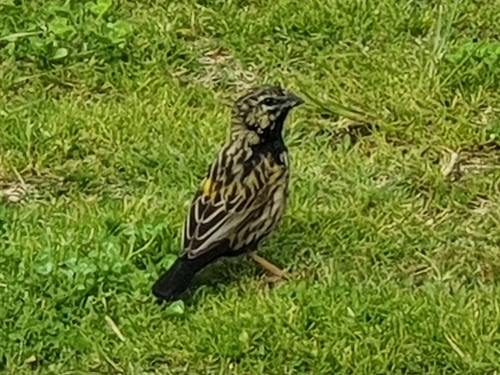 キゴシオウゴンチョウ
要点
The most reliable field mark between Yellow-crowned Bishop and Yellow Bishop is the presence or absence of a yellow crown in adult breeding males: only Yellow-crowned Bishop males show a bright yellow crown and forehead, while Yellow Bishop males have an all-black head. Both species have yellow shoulder and rump patches in breeding plumage, but the Yellow Bishop is much larger and bulkier. Females and non-breeding birds of both species are very similar, but Yellow-crowned Bishop is smaller and has paler, less buffy underparts. Juvenile and non-breeding birds are notoriously difficult to separate, but careful attention to size, crown color, and underpart tone can help.
識別のコツ
- Breeding male crown color: Only Yellow-crowned Bishop males in breeding plumage have a bright yellow crown, forehead, and hindcrown. Yellow Bishop breeding males have an all-black head. This is the single most reliable mark in the field for adult males in breeding condition.
- Yellow rump and shoulder patches: Both species' breeding males show yellow on the rump and shoulder, but Yellow Bishop's yellow is more restricted to the lower back and rump, and never extends to the crown. Yellow-crowned Bishop's yellow extends from the crown down the back.
- Body size and bulk: Yellow Bishop is much larger and bulkier than Yellow-crowned Bishop. Even in poor light or at a distance, the size difference can be apparent if you have a reference point. Use this especially when comparing birds in mixed flocks.
- Bill size and shape: Both have thick, conical bills, but Yellow Bishop's bill is proportionally larger and can appear stubbier, especially in some races. Bill color is black in breeding males of both, but turns pale/horn in non-breeding birds and females.
- Non-breeding and female plumage: Both species become streaky brown above and pale below outside the breeding season, but Yellow-crowned Bishop is smaller and has whiter, less buff underparts, while Yellow Bishop is bulkier with more buffy, heavily streaked underparts. The yellow shoulder and rump patches are retained in non-breeding Yellow Bishop but are much reduced or absent in non-breeding Yellow-crowned Bishop.
- Eyebrow and underpart streaking (females): Female Yellow-crowned Bishop has a paler eyebrow and off-white underparts with fine streaks, while female Yellow Bishop has a less distinct eyebrow and more buffy, heavily streaked underparts.
- Juvenile confusion: Juveniles of both species are very similar and can be nearly impossible to separate in the field without size comparison or context. If you see a small, pale-bellied, streaky bishop in a flock, lean toward Yellow-crowned Bishop; if it is larger and buffier, consider Yellow Bishop.
- Flight jizz: No distinctive wing patterns are described for either species in juvenile or non-breeding plumage, so rely on size, flock structure, and habitat.
- Tail and crest: Yellow Bishop breeding males have a short crest and relatively short tail, which can give them a stocky, round-headed appearance. Yellow-crowned Bishop lacks a crest and appears more compact.
- Habitat context: In open, weedy, or agricultural areas, especially near water, expect Yellow-crowned Bishop. In lush, montane, or fynbos habitats, especially at higher elevations, Yellow Bishop is more likely.
- Seasonal context: Breeding plumage is the best time for separation; outside the breeding season, identification is much more difficult and often relies on subtle size and underpart tone differences.
- Mixed flocks: In mixed Euplectes flocks, use size and any remaining yellow patches to separate non-breeding Yellow Bishop from Yellow-crowned Bishop, but expect overlap and uncertainty.
- Bill color in non-breeding birds: Both species' bills become pale/horn-colored outside the breeding season, so this is not a reliable separator then.
- Do not rely on voice: No distinctive vocal differences are described in the sources for field separation.
- When in doubt: If you cannot see the crown color or judge size, and the bird is not in breeding plumage, identification may not be possible to species in the field.
大きさ
Yellow Bishop is significantly larger and heavier than Yellow-crowned Bishop, with an average body mass of about 34 g compared to 14.5 g for Yellow-crowned Bishop. The Yellow Bishop is also longer (about 15 cm vs. 9.5–10.5 cm for Yellow-crowned Bishop), appearing stockier and more robust in the field. This size difference is often noticeable when the two species are seen side by side or with familiar reference species.
羽色
- Juvenile and non-breeding plumage (both sexes): Both species are streaky brown above with pale underparts, but Yellow-crowned Bishop is smaller and has whiter, less buff underparts, while Yellow Bishop is bulkier with more buffy, heavily streaked underparts. Both lack obvious yellow on the crown or head. The yellow shoulder and rump patches may persist in non-breeding Yellow Bishop, but are much reduced or absent in non-breeding Yellow-crowned Bishop.
- Adult breeding male: Yellow-crowned Bishop shows a striking yellow crown, forehead, and hindcrown, with a black face, throat, breast, and belly, and yellow shoulder, rump, and back. The wings and tail are brown. Yellow Bishop breeding males are black overall except for bright yellow lower back, rump, and shoulder patches, and brown-edged wing feathers; their head is entirely black with no yellow crown. Bill color is black in both during breeding, but Yellow-crowned Bishop males switch to a horn-colored bill outside breeding.
- Females: Both are brown and streaky, but Yellow-crowned Bishop females are smaller, with paler eyebrows and off-white underparts with fine streaks, while Yellow Bishop females are bulkier, more buffy below, and lack yellow patches.
行動
Yellow Bishop is generally more solitary or found in pairs during the breeding season, but becomes gregarious and forms mixed flocks with other Euplectes species outside the breeding season. Yellow-crowned Bishop is also gregarious, especially outside the breeding season, and can be found in flocks in grasslands and agricultural fields. Both species feed mainly on seeds and insects, but Yellow-crowned Bishop is more likely to be seen in open weedy or agricultural habitats.
生息環境
Yellow-crowned Bishop prefers open grasslands, wetlands, and agricultural fields (especially wheat and sorghum), often near water. Yellow Bishop is more associated with less arid, vegetated habitats such as fynbos, moist grassland, and bracken-covered valleys, often at higher altitudes but also from sea level to highlands. If you see a bishop in a dry, open, or cultivated area, Yellow-crowned Bishop is more likely; in lush, montane, or fynbos habitats, Yellow Bishop is favored.
オウゴンチョウ · キゴシオウゴンチョウ · 苦手な鳥