

Motmot

セイケイ 対 ヒメクイナ

Porphyrio porphyrio 対 Zapornia pusilla

セイケイとヒメクイナのクイズ
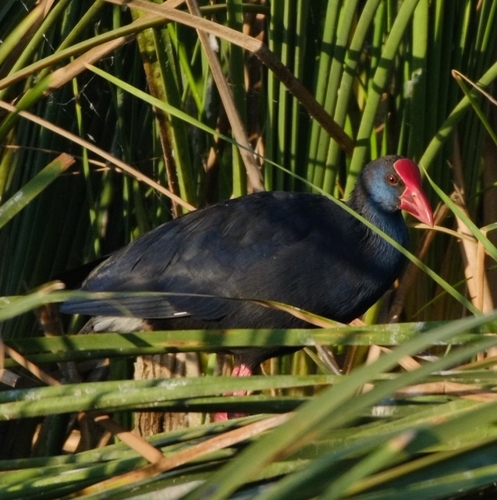
セイケイ (Porphyrio porphyrio) セイケイ
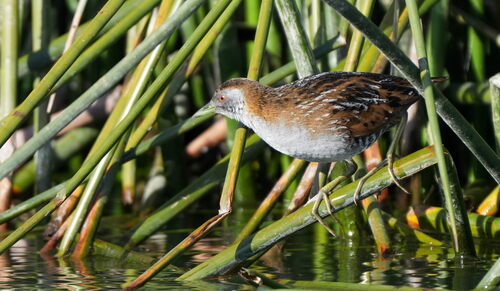
ヒメクイナ (Zapornia pusilla) ヒメクイナ

メディア

読み込み中…

要点

The most reliable field mark separating Western Swamphen from Baillon's Crake is overall size and structure: Western Swamphen is a large, chicken-sized bird with massive feet and a thick red bill, while Baillon's Crake is tiny, delicate, and short-billed. In any view, the swamphen's vivid blue and purple plumage, red bill and shield, and bulk stand out against the crake's brown upperparts, grey underparts, and greenish bill. Juvenile Baillon's Crakes have barred, duller underparts, but never approach the swamphen's brightness or size. Even in poor views or flight, the huge size gap and contrasting structure are unmistakable.

識別のコツ

  1. Size is the first check: If the bird is chicken-sized or larger than a moorhen, it is a Western Swamphen. If it is tiny, sparrow-sized, and delicate, it is Baillon's Crake. This works for all ages and seasons.
  2. Bill and shield: Swamphen has a thick, deep, bright red bill with a prominent red frontal shield; Baillon's Crake has a short, straight, yellow or green bill with no shield or red at the base. This is diagnostic at any age.
  3. Legs and feet: Swamphen's legs are long and thick with huge feet, often visible even in dense vegetation. Baillon's Crake has olive-green legs, long toes, but much finer and more delicate than the swamphen.
  4. Plumage color: Swamphen is bright blue to purple all over, never brown or ochre. Baillon's Crake is brown above, blue-grey below, with black-and-white barring on the flanks and undertail. This contrast is reliable for all ages.
  5. Flank and undertail pattern: Baillon's Crake (all ages) shows bold black-and-white barring on the flanks and undertail; swamphen never shows barring in these areas.
  6. Juvenile/immature marks: Young Baillon's Crakes have duller, more extensively barred underparts, but still lack any blue or purple. Swamphen juveniles are still large and structurally obvious.
  7. In flight: Swamphen appears large, slow, and heavy with broad wings; Baillon's Crake is quick, fluttery, and compact. No distinctive upperwing patterns are described for either, but size and shape are unmistakable.
  8. Habitat context: Swamphen is often in open, sometimes human-modified wetlands (including rice fields), and may be seen walking in the open. Baillon's Crake prefers dense reeds and is rarely seen in the open except on migration.
  9. Behavior: Swamphen is bold and often visible; Baillon's Crake is secretive, more often heard than seen, and usually glimpsed briefly or flushed.
  10. Vocalization: If you hear a rattling, frog-like or garganey-like call from dense reeds, suspect Baillon's Crake. Swamphen's calls are not similar and are less likely to be heard.
  11. Group context: Swamphens may be seen in small groups, especially in open habitat; Baillon's Crake is usually solitary or in loose association with other small rails.
  12. Confusion risk: There is no realistic confusion in size or structure, even in poor light or partial views. If you see a bird that looks remotely like a chicken, it's a swamphen; if it is tiny and skulking, it's a crake.
  13. Bill color in poor light: If the bill looks red, it's a swamphen; if it is yellow or greenish and lacks a shield, it's a crake.
  14. Seasonal context: Baillon's Crake is easiest to see on migration or wintering; swamphen may be present year-round in its range.
  15. When in doubt, trust size and structure: Even if plumage is obscured, the bulk and proportions of swamphen versus the daintiness of Baillon's Crake are always reliable.

大きさ

Western Swamphen is dramatically larger: it is chicken-sized, towering over Baillon's Crake, which is among the smallest rails at only about 35 grams [wikidata]. The swamphen's bulk, long legs, and massive feet are obvious even at a distance, while Baillon's Crake is petite, with fine, olive-green legs and long toes but a much lighter build. The bill of Western Swamphen is thick, deep, and bright red with a prominent frontal shield; Baillon's Crake has a short, straight, yellow or green bill, lacking any red base or shield. In direct comparison, there is no overlap in size or structure.

羽色

No matter the age or season, Western Swamphen is bright and unmistakable: adults are vivid blue to purple with a red bill and shield, while Baillon's Crake is much duller. Adult Baillon's Crakes have ochre-brown upperparts with some black and white streaks, light blue-grey underparts, and bold black-and-white barring on the flanks and undertail. Immature Baillon's Crakes are even duller, with more extensive barring below, but still lack any blue or purple tones. Western Swamphen never shows barring on the flanks or undertail, and its plumage is consistently bright, with no brown or ochre tones. In flight, the swamphen's large, broad wings and blue upperparts contrast with the crake's small, brownish wings and compact shape. There are no age-specific upperwing patterns in either species that are diagnostic for separation.

行動

Western Swamphen is often seen striding boldly in open wetlands or even in rice fields, using its massive feet to walk atop floating vegetation. It can be conspicuous, especially in areas where protected. Baillon's Crake is extremely secretive, especially during breeding season, and is more often heard than seen. It typically creeps through dense reeds and is rarely seen in the open except during migration or winter. Swamphens may be seen swimming, but crakes are more likely to be seen probing mud or shallow water with their bill.

生息環境

Both species are associated with wetlands, but Western Swamphen favors larger, open marshes, reedbeds, and even human-managed habitats like paddy fields, where it can be locally common and sometimes problematic for farmers. Baillon's Crake prefers dense, reedy marshes and is much more secretive, often remaining hidden in thick cover. Swamphen is more likely to be seen in the open, while crake is usually glimpsed briefly or flushed from cover.

声

Baillon's Crake is most often detected by its call, a rattling, frog-like or garganey-like sound, especially during the breeding season. Western Swamphen is not described as particularly vocal in the provided notes, but its calls are not similar to the crake's distinctive rattle. In practice, hearing a rattling call in dense reeds is a strong clue for Baillon's Crake, while swamphens are more likely to be seen than heard.

より良い説明を送る

比較と同じ項目を使ってください。文章はすぐに公開されます。

The most reliable field mark separating Western Swamphen from Baillon's Crake is overall size and structure: Western Swamphen is a large, chicken-sized bird with massive feet and a thick red bill, while Baillon's Crake is tiny, delicate, and short-billed. In any view, the swamphen's vivid blue and purple plumage, red bill and shield, and bulk stand out against the crake's brown upperparts, grey underparts, and greenish bill. Juvenile Baillon's Crakes have barred, duller underparts, but never approach the swamphen's brightness or size. Even in poor views or flight, the huge size gap and contrasting structure are unmistakable.

  1. Size is the first check: If the bird is chicken-sized or larger than a moorhen, it is a Western Swamphen. If it is tiny, sparrow-sized, and delicate, it is Baillon's Crake. This works for all ages and seasons.
  2. Bill and shield: Swamphen has a thick, deep, bright red bill with a prominent red frontal shield; Baillon's Crake has a short, straight, yellow or green bill with no shield or red at the base. This is diagnostic at any age.
  3. Legs and feet: Swamphen's legs are long and thick with huge feet, often visible even in dense vegetation. Baillon's Crake has olive-green legs, long toes, but much finer and more delicate than the swamphen.
  4. Plumage color: Swamphen is bright blue to purple all over, never brown or ochre. Baillon's Crake is brown above, blue-grey below, with black-and-white barring on the flanks and undertail. This contrast is reliable for all ages.
  5. Flank and undertail pattern: Baillon's Crake (all ages) shows bold black-and-white barring on the flanks and undertail; swamphen never shows barring in these areas.
  6. Juvenile/immature marks: Young Baillon's Crakes have duller, more extensively barred underparts, but still lack any blue or purple. Swamphen juveniles are still large and structurally obvious.
  7. In flight: Swamphen appears large, slow, and heavy with broad wings; Baillon's Crake is quick, fluttery, and compact. No distinctive upperwing patterns are described for either, but size and shape are unmistakable.
  8. Habitat context: Swamphen is often in open, sometimes human-modified wetlands (including rice fields), and may be seen walking in the open. Baillon's Crake prefers dense reeds and is rarely seen in the open except on migration.
  9. Behavior: Swamphen is bold and often visible; Baillon's Crake is secretive, more often heard than seen, and usually glimpsed briefly or flushed.
  10. Vocalization: If you hear a rattling, frog-like or garganey-like call from dense reeds, suspect Baillon's Crake. Swamphen's calls are not similar and are less likely to be heard.
  11. Group context: Swamphens may be seen in small groups, especially in open habitat; Baillon's Crake is usually solitary or in loose association with other small rails.
  12. Confusion risk: There is no realistic confusion in size or structure, even in poor light or partial views. If you see a bird that looks remotely like a chicken, it's a swamphen; if it is tiny and skulking, it's a crake.
  13. Bill color in poor light: If the bill looks red, it's a swamphen; if it is yellow or greenish and lacks a shield, it's a crake.
  14. Seasonal context: Baillon's Crake is easiest to see on migration or wintering; swamphen may be present year-round in its range.
  15. When in doubt, trust size and structure: Even if plumage is obscured, the bulk and proportions of swamphen versus the daintiness of Baillon's Crake are always reliable.

Western Swamphen is dramatically larger: it is chicken-sized, towering over Baillon's Crake, which is among the smallest rails at only about 35 grams [wikidata]. The swamphen's bulk, long legs, and massive feet are obvious even at a distance, while Baillon's Crake is petite, with fine, olive-green legs and long toes but a much lighter build. The bill of Western Swamphen is thick, deep, and bright red with a prominent frontal shield; Baillon's Crake has a short, straight, yellow or green bill, lacking any red base or shield. In direct comparison, there is no overlap in size or structure.

No matter the age or season, Western Swamphen is bright and unmistakable: adults are vivid blue to purple with a red bill and shield, while Baillon's Crake is much duller. Adult Baillon's Crakes have ochre-brown upperparts with some black and white streaks, light blue-grey underparts, and bold black-and-white barring on the flanks and undertail. Immature Baillon's Crakes are even duller, with more extensive barring below, but still lack any blue or purple tones. Western Swamphen never shows barring on the flanks or undertail, and its plumage is consistently bright, with no brown or ochre tones. In flight, the swamphen's large, broad wings and blue upperparts contrast with the crake's small, brownish wings and compact shape. There are no age-specific upperwing patterns in either species that are diagnostic for separation.

Western Swamphen is often seen striding boldly in open wetlands or even in rice fields, using its massive feet to walk atop floating vegetation. It can be conspicuous, especially in areas where protected. Baillon's Crake is extremely secretive, especially during breeding season, and is more often heard than seen. It typically creeps through dense reeds and is rarely seen in the open except during migration or winter. Swamphens may be seen swimming, but crakes are more likely to be seen probing mud or shallow water with their bill.

Both species are associated with wetlands, but Western Swamphen favors larger, open marshes, reedbeds, and even human-managed habitats like paddy fields, where it can be locally common and sometimes problematic for farmers. Baillon's Crake prefers dense, reedy marshes and is much more secretive, often remaining hidden in thick cover. Swamphen is more likely to be seen in the open, while crake is usually glimpsed briefly or flushed from cover.

Baillon's Crake is most often detected by its call, a rattling, frog-like or garganey-like sound, especially during the breeding season. Western Swamphen is not described as particularly vocal in the provided notes, but its calls are not similar to the crake's distinctive rattle. In practice, hearing a rattling call in dense reeds is a strong clue for Baillon's Crake, while swamphens are more likely to be seen than heard.

変更を破棄しますか?

保存していない編集があります。今離れると失われます。

セイケイ · ヒメクイナ · 苦手な鳥