

Motmot

ヨーロッパビンズイ 対 セジロタヒバリ

Anthus trivialis 対 Anthus gustavi

ヨーロッパビンズイとセジロタヒバリのクイズ
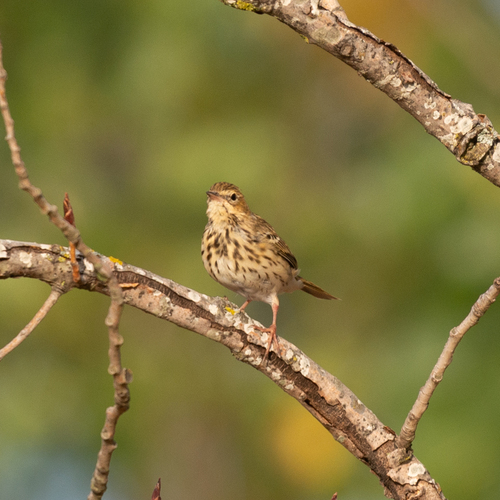
ヨーロッパビンズイ (Anthus trivialis) ヨーロッパビンズイ
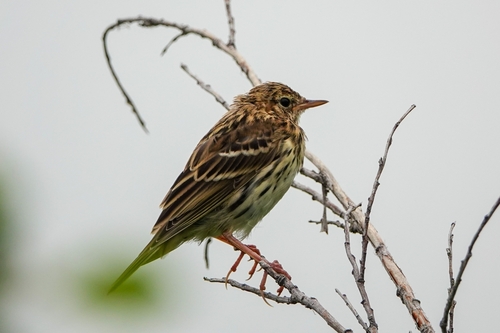
セジロタヒバリ (Anthus gustavi) セジロタヒバリ

メディア

読み込み中…

要点

The most reliable field mark between Tree Pipit and Pechora Pipit is the overall structure and behavior: Tree Pipit is heavier-billed, more likely to perch in trees, and shows a stronger contrast between its buff breast and white belly. Pechora Pipit is smaller, more heavily streaked above with distinctive whitish mantle stripes, and is extremely skulking, creeping through dense grass and rarely flying. In the field, Tree Pipit often sings from exposed perches or in parachuting song flights, while Pechora Pipit is secretive and difficult to flush. Voice is also a strong separator: Tree Pipit gives a strong 'spek' call, Pechora Pipit a rarely-heard, electrical 'zip'.

識別のコツ

  1. Mantle stripes: Pechora Pipit has bold whitish mantle stripes on the back, creating a strong contrast with the brown upperparts. Tree Pipit lacks these pale mantle stripes and is more uniformly streaked above. This is the single best plumage mark on perched birds of any age.
  2. Breast and belly contrast: Tree Pipit shows a sharper contrast between its buff breast and white belly, while Pechora Pipit’s underparts are more evenly toned, though both have streaked buff breasts.
  3. Upperpart streaking: Pechora Pipit is more heavily streaked above, giving a more patterned appearance, while Tree Pipit is plainer on the upperparts.
  4. Bill structure: Tree Pipit has a heavier, more robust bill, which can be seen well on perched birds. Pechora Pipit’s bill is finer and more delicate.
  5. Size and bulk: Tree Pipit is heavier and appears bulkier, especially around the chest and bill. Pechora Pipit is smaller and more delicate, but this is subtle and best used in direct comparison or with experience.
  6. Perching behavior: Tree Pipit frequently perches in trees or on exposed branches, often singing from high perches. Pechora Pipit almost never perches in the open and is rarely seen above ground vegetation.
  7. Song flight: Tree Pipit performs a distinctive parachuting song flight, rising from a tree and descending with stiff wings while singing. Pechora Pipit does not display this behavior.
  8. Skulking habits: Pechora Pipit is extremely skulking, creeping through dense grass and rarely flying even when disturbed. Tree Pipit is much more visible and confiding.
  9. Habitat: Tree Pipit is found in open woodland, woodland edges, and areas with scattered trees and low scrub. Pechora Pipit prefers dense, damp grass, tundra, or marshy ground, and is rarely seen in trees or open areas.
  10. Vocalizations: Tree Pipit gives a strong 'spek' call and a distinctive song flight. Pechora Pipit calls infrequently, but when heard, gives a sharp, electrical 'zip'.
  11. Flight views: No distinctive upperwing or flight pattern marks are described for either species in the available notes, so identification in flight relies on structure, behavior, and call.
  12. Pitfalls: Pechora Pipit can resemble non-breeding Red-throated Pipit, but compared to Tree Pipit, always shows bolder mantle stripes and heavier upperpart streaking. Tree Pipit may be confused with Meadow Pipit, but is bulkier and more contrasty below.
  13. Seasonal context: In western Europe, Pechora Pipit is a rare vagrant, usually found in autumn in dense grassy areas, especially on islands like Fair Isle. Tree Pipit is a common breeder in suitable woodland habitats.
  14. Sex differences: No sex-specific differences are described for either species in the notes; all field marks apply to both sexes.
  15. Age differences: No age-specific upperwing or flight pattern marks are noted; mantle stripes and upperpart streaking are present in all ages for Pechora Pipit and are diagnostic.

大きさ

Tree Pipit is noticeably heavier (23.5g vs 19.8g) and appears slightly larger and more robust, with a heavier bill. Pechora Pipit is smaller, lighter, and more delicate overall. These differences are subtle in the field, but Tree Pipit often looks bulkier, especially around the bill and chest.

羽色

Both species are brown, streaked pipits with buffy underparts and white bellies, but Pechora Pipit is more heavily streaked above, with prominent whitish mantle stripes that stand out against the brown upperparts. Tree Pipit is less boldly marked above, with more uniform brown streaking. Both have buff breasts with blackish streaks and white bellies, but Tree Pipit shows a sharper contrast between the buff breast and white belly. In all plumages, Pechora Pipit’s mantle stripes are a key separator. No age-specific upperwing or flight pattern marks are described for either species in the notes, so focus on ground and perched views. Both have similar underpart streaking, but Pechora Pipit can resemble a non-breeding Red-throated Pipit, which may cause confusion.

行動

Tree Pipit is much more likely to perch openly, especially in trees or on exposed branches, and is frequently seen performing its parachuting song flight. Pechora Pipit is extremely skulking, creeping mouse-like through dense grass or low vegetation, and is very reluctant to fly, often remaining hidden even when disturbed. If flushed, Pechora Pipit quickly drops back into cover. Tree Pipit is more confiding and visible, especially during the breeding season.

生息環境

Tree Pipit prefers open woodland, woodland edges, and areas with scattered trees and low scrub, often near grass and bracken mosaics but not in heavily grazed short turf. Pechora Pipit breeds in damp tundra, dense grassy riverbanks, open forest, or marshland, and as a vagrant in western Europe, is usually found in long grass or dense ground cover. In migration or vagrancy, Pechora Pipit is almost always in dense, wet, or grassy habitats, rarely in open woodland or trees.

声

Tree Pipit gives a strong, clear 'spek' call, which is much bolder than the weak calls of Meadow Pipit. Its song is a distinctive, drawn-out sequence delivered during a parachuting flight from a tree. Pechora Pipit calls infrequently, but when heard, the call is a sharp, electrical 'zip', quite unlike Tree Pipit’s call. Pechora Pipit’s secretive habits mean it is often silent and hard to detect by voice.

より良い説明を送る

比較と同じ項目を使ってください。文章はすぐに公開されます。

The most reliable field mark between Tree Pipit and Pechora Pipit is the overall structure and behavior: Tree Pipit is heavier-billed, more likely to perch in trees, and shows a stronger contrast between its buff breast and white belly. Pechora Pipit is smaller, more heavily streaked above with distinctive whitish mantle stripes, and is extremely skulking, creeping through dense grass and rarely flying. In the field, Tree Pipit often sings from exposed perches or in parachuting song flights, while Pechora Pipit is secretive and difficult to flush. Voice is also a strong separator: Tree Pipit gives a strong 'spek' call, Pechora Pipit a rarely-heard, electrical 'zip'.

  1. Mantle stripes: Pechora Pipit has bold whitish mantle stripes on the back, creating a strong contrast with the brown upperparts. Tree Pipit lacks these pale mantle stripes and is more uniformly streaked above. This is the single best plumage mark on perched birds of any age.
  2. Breast and belly contrast: Tree Pipit shows a sharper contrast between its buff breast and white belly, while Pechora Pipit’s underparts are more evenly toned, though both have streaked buff breasts.
  3. Upperpart streaking: Pechora Pipit is more heavily streaked above, giving a more patterned appearance, while Tree Pipit is plainer on the upperparts.
  4. Bill structure: Tree Pipit has a heavier, more robust bill, which can be seen well on perched birds. Pechora Pipit’s bill is finer and more delicate.
  5. Size and bulk: Tree Pipit is heavier and appears bulkier, especially around the chest and bill. Pechora Pipit is smaller and more delicate, but this is subtle and best used in direct comparison or with experience.
  6. Perching behavior: Tree Pipit frequently perches in trees or on exposed branches, often singing from high perches. Pechora Pipit almost never perches in the open and is rarely seen above ground vegetation.
  7. Song flight: Tree Pipit performs a distinctive parachuting song flight, rising from a tree and descending with stiff wings while singing. Pechora Pipit does not display this behavior.
  8. Skulking habits: Pechora Pipit is extremely skulking, creeping through dense grass and rarely flying even when disturbed. Tree Pipit is much more visible and confiding.
  9. Habitat: Tree Pipit is found in open woodland, woodland edges, and areas with scattered trees and low scrub. Pechora Pipit prefers dense, damp grass, tundra, or marshy ground, and is rarely seen in trees or open areas.
  10. Vocalizations: Tree Pipit gives a strong 'spek' call and a distinctive song flight. Pechora Pipit calls infrequently, but when heard, gives a sharp, electrical 'zip'.
  11. Flight views: No distinctive upperwing or flight pattern marks are described for either species in the available notes, so identification in flight relies on structure, behavior, and call.
  12. Pitfalls: Pechora Pipit can resemble non-breeding Red-throated Pipit, but compared to Tree Pipit, always shows bolder mantle stripes and heavier upperpart streaking. Tree Pipit may be confused with Meadow Pipit, but is bulkier and more contrasty below.
  13. Seasonal context: In western Europe, Pechora Pipit is a rare vagrant, usually found in autumn in dense grassy areas, especially on islands like Fair Isle. Tree Pipit is a common breeder in suitable woodland habitats.
  14. Sex differences: No sex-specific differences are described for either species in the notes; all field marks apply to both sexes.
  15. Age differences: No age-specific upperwing or flight pattern marks are noted; mantle stripes and upperpart streaking are present in all ages for Pechora Pipit and are diagnostic.

Tree Pipit is noticeably heavier (23.5g vs 19.8g) and appears slightly larger and more robust, with a heavier bill. Pechora Pipit is smaller, lighter, and more delicate overall. These differences are subtle in the field, but Tree Pipit often looks bulkier, especially around the bill and chest.

Both species are brown, streaked pipits with buffy underparts and white bellies, but Pechora Pipit is more heavily streaked above, with prominent whitish mantle stripes that stand out against the brown upperparts. Tree Pipit is less boldly marked above, with more uniform brown streaking. Both have buff breasts with blackish streaks and white bellies, but Tree Pipit shows a sharper contrast between the buff breast and white belly. In all plumages, Pechora Pipit’s mantle stripes are a key separator. No age-specific upperwing or flight pattern marks are described for either species in the notes, so focus on ground and perched views. Both have similar underpart streaking, but Pechora Pipit can resemble a non-breeding Red-throated Pipit, which may cause confusion.

Tree Pipit is much more likely to perch openly, especially in trees or on exposed branches, and is frequently seen performing its parachuting song flight. Pechora Pipit is extremely skulking, creeping mouse-like through dense grass or low vegetation, and is very reluctant to fly, often remaining hidden even when disturbed. If flushed, Pechora Pipit quickly drops back into cover. Tree Pipit is more confiding and visible, especially during the breeding season.

Tree Pipit prefers open woodland, woodland edges, and areas with scattered trees and low scrub, often near grass and bracken mosaics but not in heavily grazed short turf. Pechora Pipit breeds in damp tundra, dense grassy riverbanks, open forest, or marshland, and as a vagrant in western Europe, is usually found in long grass or dense ground cover. In migration or vagrancy, Pechora Pipit is almost always in dense, wet, or grassy habitats, rarely in open woodland or trees.

Tree Pipit gives a strong, clear 'spek' call, which is much bolder than the weak calls of Meadow Pipit. Its song is a distinctive, drawn-out sequence delivered during a parachuting flight from a tree. Pechora Pipit calls infrequently, but when heard, the call is a sharp, electrical 'zip', quite unlike Tree Pipit’s call. Pechora Pipit’s secretive habits mean it is often silent and hard to detect by voice.

変更を破棄しますか?

保存していない編集があります。今離れると失われます。

ヨーロッパビンズイ · セジロタヒバリ · 苦手な鳥