

ヒメモリバト 対 モリバト
Columba oenas 対 Columba palumbus
ヒメモリバトとモリバトのクイズ
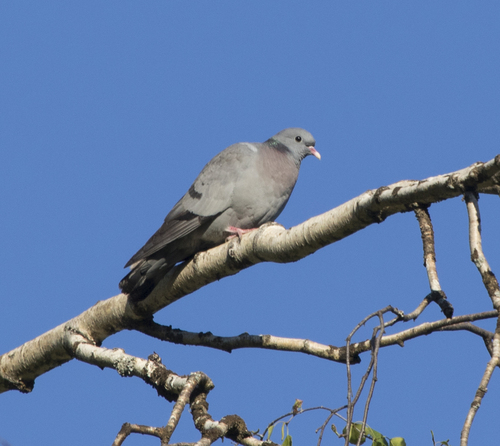 ヒメモリバト
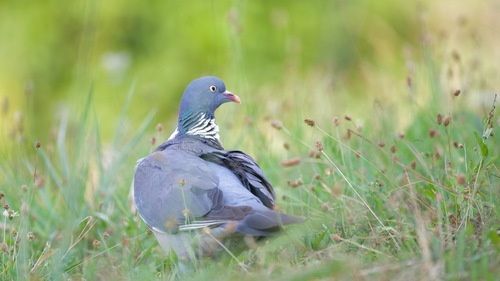 モリバト
要点
The most reliable field mark to separate Stock Dove from Common Woodpigeon is the presence of bold white patches on the neck and wing of adult Woodpigeons, which are completely absent in Stock Doves of any age. In flight, Stock Doves show a uniform grey upperwing with two short, incomplete dark bars and a dark trailing edge, while Woodpigeons display a broad white wing band and no trailing edge. Juvenile Woodpigeons lack the neck and wing white, but remain much larger and have pale yellow eyes, unlike the Stock Dove's dark eye. Structure and size also help: Woodpigeon is noticeably bulkier and longer-winged. Voice is distinct if heard, but visual marks are usually enough.
識別のコツ
- White neck and wing patches (adults): Only Woodpigeon shows large white patches on the neck and a broad white band on the upperwing. Stock Dove never shows white in these areas at any age.
- Upperwing in flight (all ages): Stock Dove has two short, incomplete dark bars on the upperwing coverts and a dark trailing edge; Woodpigeon shows a bold white wing band and lacks a trailing edge. This is diagnostic in flight.
- Eye color (all ages): Stock Dove has a dark eye; Woodpigeon has a pale yellow eye, even in juveniles. This is a reliable close-range mark.
- Size and structure: Woodpigeon is much larger, bulkier, and longer-winged. When seen together, the difference is obvious. Alone, use the more compact, shorter-tailed look of Stock Dove.
- Neck iridescence: Stock Dove shows a green or purple iridescent patch on the neck (adults only), but never white. Juveniles lack the iridescence. Woodpigeon has a green and white neck patch (adults), but no iridescence in the same way.
- Rump color: Both have grey rumps (not white as in Rock Dove), so this is not diagnostic between these two.
- Bill color: Stock Dove has a pink bill with a yellow tip; Woodpigeon has a slightly longer, pale bill. This is subtle but can help at close range.
- Juvenile confusion: Juvenile Woodpigeons lack the white neck and wing patches, but are still larger, paler grey, and have a pale yellow eye. Juvenile Stock Doves are uniform blue-grey with dark eyes and lack neck iridescence.
- Tail band: Both show a broad dark tail band, but Woodpigeon's tail is longer and more graduated.
- Underwing: Stock Dove has a dark grey underwing; Woodpigeon is paler below, but this is subtle in the field.
- Voice: Stock Dove gives a short, deep grunt; Woodpigeon has a long, modulated coo. If heard, this is diagnostic.
- Flock size and context: Large flocks in open fields are usually Woodpigeon; Stock Dove is more often in small groups or alone, especially at woodland edge.
- Perched jizz: Woodpigeon looks heavier, with a deeper chest and longer neck; Stock Dove is more compact and upright.
- Seasonal marks: In late summer/autumn, juvenile Woodpigeons may lack white neck/wing, but eye color and size still separate them from Stock Dove.
- Display flight: Both species perform display flights with wing cracks, but Woodpigeon is more likely to be seen high over open ground, Stock Dove lower and closer to woodland.
大きさ
Common Woodpigeon is substantially larger: 38–44.5 cm in length and 300–615 g in weight, with a wingspan of 68–80 cm. Stock Dove is smaller and more compact, measuring 28–34 cm and 286–365 g (females slightly lighter), with a wingspan of 60–66 cm. In the field, Woodpigeon appears bulkier, longer-tailed, and longer-winged, often dwarfing Stock Dove when seen together. Bill and tarsus are also proportionally longer in Woodpigeon.
羽色
-
Juveniles: Juvenile Stock Doves lack the iridescent neck patch but otherwise resemble adults, with uniform blue-grey plumage, two short dark bars on the upperwing, and a grey rump. Juvenile Woodpigeons are overall paler grey, lack the adult's white neck and wing patches, and have a greyer bill; their eye is already pale yellow, unlike the Stock Dove's dark eye. As Woodpigeons age (6–8 months), small white neck patches develop.
-
Adults: Stock Dove adults have a blue-grey body, two short dark bars on the upperwing (not extending across the whole wing), a broad dark tail band, and an iridescent green or purple neck patch (no white). Woodpigeon adults are grey with a pinkish breast, large white patches on the neck and a broad white band on the upperwing (very obvious in flight), and a pale yellow eye. The rump is grey in Stock Dove, not white as in Rock Dove, and Woodpigeon also has a grey rump. Underwing is dark grey in Stock Dove, but Woodpigeon shows a paler underwing.
-
In flight: Stock Dove shows a uniform grey upperwing with two short, incomplete bars and a dark trailing edge; Woodpigeon shows a broad white wing band and lacks the trailing edge. Both have a broad dark tail band, but Woodpigeon is longer-winged and heavier in flight.
行動
Both species perch well and display typical pigeon flight with quick, regular wingbeats and occasional sharp flicks. Both perform nuptial displays with swelled necks and fanned tails. Woodpigeon is more gregarious, often forming large flocks outside the breeding season, and is more likely to be seen in open agricultural areas or urban parks. Stock Dove is less conspicuous, often seen singly or in small groups, and its display flight includes sharp wing cracks. Both species take off with a clatter, but Woodpigeon is more likely to be heard before seen due to its loud calls.
生息環境
Stock Dove prefers open woodlands, parkland, and farmland with access to old trees or cliffs for nesting, often favoring hollow trees. Woodpigeon is more adaptable, common in woodlands, parks, gardens, farmland, and even urban areas, often near roads and rivers. In mixed flocks, Woodpigeon dominates open fields, while Stock Dove is more likely at woodland edges or quieter farmland.
声
Stock Dove has a short, deep, grunting 'Ooo-uu-ooh' call, quite distinct from the Woodpigeon's more modulated, repeated cooing. Woodpigeon calls are louder and more drawn out, often heard before the bird is seen. If you hear a deep, short grunt, suspect Stock Dove; if you hear a classic, rhythmic coo, it's likely Woodpigeon.