

オウチュウカッコウ 対 インドシナジュウイチ
Surniculus lugubris 対 Hierococcyx nisicolor
オウチュウカッコウとインドシナジュウイチのクイズ
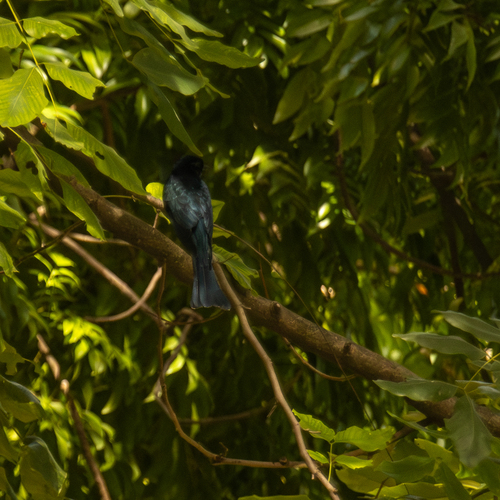 オウチュウカッコウ
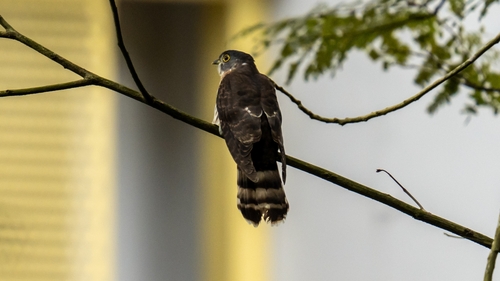 インドシナジュウイチ
要点
The most reliable field mark to separate Square-tailed Drongo-Cuckoo from Hodgson's Hawk-Cuckoo is the presence of a white stripe on the underwing in flight and a notched, square-tipped tail in the drongo-cuckoo, compared to the hawk-cuckoo's lack of these features. The drongo-cuckoo also shows a downcurved bill and white barring on the vent and outer undertail, while Hodgson's Hawk-Cuckoo is bulkier and lacks these drongo-like features. Both are brood parasites and can be found in overlapping ranges in South and Southeast Asia, but their structure, flight pattern, and subtle plumage differences are key for field separation.
識別のコツ
- White underwing stripe in flight (all ages): Square-tailed Drongo-Cuckoo shows a clear white stripe on the underwing from below when flying; Hodgson's Hawk-Cuckoo does not. This is the single best mark in flight.
- Tail shape: Drongo-cuckoo has a notched, square-tipped tail with slightly flared tips; hawk-cuckoo's tail is longer, more rounded, and lacks the squared-off look.
- Bill shape: Drongo-cuckoo has a noticeably downcurved bill, unlike the straighter, more hawk-like bill of Hodgson's Hawk-Cuckoo.
- Ventral barring: Drongo-cuckoo shows white barring on the vent and outer undertail, visible when perched or in flight; hawk-cuckoo lacks this feature.
- Overall coloration: Drongo-cuckoo is glossy blackish, resembling a Black Drongo; hawk-cuckoo is less glossy and more hawk-like in color and stance.
- Size and bulk: Hodgson's Hawk-Cuckoo is significantly larger and heavier (81g) than the drongo-cuckoo, which is much more slender and lightweight.
- Flight style: Drongo-cuckoo often flies with agile, drongo-like sallies and tail flicks; hawk-cuckoo's flight is steadier, more accipiter-like.
- Perching jizz: Drongo-cuckoo perches upright, often flicking its tail; hawk-cuckoo is bulkier and perches more horizontally, with a hawk-like demeanor.
- Voice: Drongo-cuckoo's call is a series of sharp, rising, choppy whistles; hawk-cuckoo's call is not described in detail here, but the drongo-cuckoo's call is distinctive if heard.
- Brood parasite context: Both are brood parasites, so seeing them near babbler or small songbird nests is not diagnostic.
- Juvenile/immature confusion: No distinctive juvenile upperwing or tail pattern is described for Hodgson's Hawk-Cuckoo, so rely on the drongo-cuckoo's white underwing stripe and tail shape for all ages.
- Sex/season: No sexual or seasonal plumage differences are noted for either species, so all field marks apply year-round and to both sexes.
- Habitat: Both can occur in similar wooded/forest habitats; do not use habitat alone for separation.
- Chick gape-patch: The hawk-cuckoo chick's underwing gape-colored skin is not a field mark for wild birders.
- Drongo mimicry: If the bird strongly resembles a Black Drongo in both plumage and behavior, especially with a notched tail and white underwing stripe, it is almost certainly Square-tailed Drongo-Cuckoo.
大きさ
Hodgson's Hawk-Cuckoo is noticeably larger and heavier, with a body mass around 81g [wikidata], while no mass is provided for Square-tailed Drongo-Cuckoo, but it is known to be distinctly smaller and more slender. The hawk-cuckoo also has a more robust, hawk-like build, whereas the drongo-cuckoo is slimmer and more reminiscent of a drongo in proportions.
羽色
-
Juvenile/Immature/Flight views: Square-tailed Drongo-Cuckoo (all ages) shows a distinctive white stripe on the underwing visible in flight, along with a notched, square-tipped tail with slightly flared tips. The vent and outer undertail are white-barred, which may be visible when perched or in flight. Hodgson's Hawk-Cuckoo does not show a white underwing stripe and lacks the white-barred vent/undertail; its underwing is instead notable for the presence of gape-colored skin patches in chicks (not a field mark for wild birds).
-
Adult perched: Drongo-cuckoo is glossy blackish overall, with a downcurved bill and drongo-like jizz. Hawk-cuckoo is larger, with a more hawk-like shape, and lacks the drongo's glossy black and white-barred vent. Tail shape is a key difference: drongo-cuckoo's tail is notched and square-tipped, while the hawk-cuckoo's is longer and more rounded.
-
Sex/season: No strong sexual dimorphism or seasonal change is noted for either species in the sources.
行動
Both species are brood parasites, but their foraging and flight jizz differ. Square-tailed Drongo-Cuckoo often mimics the flight and perching behavior of a drongo, with agile, sallying movements and frequent tail flicks. Hodgson's Hawk-Cuckoo is more likely to move with slower, more deliberate, hawk-like flight and perching, sometimes reminiscent of a small accipiter. The hawk-cuckoo's chicks display gape-colored skin under the wing to increase food provisioning, but this is not a field mark for identification in the wild.
生息環境
Both species can occur in overlapping ranges in the Himalayas and Southeast Asia, often in forested or wooded habitats. There is no strong habitat separation in the notes, so context is not a reliable field mark between these two.
声
Square-tailed Drongo-Cuckoo gives a series of piercing, sharp whistles that rise in pitch but are shrill and choppily delivered [wikipedia]. Hodgson's Hawk-Cuckoo is also known as the 'whistling hawk-cuckoo,' but the notes do not provide a detailed description of its call for comparison. Thus, drongo-cuckoo's choppy, rising whistles are more distinctive if heard well.
オウチュウカッコウ · インドシナジュウイチ · 苦手な鳥