

カタジロオナガモズ 対 ムナジロガラス
Lanius collaris 対 Corvus albus
カタジロオナガモズとムナジロガラスのクイズ
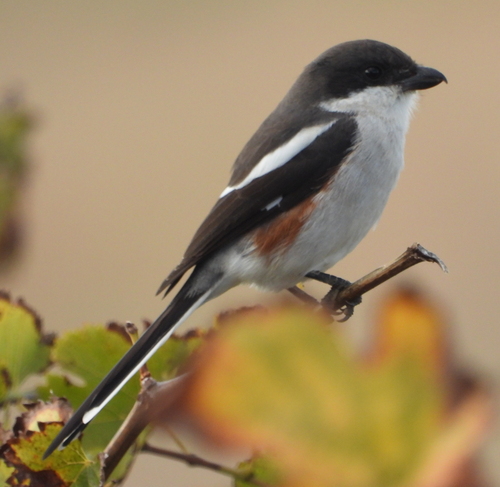 カタジロオナガモズ
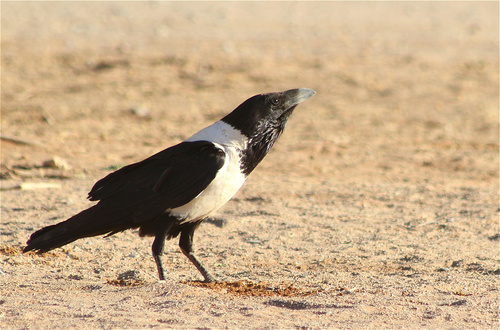 ムナジロガラス
要点
The most reliable field mark to separate Southern Fiscal from Pied Crow is overall size and structure: Pied Crow is more than twice as long, with a much heavier build, longer legs, and a massive bill, while Southern Fiscal is a slender, shrike-like bird. In flight or perched, Southern Fiscal shows a bold white 'V' on the back and white in the tail, whereas Pied Crow’s white is restricted to the neck and upper breast, forming a 'collar' that never extends onto the back or wings. Juvenile Pied Crows may have some black mixed into the white collar, but never the sharp 'V' pattern of the fiscal. If you see a small, black-and-white bird with a hooked bill and agile movements, it’s a fiscal; a large, robust, crow-shaped bird with a thick neck and heavy bill is a Pied Crow.
識別のコツ
- Size is the quickest separator: Pied Crow is more than twice as long and over ten times heavier than Southern Fiscal. If the bird looks crow-sized, it is not a fiscal. This works for all ages and seasons.
- Bill structure: Southern Fiscal has a fine, hooked shrike bill; Pied Crow has a massive, thick, straight crow bill. Even at a distance, the crow’s bill looks heavy and prominent.
- White 'V' on the back (fiscal only): Southern Fiscal always shows a sharp white 'V' on the back, visible both perched and in flight. Pied Crow never shows white on the back—its white is only on the neck and upper breast.
- Tail pattern: Fiscal’s tail is long and black with white outer feathers and white tips; Pied Crow’s tail is all black, matching the wings and back.
- White collar (crow only): Pied Crow’s white forms a broad collar from the shoulders to the lower breast, never extending onto the back or wings. Southern Fiscal’s white is on the underparts and back, not forming a collar.
- Leg length and stance: Pied Crow has long legs and a heavy, upright stance; Southern Fiscal is more slender and perches more upright, often on exposed perches.
- Flight style: Fiscal is agile and quick, often making short flights between perches; Pied Crow has slow, powerful, steady wingbeats and a heavier, more direct flight.
- Juvenile confusion: Young Pied Crows may have some black mixed into the white collar, but never show a white 'V' on the back or white in the tail. Juvenile fiscals look like adults, so the same marks apply.
- Sex differences: Female Southern Fiscal may show a rufous tinge on the lower flanks, but this is subtle and not present in Pied Crow.
- Vocalizations: Fiscal gives sharp, high-pitched, shrike-like calls; Pied Crow’s calls are deeper, harsher, and more resonant.
- Habitat context: Fiscals prefer open country with scattered perches; Pied Crows are often seen in towns, villages, and open areas, sometimes in large groups.
- Perching behavior: Fiscals perch conspicuously on wires, fences, or exposed branches; Pied Crows are more likely to be seen on the ground or in trees, less often on wires.
- Group size: Fiscals are usually alone or in pairs; Pied Crows are often in pairs or small groups, sometimes gathering in larger numbers at food sources.
- Eye color: Both species have dark eyes, so this is not a useful separator.
- Pitfall: At a distance, a perched fiscal may look like a small crow, but the size, bill shape, and white 'V' on the back are always reliable for separation.
大きさ
Southern Fiscal is a small passerine, about 21–23 cm in length and weighing around 40 g [wikidata]. In contrast, Pied Crow is much larger, measuring 46–52 cm in length and weighing approximately 520 g [wikipedia]. The crow is more than twice as long and over ten times heavier, with a much bulkier build, longer legs, and a proportionately larger bill. Even at a distance, the size gap is striking: fiscals are shrike-sized, while Pied Crows are true crows, similar to a Carrion Crow or small raven.
羽色
-
Juvenile/immature birds: Juvenile Pied Crows may show some black mixed into the white collar, but the white is always restricted to the neck and upper breast and never forms a 'V' on the back. Southern Fiscal immatures resemble adults, with the diagnostic white 'V' on the back and white in the tail.
-
Adults: Southern Fiscal is black above (from crown to tail) and white below, with a sharp white 'V' on the back and white outer tail feathers. The bill, legs, and eyes are black. Females may show a rufous tinge on the lower flanks. Pied Crow is glossy black on the head, neck, wings, and tail, with a large white patch from the shoulders down to the lower breast, forming a 'collar' but never a 'V' on the back. The bill is much thicker and heavier than the fiscal’s. In flight, the fiscal shows white in the tail and back, while the crow’s white is confined to the neck and upper breast.
行動
Southern Fiscal is typically seen singly or in pairs, often perched conspicuously on wires, fences, or exposed branches, scanning for prey. It is agile and quick in its movements, sometimes impaling prey on thorns. Pied Crow is usually encountered in pairs or small groups, often on the ground or flying with slow, powerful wingbeats. Crows may gather in large numbers at food sources and are known for mobbing raptors. Their movements are heavier, and they rarely perch as upright or as exposed as a fiscal.
生息環境
Both species are widespread and adaptable, but Southern Fiscal prefers open habitats such as savannas, grasslands, and farmlands with scattered perches. It is often seen along roadsides and in suburban gardens. Pied Crow is also highly adaptable, found in a wide range of habitats including towns, villages, open country, and near human habitation. The main difference is that fiscals are more tied to open country with perches, while Pied Crows are more likely to be seen in urban areas and larger open spaces.
声
Southern Fiscal’s calls are a mix of shrike-like swizzling sounds, harsh 'Dzzzttt-dzzzt-dzzzt' alarms, and occasionally a sweet, quiet song. These are generally high-pitched and sharp. Pied Crow, like other crows, has a deeper, harsher, and more varied repertoire, including cawing and croaking notes. Fiscal’s voice is more shrike-like and less resonant than the crow’s loud, carrying calls.