

イワサザイ 対 チャタムヒタキ
Xenicus gilviventris 対 Petroica traversi
イワサザイとチャタムヒタキのクイズ
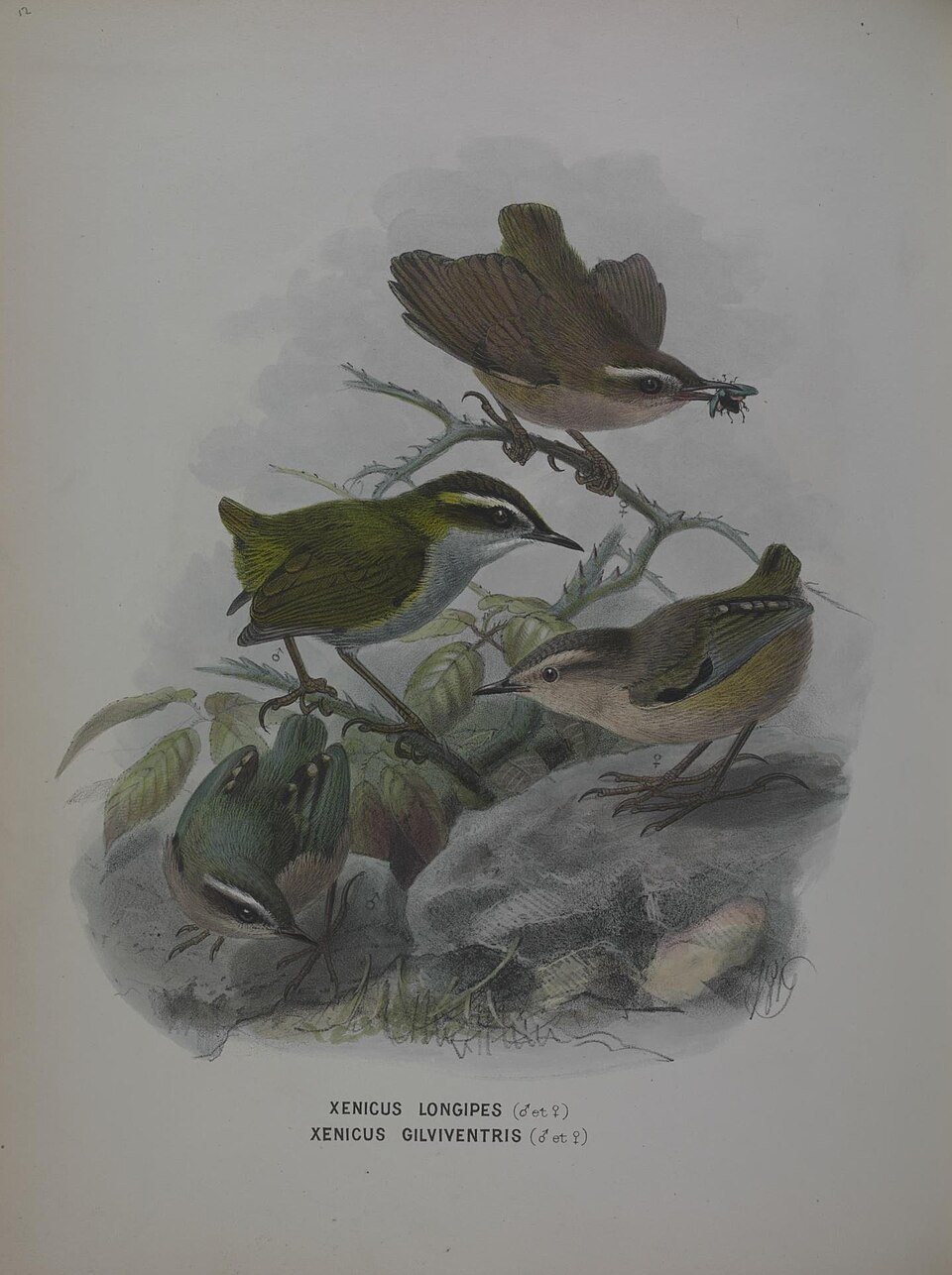 イワサザイ
 チャタムヒタキ
要点
The most reliable way to separate South Island Wren from Black Robin is by overall structure and plumage: the wren is a tiny, nearly tailless, greenish or brownish bird with a distinctive bobbing, hopping gait, while the robin is larger, with a full tail and uniform brownish-black plumage. The wren’s short, rounded wings and almost absent tail make it look compact and ball-shaped, especially when perched or moving on rocks. In contrast, the Black Robin is more thrush-like in posture, with a longer tail and a darker, more uniform appearance. Habitat is also a strong clue: South Island Wrens are restricted to alpine and subalpine rocky areas of the South Island, while Black Robins are found only on lowland forested islands of the Chathams.
識別のコツ
- Tail length and shape: South Island Wren is almost tailless, giving it a rounded, ball-like appearance; Black Robin has a normal, full-length tail. This is the quickest visual check.
- Overall size and jizz: The wren is much smaller and more compact, with a short neck and long legs; the robin is larger, with a more typical songbird shape.
- Plumage color and contrast: Wren males are greenish with yellow flanks and pale underparts; females are browner but still paler below. Black Robin is uniformly brownish-black with little contrast between upper and underparts.
- Legs and stance: The wren’s long legs and upright, hopping posture are distinctive, especially when it bobs and flicks its wings. Robins perch more upright and use their tail for balance.
- Flight style: Wrens rarely fly and when they do, it’s low and brief (under 2 m high, under 30 m distance). Robins fly readily between perches and can cover longer distances.
- Habitat: If you are above the treeline in rocky alpine areas of the South Island, it is a wren. If you are in lowland forest on the Chatham Islands, it is a robin. Range and habitat are nearly non-overlapping.
- Bill shape: The wren’s bill is fine and short, suited for picking invertebrates from crevices; the robin’s bill is more robust, typical of insectivorous songbirds.
- Behavior: Wrens are constantly moving, hopping, and bobbing among rocks; robins are more sedentary, often sitting still or making short flights from perch to perch.
- Vocalizations: Wren gives three high-pitched notes, sometimes in duet; robin gives a single high-pitched note or a short, simple song. Use with caution unless familiar with both.
- Sex differences: Wren females are browner than males but still show a pale belly; robin females are only slightly smaller than males and otherwise similar in plumage.
- Juvenile confusion: No distinctive juvenile or immature wing patterns are described for either species, so age is unlikely to cause confusion in flight.
- Contextual clues: If you see a bird collecting feathers for a nest in an alpine area, it is likely a wren; robins nest in forested areas and do not show this behavior.
- Feet color: Robin’s feet are brownish-black with yellow soles; wren’s feet color is not specified but are less likely to be noticed due to their constant movement.
- Group size: Wrens are usually seen in pairs maintaining territory; robins may be seen singly or in pairs, but this is less reliable for separation.
- Pitfalls: Do not confuse the South Island Wren with the South Island Robin (a different species); Black Robin is only on the Chathams and is darker and larger than either wren or robin from the mainland.
大きさ
South Island Wren is noticeably smaller and lighter (body mass ~17.7 g) than Black Robin (~23.5 g). The wren is about 9 cm in length, appearing very compact and almost tailless, while the robin is sparrow-sized (10–15 cm) with a more typical songbird silhouette. In the field, the wren’s tiny, rounded form stands out against the robin’s larger, more elongated body and longer tail.
羽色
No age-specific upperwing or flight pattern marks are described for either species, so separation relies on overall coloration and structure. South Island Wren males are greenish above with yellow flanks and a pale underside; females are browner, but both sexes show a pale belly and a generally mottled look. The wren’s wings are rounded and short, and the tail is extremely reduced, often barely visible. Black Robin, by contrast, is almost entirely brownish-black across all ages and sexes, with little contrast between upperparts and underparts, and has a full-length tail. The robin’s bill and legs are dark, while the wren’s longer legs are more prominent due to its upright, hopping stance. There are no reported seasonal or juvenile-specific plumage differences that would cause confusion between these two species.
行動
South Island Wren is a poor flier, rarely flying more than a couple of meters at a time, preferring to hop and run with frequent bobbing and wing flicks. Its movement is mouse-like and low to the ground, often among rocks. Black Robin behaves more like a typical robin, perching upright, using its tail for balance, and flying readily between perches. Robins may be seen foraging on or near the ground but do not show the wren’s constant bobbing or reduced tail. The wren’s tendency to stay close to the ground and avoid flight is a strong behavioral clue.
生息環境
Habitat is a strong separator: South Island Wren is confined to alpine and subalpine rocky areas (900–2500 m) in the South Island’s mountains, often above the treeline, and is New Zealand’s only truly alpine bird. Black Robin is restricted to lowland forested islands (Mangere and Rangatira) in the Chatham group, far from the South Island. If you are in alpine scree or tussock above the bushline, you are seeing a wren; if you are in lowland forest on the Chathams, it is a robin.
声
South Island Wren gives three high-pitched notes, sometimes in duet, while Black Robin’s call is a high-pitched single note and the male’s song is a simple phrase of 5–7 notes. Both are high-pitched, but the wren’s call is shorter and more repetitive, while the robin’s song is slightly longer and more structured. However, vocalizations are not the most reliable separation tool unless you are familiar with both.