

ウロコムジチメドリ 対 アフリカギンバシ
Illadopsis albipectus 対 Euodice cantans
ウロコムジチメドリとアフリカギンバシのクイズ
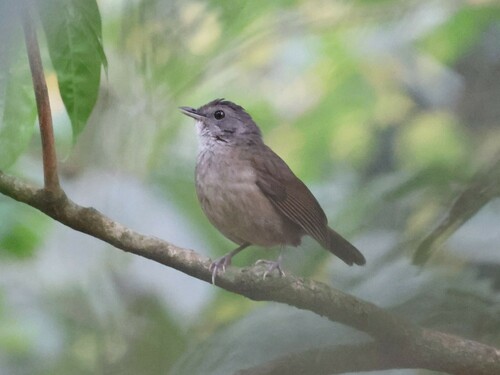 ウロコムジチメドリ
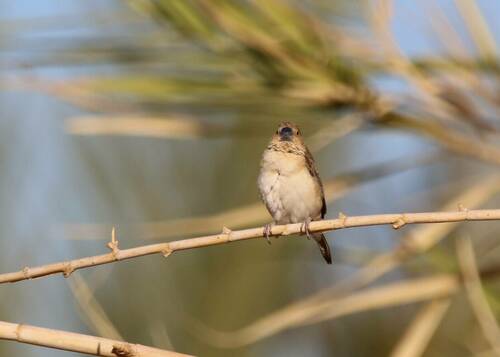 アフリカギンバシ
要点
The most reliable way to separate Scaly-breasted Illadopsis from African Silverbill is by overall jizz and habitat: Illadopsis is a heavier, more secretive understory bird of dense Congo Basin forests, while Silverbill is a small, active finch of open dry savannas. In the field, Illadopsis shows a heavier build and lacks the Silverbill's distinctive silver-blue bill and black tail. Juvenile Silverbills lack the fine vermiculations of adults, but still show the pale bill and contrasting tail. If you see a small, pale-billed, long-tailed bird in open country, it's a Silverbill; a heavier, plain-billed skulker in forest is Illadopsis.
識別のコツ
- Habitat is key: If you are in dense, moist forest understory, expect Scaly-breasted Illadopsis; if in open, dry savanna or grassland, look for African Silverbill. Almost never overlap.
- Bill color and shape: African Silverbill has a short, stubby, silver-blue bill—very distinctive at close range. Illadopsis has a plain, non-silvery bill.
- Tail shape and color: Silverbill has a long, pointed, black tail that contrasts with the rest of the body. Illadopsis lacks a long or contrasting tail.
- Upperparts and underparts: Adult Silverbill is finely vermiculated light-brown above and whitish below, with a black rump and wings. Illadopsis is not vermiculated and does not show strong contrasts.
- Juvenile Silverbill: Lacks vermiculations but still has the pale bill and black tail, helping separate from Illadopsis at all ages.
- Size and bulk: Illadopsis is heavier and bulkier than the petite Silverbill. If the bird looks chunky for a finch, consider Illadopsis.
- Behavior: Silverbill is active, often in groups, feeding openly on the ground or on grass stems. Illadopsis is solitary or in pairs, secretive, and moves through dense cover.
- Perched vs. in flight: Silverbill often perches in the open and flies with a bounding, undulating flight. Illadopsis is more likely to be glimpsed moving low in vegetation.
- Vocalizations: If you hear a high, repeated 'tseep' or a trilling song, it is Silverbill. Illadopsis' voice is not described here, so absence of these calls may suggest Illadopsis in forest.
- Sexes and ages: Both species are sexually monomorphic. Juvenile Silverbill is plainer but still shows the pale bill and black tail; Illadopsis does not have a similar juvenile pattern.
- Plumage pitfalls: Do not mistake a plain juvenile Silverbill for Illadopsis; check for the pale bill and black tail. Conversely, a scaly or streaked breast (if visible) may point to Illadopsis.
- Geographic context: Silverbill is widespread in dry savannas south of the Sahara, including introduced populations outside Africa. Illadopsis is strictly Central African forest.
- Feeding behavior: Silverbill feeds mainly on seeds, often seen clinging to grass stems. Illadopsis forages in leaf litter or low vegetation.
- Group size: Silverbill is often in flocks; Illadopsis is usually alone or in pairs.
- When in doubt: Use a combination of habitat, bill color, tail shape, and behavior—these are reliable even if plumage details are hard to see.
大きさ
Scaly-breasted Illadopsis is noticeably heavier (body mass ~29.4 g [wikidata]) than African Silverbill, which is a small estrildid finch (length ~10 cm [wikipedia], but no mass given; typically much lighter than Illadopsis). Illadopsis appears bulkier and more robust, while Silverbill is petite and delicate. This size difference is obvious in direct comparison, but may be less apparent if seen alone or at a distance.
羽色
- Juvenile/immature: Juvenile African Silverbills lack the fine vermiculations of adults, appearing plainer above, but still show the pale silver-blue bill and black tail. There is no mention of distinctive juvenile wing pattern for either species, so flight views rely on overall color and structure.
- Adult: Adult African Silverbill shows finely vermiculated light-brown upperparts, whitish underparts, a black rump and wings, and a long black pointed tail. The bill is stubby and silver-blue. Scaly-breasted Illadopsis lacks all these features; its name suggests scaled breast pattern, but no further plumage detail is given. Illadopsis does not have a contrasting tail, pale bill, or vermiculated upperparts. Sexes are similar in both species.
行動
African Silverbill is active, often seen in small flocks, feeding on grass seeds on the ground or clinging to stems. It is conspicuous in open country and often perches in the open. Scaly-breasted Illadopsis is a skulking, solitary or paired bird of dense forest understory, rarely venturing into the open. Its behavior is secretive, and it is more often heard than seen, moving through low vegetation.
生息環境
Habitat is a strong separator: Scaly-breasted Illadopsis is confined to the moist lowland forests of the Congo Basin and a few isolated forest patches in Angola, Uganda, and South Sudan, always in dense understory. African Silverbill is a bird of dry savanna south of the Sahara, favoring open, grassy, and bushy areas, and is absent from dense forest. If you are in closed-canopy forest, Silverbill is extremely unlikely; if in open savanna, Illadopsis is not expected.
声
African Silverbill gives a high 'tseep' call and a trilling song; males and females have slightly different contact calls. Scaly-breasted Illadopsis' voice is not described in the provided notes, so vocalization is only diagnostic for Silverbill if you hear the characteristic 'tseep' or trilling song.