

ニセヤブヒバリ 対 Red-collared Widowbird
Heteromirafra ruddi 対 Euplectes ardens
ニセヤブヒバリとRed-collared Widowbirdのクイズ
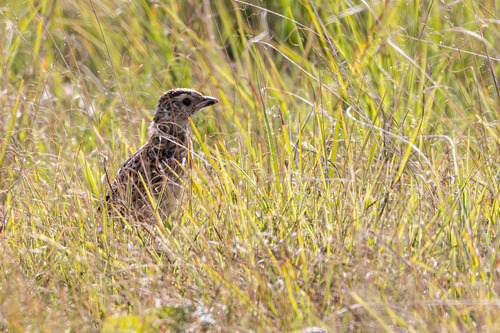 ニセヤブヒバリ
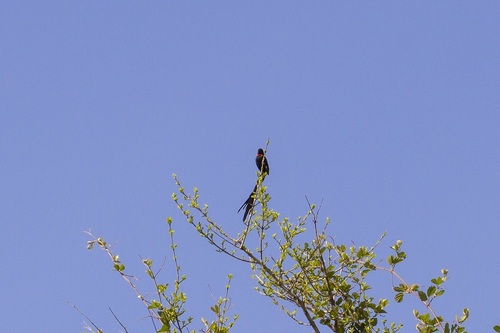 Red-collared Widowbird
要点
The most reliable field mark between Rudd's Lark and Red-collared Widowbird is the widowbird's dramatic tail in breeding males—exceptionally long and flowing, paired with a bold red chest patch, which is never seen in Rudd's Lark. Outside the breeding season, or in females and immatures, widowbirds become streaky brown and short-tailed, more similar to larks, but still differ in structure and subtle plumage. Rudd's Lark is a small, plain, high-altitude grassland lark with no red or black, and a compact, lark-like build. If you see a long-tailed, black bird with a red chest in grassland, it's a male widowbird in breeding plumage; a drab, streaky, short-tailed bird is trickier, but structure and subtle color cues still separate them.
識別のコツ
- Tail length and shape (breeding male widowbird): If you see a bird with a tail longer than its body, especially with a flowing, ribbon-like appearance, it's a male Red-collared Widowbird in breeding plumage. Rudd's Lark never shows a long tail.
- Red chest patch (breeding male widowbird): A vivid red crescent on the chest is unique to the breeding male widowbird. Rudd's Lark is always plain and earth-toned.
- Overall color (breeding season): Jet black body (widowbird) vs. streaky brown or buff (lark). No lark is all black or red-chested.
- Nonbreeding/female/subadult widowbird: These are streaky brown and short-tailed, but still bulkier than Rudd's Lark and lack the lark's subtle, fine bill and face pattern. Nonbreeding males retain a black tail (short), while females and subadults have a dark-brown tail.
- Bill shape: Rudd's Lark has a fine, pointed bill typical of larks (adapted for seeds/insects), while widowbirds have a thicker, conical bill (weaver type), especially obvious at close range.
- Face and head pattern: Rudd's Lark has a plain, lark-like face with subtle streaks; widowbirds (outside breeding males) may show a more robust, rounded head and less defined face pattern.
- Size and jizz: Widowbirds are generally bulkier and, in breeding males, much longer due to the tail. Rudd's Lark is compact and short-tailed, with a horizontal, crouched posture.
- Flocking behavior: Large, noisy flocks on the ground or in flight suggest widowbird. Rudd's Lark is solitary or in pairs.
- Display flight: If you see a bird flying with slow wingbeats and a long trailing tail, it's a displaying male widowbird.
- Habitat context: High-altitude, open grassland in South Africa favors Rudd's Lark; bushy or lowland grassland, especially with mixed flocks, favors widowbird.
- Seasonal timing: Only male widowbirds in breeding plumage (October–April) show the long tail and red chest. Outside this period, all widowbirds are streaky brown and short-tailed, making confusion with larks more likely.
- Plumage consistency: Rudd's Lark does not change appearance seasonally or by sex; widowbirds are highly variable by sex and season.
- Association with other species: Widowbirds often mix with bishops and queleas; Rudd's Lark does not.
- No red or black on Rudd's Lark: Any hint of red or solid black rules out Rudd's Lark.
- No distinctive juvenile wing pattern in either species: Separation relies on structure and plumage, not flight pattern.
大きさ
Red-collared Widowbird is notably heavier (adult mass ~21 g) and, in breeding males, much longer due to the extravagant tail (up to 25 cm overall, tail ~22 cm). Females and nonbreeding males are smaller (13 cm), but still tend to be bulkier than Rudd's Lark, which is a small, compact lark (no exact mass given, but typical lark size is less than 20 g). Rudd's Lark appears more compact and less elongated, especially when perched.
羽色
- Breeding male Red-collared Widowbird: Jet black overall with a brilliant red crescent on the chest and an extremely long, flowing tail. No lark, including Rudd's, shows this combination of color and tail length at any age or sex.
- Nonbreeding male/female/subadult widowbird: Streaky brown above and below, short-tailed (tail ~4 cm), but nonbreeding males retain a black tail (shorter than breeding season). Females and subadults have a dark-brown tail. These ages can look superficially like a lark, but are still bulkier and have a different face and bill shape.
- Rudd's Lark (all ages/sexes): Uniformly plain, earth-toned, and streaky with no red, black, or bright patches. Always short-tailed, with a subtle, lark-like face and bill. No seasonal or sexual dimorphism in color. No distinctive upperwing or juvenile flight pattern is described for either species in the notes.
行動
Red-collared Widowbirds often form large, conspicuous flocks (sometimes 50–100 birds), especially when feeding on the ground, and may associate with other weavers and bishops. Males display by flying with exaggerated, slow wingbeats and trailing their long tails. Rudd's Lark is more solitary or found in pairs, and is generally less conspicuous, foraging quietly in high-altitude grassland. Larks typically walk or run on the ground, rarely flocking in large numbers.
生息環境
Both species can occur in grassland, but Rudd's Lark is restricted to high-altitude grasslands in South Africa and is a local specialty. Red-collared Widowbird is much more widespread in grasslands and bush clearings across western and southern Africa, including lower elevations. If you are in high-altitude, open grassland in South Africa, Rudd's Lark is possible; in bushy or lowland grassland, especially with large flocks or displaying males, widowbird is more likely.