

クビワヤマセミ 対 オオミドリヤマセミ
Megaceryle torquata 対 Chloroceryle amazona
クビワヤマセミとオオミドリヤマセミのクイズ
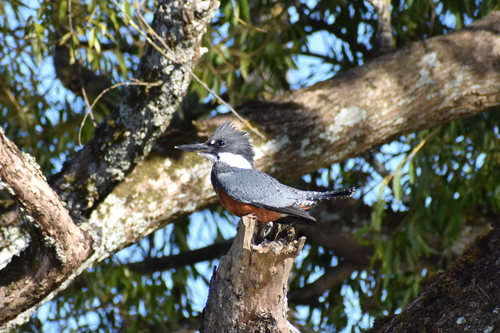 クビワヤマセミ
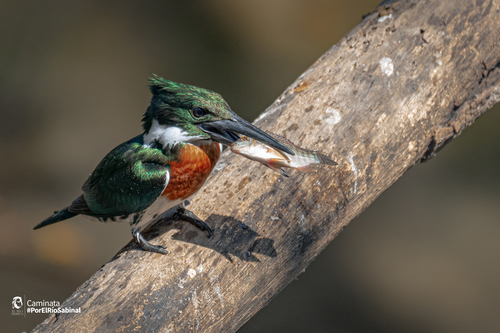 オオミドリヤマセミ
要点
The most reliable field mark between Ringed and Amazon Kingfishers is size: Ringed is much larger and bulkier, with a massive bill and slow, powerful wingbeats, while Amazon is noticeably smaller and slimmer. For perched birds, check the underparts: adult male Ringed shows extensive rufous below with a white throat, while male Amazon has a rufous breast but a white belly and green-streaked flanks; females differ more, with Ringed showing a bluish breast band and Amazon a green band. In flight, juvenile Amazon Kingfishers show buff spots on the upperwing coverts, which Ringed lacks. Bill length and shape, as well as voice, also help in tricky views.
識別のコツ
- Size is the first check: If the bird looks huge, with a bill nearly as long as its head and a heavy, deep body, it's Ringed. Amazon is much smaller and slimmer, with a proportionally shorter bill.
- Bill shape and color: Ringed's bill is massive, straight, and often shows some yellowish at the base of the lower mandible; Amazon's is heavy but shorter, with a large yellow patch at the base in juveniles.
- Juvenile upperwing pattern: Only juvenile Amazon Kingfishers have buff spots on the upperwing coverts—look for these in flight or when wings are spread. Ringed juveniles lack this feature.
- Adult male underparts: Male Ringed is solid rufous from breast to belly, with a white throat and undertail coverts. Male Amazon has a rufous breast only, white belly, and green-streaked flanks.
- Adult female breast band: Female Ringed has a broad bluish-gray band across the upper breast, above the rufous belly. Female Amazon has green extending across the breast, with no rufous below.
- White collar: Both show a white neck collar, but Ringed's is broader and more obvious, especially in flight or from behind.
- Crest and head shape: Ringed's head and crest are much more massive and shaggy, giving a blocky, imposing look. Amazon's crest is smaller and the head less bulky.
- Flight style: Ringed flies with slow, deep wingbeats, often high and direct; Amazon is quicker, more fluttery, and usually stays close to the water.
- Voice: Ringed's call is a deep, slow rattle or 'klek', carrying far; Amazon's is a sharper, higher 'tek' or 'chrit', sometimes a rapid rattle.
- Perching posture: Ringed often perches high and exposed, looking heavy and upright. Amazon perches lower, often near the water, and appears more delicate.
- Undertail coverts: Ringed's are white or lightly spotted in males, brownish in females; Amazon's are white.
- Bill color in juveniles: Look for a large yellow patch at the base of the bill in young Amazon Kingfishers—absent in Ringed.
- Habitat context: In open, broad rivers or lakes, especially in the southern US or northern Mexico, Ringed is more likely; Amazon is more frequent on smaller streams and wooded lakeshores.
- Sexual dimorphism: Both show sex differences, but the pattern is different—study the breast and belly color carefully.
- Overlap and confusion: Where both occur, always check for size, bill length, and underpart pattern first, then use wing covert spots (juveniles) and voice as supporting marks.
大きさ
Ringed Kingfisher is a giant among American kingfishers, with males and females both averaging around 196 mm wing length, tails over 110 mm, and bills up to 94 mm. Adults weigh 305–341 g. Amazon Kingfisher is much smaller: about 30 cm long, males weighing 98–121 g and females 125–140 g. The difference is dramatic in the field—Ringed looks almost twice as heavy, with a much longer, deeper bill and a more imposing head and crest. Even at a distance, the bulk and long bill of Ringed stand out, while Amazon appears more compact and less top-heavy.
羽色
- Juvenile/immature birds: Juvenile Amazon Kingfishers have distinctive buff spots on the upperwing coverts and a large yellow patch at the base of the bill. Juvenile Ringed Kingfishers do not show these wing covert spots or yellow bill patch.
- Adult males: Ringed males are deep rufous below from breast to belly, with a white throat and undertail coverts, and blue-gray upperparts. Amazon males have a rufous breast, but the belly is white with green streaks on the sides, and upperparts are bronzy green.
- Adult females: Female Ringed has a bluish-gray breast band above the rufous belly, while female Amazon has green extending across the breast but lacks rufous. Both sexes of Ringed have a white collar around the neck, which is less bold in Amazon.
- Flight views: No distinctive upperwing pattern in Ringed; Amazon juveniles show buff spots on upperwing coverts. Both have white collars, but Ringed's is broader and more obvious.
行動
Ringed Kingfisher is less agile on land, shuffling awkwardly between perches, and tends to fly with slow, heavy wingbeats, often covering long distances over open water or land. Amazon Kingfisher is more agile, perching lower and often hovering briefly before diving. Ringed is more likely to be seen flying high and direct, while Amazon sticks closer to the water and perches more frequently. Both hunt by diving from a perch, but Ringed's size and slower flight are distinctive.
生息環境
Both species overlap widely in Central and South America, especially along rivers and lakes. Ringed Kingfisher is more likely to be found along larger, open rivers and lakes, sometimes in more open country. Amazon Kingfisher also uses large rivers but can be found along smaller streams, wooded lake shores, and even brackish or tidal waters. In Texas and the US, Ringed is rare and local, while Amazon is only a rare vagrant. Both avoid dense forest interiors, but Amazon tolerates more cover and a wider range of water bodies.
声
Ringed Kingfisher gives a loud, low-pitched rattle or 'klek' call, deeper and more resonant than Amazon. Amazon Kingfisher's calls are higher-pitched, sharper 'tek' or 'klek' notes, sometimes extended into a staccato rattle, and also gives a 'see see see...su su su' greeting/alarm call. In direct comparison, Ringed's voice is slower, lower, and carries farther; Amazon's is quicker and more piercing.