

アカアシイワシャコ 対 イワシャコ
Alectoris rufa 対 Alectoris chukar
アカアシイワシャコとイワシャコのクイズ
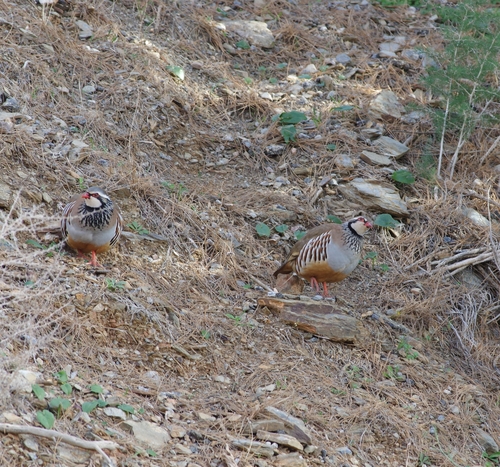 アカアシイワシャコ
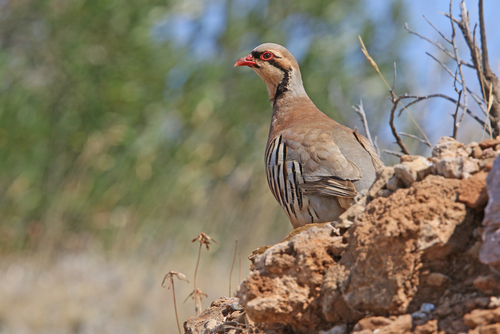 イワシャコ
要点
The most reliable field mark to separate Red-legged Partridge from Chukar is the pattern of the black collar: Red-legged Partridge shows a black gorget that breaks into bold triangular streaks on the lower throat and neck, while Chukar has a sharply defined black necklace that forms a continuous band enclosing the white throat. Both species have red legs and bills, but flank pattern and head markings also differ: Red-legged Partridge has bold rufous and black bars on the flanks and a pale blue-grey supercilium, while Chukar's flanks are rufous-streaked (not barred) and the face is white with a black band running from the forehead, through the eye, and around the throat. In flight or at a distance, focus on the collar shape and flank pattern for the most reliable separation.
識別のコツ
- Collar/Throat Pattern (All ages, all seasons): Red-legged Partridge shows a black gorget that breaks into bold triangular streaks on the lower throat and neck; Chukar has a sharply defined, continuous black necklace enclosing a white throat, with no break into streaks. This is the single most reliable field mark.
- Flank Pattern (Adults): Red-legged Partridge has bold, discrete rufous and black bars on the flanks, each bar with a pale leading and trailing edge; Chukar's flanks are rufous-streaked but lack strong, separate barring. Look for clear bars (Red-legged) vs. streaks (Chukar).
- Head Pattern (Adults): Red-legged Partridge has a pale blue-grey supercilium above the lores and blue-grey crown edges, plus a warm pinkish-brown crown and nape. Chukar has a white face with a black band running from the forehead through the eye and around the throat, giving a masked appearance.
- Bill and Leg Color (Adults): Both species have red bills and legs; this is not a separator.
- Upperparts (Adults): Red-legged Partridge is sandy-brown and plain above; Chukar is light brown to greyish, but this is subtle and not always reliable.
- Tail and Uppertail Coverts: Red-legged Partridge has pinkish-rufous tail feathers contrasting with sandy-grey uppertail coverts; Chukar's tail is not described in detail, so use with caution.
- Eye Ring: Red-legged Partridge has a bright red eye-ring; Chukar's eye-ring is not specifically described, but both may show some red.
- Flight Behavior: Chukar is known for fast, direct flight on rounded wings, often flying down slopes and calling after landing. Red-legged Partridge flight is less described but is also strong and direct.
- Vocalization: If you hear a loud, repeated "chuk-chuk-chukar-chukar" call, it is diagnostic for Chukar. Red-legged Partridge's call is not detailed here.
- Habitat Context: In upland, rocky, or arid areas, especially in the South Island of New Zealand, Chukar is more likely. In lowland farmland or game farms, especially in captivity, Red-legged Partridge is more likely.
- Group Size: Chukar may form larger coveys (up to 50 birds) in winter; Red-legged Partridge typically forms smaller groups.
- Sex Differences: Both species are similar between sexes; female Chukar is slightly smaller and lacks a spur, but this is not usually visible in the field.
- Juvenile/Immature Birds: No detailed notes on immature plumage for either species; focus on collar and flank pattern even in young birds if visible.
- Pitfalls: Both species have red legs and bills, and both have some rufous on the flanks—do not rely on these alone. Always check the collar shape and flank pattern first.
- Hybridization: In areas where both species are present, hybrids may occur and show intermediate features—be cautious if the collar or flank pattern is ambiguous.
大きさ
Both species are robust, medium-sized partridges with similar overall structure. Chukar is slightly heavier on average (adult body mass about 607.5 g [wikidata]), but this is not likely to be apparent in the field. Both have a rotund build and short tails, with sexes similar in size (female Chukar slightly smaller and lacking a spur). Size alone is not a reliable field mark between these two.
羽色
For adults, the most diagnostic plumage feature is the collar and throat pattern: Red-legged Partridge has a creamy-white chin and upper throat bordered by a solid black gorget, with the black breaking into broad triangular streaks on the lower throat and upper breast. Chukar, by contrast, has a sharply defined black necklace that runs from the forehead, through the eye, and around the white throat, forming a continuous band without breaking into streaks. Flank pattern is also key: Red-legged Partridge shows bold, bright rufous-brown bars edged with black on the flanks, each bar separated by off-white and pale grey, while Chukar's flanks are rufous-streaked but lack the strong, discrete barring. The head of Red-legged Partridge is more patterned, with a narrow off-white supercilium and blue-grey crown edges, while Chukar has a cleaner white face with a black band. Upperparts are sandy-brown and plain in Red-legged Partridge, while Chukar's back is light brown to greyish. Juvenile and immature plumages are not described in detail for either species in the provided notes, so these contrasts apply primarily to adults.
行動
Both species are ground-dwelling and prefer to run rather than fly when disturbed. Chukar is noted for its fast, direct flight on rounded wings, often flying down slopes and calling after landing. Red-legged Partridge behavior is not detailed in the notes, but both species are typically seen in small groups or coveys outside the breeding season. Chukar may form larger coveys (up to 50 birds) in winter, and is known for its pugnacious calling and fighting during the breeding season.
生息環境
Red-legged Partridge is native to southwestern Europe and introduced in parts of the UK and New Zealand, often found in farmland and open country. Chukar is a Palearctic upland gamebird, favoring rocky hillsides, dry grasslands, and open slopes. While both can occur in open habitats, Chukar is more associated with upland, rocky, or arid terrain, whereas Red-legged Partridge is more typical of lowland farmland and fields. In New Zealand, Red-legged Partridge is mostly in captivity or on game farms, while Chukar is naturalized in the South Island uplands.
声
Chukar has a distinctive, loud, repeated "chuk-chuk-chukar-chukar" call, often given in a series and used for rallying. Red-legged Partridge's vocalizations are not described in the notes, so voice is only a reliable separator if the classic Chukar call is heard. Chukar also calls frequently in the mornings and evenings, especially in coveys.