

ルリビタキ/キレンルリビタキ 対 ヒマラヤルリビタキ
Tarsiger cyanurus 対 Tarsiger rufilatus
ルリビタキ/キレンルリビタキとヒマラヤルリビタキのクイズ
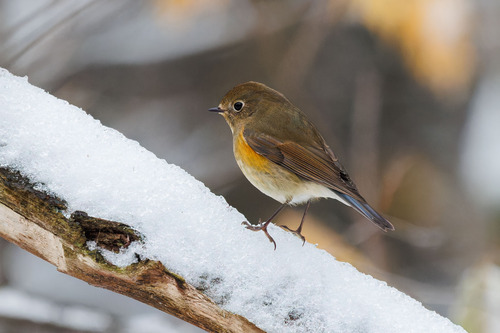 ルリビタキ/キレンルリビタキ
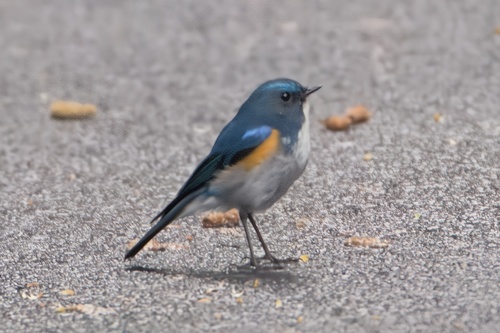 ヒマラヤルリビタキ
要点
The most reliable field mark between Red-flanked Bluetail and Himalayan Bluetail is the intensity and tone of blue on adult males: Himalayan Bluetail males show a noticeably deeper, more intense blue above, while Red-flanked Bluetail males are paler blue. For females and immatures, Himalayan Bluetail is distinctly greyer above and below, lacking the warmer brown tones of Red-flanked Bluetail. Both species share blue tails and orange flanks, but subtle differences in overall tone and contrast, especially in non-breeding or young birds, are key. Structural and behavioral differences are minimal, so careful attention to plumage—especially in females and immatures—is essential for separation.
識別のコツ
- Adult male blue intensity: Himalayan Bluetail males are a deeper, more intense blue above, especially on the head and mantle, compared to the paler blue of Red-flanked Bluetail males. Use this mark in spring and early summer when males are in fresh plumage.
- Female and immature tone: Himalayan Bluetail females and immatures are distinctly greyer above and below, lacking the warm brown tones and duskier breast of Red-flanked Bluetail females and immatures. This is the key mark for non-males and outside the breeding season.
- Blue tail and rump: Both species show blue tails and rumps in all plumages, so this is not a separator.
- Orange flanks: Both have orange-red flanks, but the contrast with the rest of the underparts is slightly stronger in Red-flanked Bluetail, which also shows a whiter throat and belly.
- Upperparts color in females/immatures: Red-flanked Bluetail females/immatures are brownish above, while Himalayan Bluetail is cold grey-brown to grey, especially on the mantle and crown.
- Underparts tone: Himalayan Bluetail is generally colder and greyer below, while Red-flanked Bluetail is whiter with a duskier breast in females/immatures.
- Bill and leg color: Both have small, thin black bills and slender black legs; not a separator.
- Tail flicking and sallying: Both species flick their tails and sally for insects; behavior is not a separator.
- Habitat and altitude: In the Himalayas, birds in high-altitude bushy conifer/mixed forest in summer are likely Himalayan Bluetail; in northern taiga or mixed forests, especially outside the Himalayas, Red-flanked Bluetail is expected.
- Seasonal movement: Himalayan Bluetail is a short-distance altitudinal migrant, moving lower in winter, while Red-flanked Bluetail is a long-distance migrant wintering in Southeast Asia and the Himalayas.
- Geographic context: If seen in Europe or northern Asia outside the Himalayas, it is almost certainly Red-flanked Bluetail. In the Himalayas, both species may occur in winter, but breeding birds at high altitude are Himalayan Bluetail.
- Song and call: Both have similar chat-like calls and trills; not a reliable field mark.
- Juvenile/first-winter wing pattern: No distinctive upperwing or flight pattern differences are described for either species at any age; separation must rely on overall color tone and contrast.
- Perched vs. in flight: Both species are best separated when perched, as flight views do not reveal diagnostic differences.
- Pitfalls: Immature and female plumages are the main source of confusion; focus on overall coldness (Himalayan) vs. warmth (Red-flanked) in brown/grey areas, and use habitat and range as supporting evidence.
大きさ
Both species are very similar in size and structure, with Red-flanked Bluetail averaging about 14.5g in mass. Both are small, slim passerines, slightly smaller and slimmer than a European Robin. No reliable difference in size or shape is noted between the two, so size is not a useful field mark.
羽色
For adult males, Himalayan Bluetail is a richer, more saturated blue above, especially on the head and upperparts, compared to the paler, less intense blue of Red-flanked Bluetail. Both have blue tails and rumps, orange-red flanks, and white throats, but the Himalayan Bluetail's blue is more vivid and extensive. Females and immatures are trickier: Himalayan Bluetail females and juveniles are distinctly greyer above and below, lacking the warmer brown tones and slightly duskier breast of Red-flanked Bluetail females/immatures. Both have blue tails/rump and orange flanks, but the Himalayan Bluetail is colder-toned overall. No age-specific upperwing or flight pattern differences are described in the sources, so separation relies on overall color tone and contrast, especially in perched birds.
行動
Both species behave similarly, often flicking their tails and sallying from perches to catch insects, in a manner reminiscent of redstarts. No behavioral differences are noted that would reliably separate them in the field.
生息環境
Red-flanked Bluetail breeds in mixed coniferous forests with undergrowth across northern Asia and northeastern Europe, wintering in Southeast Asia and the Himalayas. Himalayan Bluetail is more restricted to the Himalayas, breeding at high elevations (3000–4400m) in bushy layers of conifer and mixed forests, and wintering at lower elevations (1500–2500m) in dense, dark undergrowth of broadleaf evergreen forests, often along ridges and mountain tops. In the Himalayas, context and altitude can help: birds at high elevation bushy habitats in summer are likely Himalayan Bluetail, while those in northern forests outside the Himalayas are Red-flanked Bluetail.
声
Both species are described as having typical chat-like calls, with Red-flanked Bluetail's call a 'tacc' and a melancholy trill song. No distinctive vocal differences are detailed in the sources, so voice is not a reliable separator in the field.