

アカメジュズカケバト 対 アフリカジュズカケバト
Streptopelia semitorquata 対 Streptopelia capicola
アカメジュズカケバトとアフリカジュズカケバトのクイズ
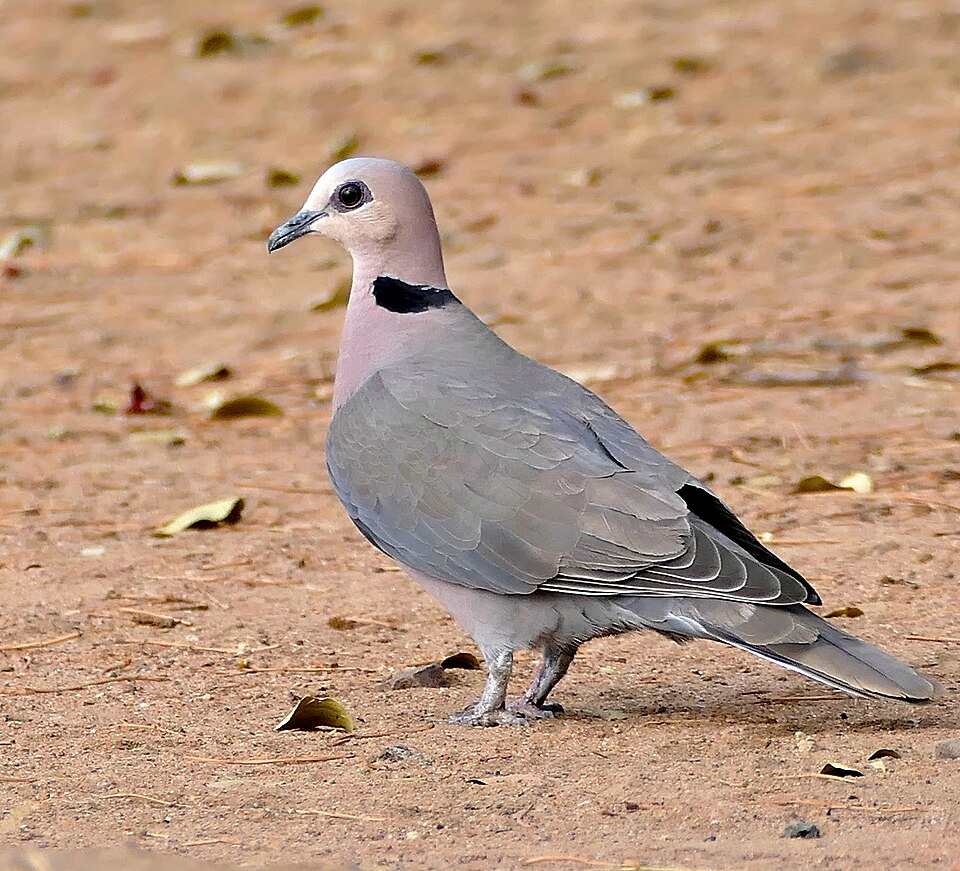 アカメジュズカケバト
 アフリカジュズカケバト
要点
The most reliable field mark between Red-eyed Dove and Ring-necked Dove is the eye color: Red-eyed Dove has striking red to orange-red eyes with purplish-red orbital skin, while Ring-necked Dove has almost black eyes. Red-eyed Dove is also noticeably larger and darker overall, with a greyer belly and tail tips, compared to the paler, more contrasty Ring-necked Dove, which shows white tips to the tail and a white lower belly. Juvenile birds of both species are duller, but Ring-necked Dove immatures lack the adult's semi-collar and have buff edges to the upperparts. In flight, Red-eyed Dove appears bulkier and darker, while Ring-necked Dove shows a more obvious white tail tip. Both species have similar structure and display flights, so careful attention to eye color, size, and tail pattern is key.
識別のコツ
- Eye color is the most reliable mark: Red-eyed Dove has red to orange-red irises with purplish-red orbital skin; Ring-necked Dove's eyes are almost black. This is visible at close range or in good light with binoculars.
- Size and bulk: Red-eyed Dove is much larger and heavier (235 g vs 153.5 g), appearing bulkier both perched and in flight. Use this when both species are present for comparison.
- Tail pattern in flight: Ring-necked Dove shows conspicuous white tips to the slate-grey tail feathers, especially obvious in display or when the tail is fanned. Red-eyed Dove's tail is dark grey basally and light brownish-grey at the tip, lacking the crisp white edge.
- Belly and undertail color: Ring-necked Dove has a white lower belly and crissum, contrasting with the paler pinkish-lavender underparts. Red-eyed Dove has a grey belly and underparts that are dark mauve-pink to wine-red, with no white crissum.
- Head and neck color: Red-eyed Dove has a pale bluish-grey forehead and darker crown, while Ring-necked Dove's crown is grey, sometimes with a lavender nape.
- Neck collar: Both species have a black semi-collar, but in Red-eyed Dove it is more restricted and indistinct, limited to the sides of the neck. In Ring-necked Dove, the semi-collar is more obvious in adults, but absent in immatures.
- Juvenile/immature marks: Immature Ring-necked Doves lack the semi-collar and have buff edges to upperparts and wing coverts, with underparts broadly edged greyish-white. Red-eyed Dove juveniles are duller and browner but still show some collar.
- Wing coverts: Red-eyed Dove has dark slaty blue outer wing-coverts; Ring-necked Dove's are dull grey-brown with possible buff edges in immatures.
- Leg and orbital skin color: Red-eyed Dove has purplish-red legs and orbital skin; Ring-necked Dove's feet are dark purple, but orbital skin color is not distinctive.
- Display flight: Both species perform similar display flights, so this is not a reliable separator.
- Habitat context: If in dense woodland or near rivers, Red-eyed Dove is more likely; in open country, Ring-necked Dove is more typical, though overlap occurs.
- Flock size: Large, noisy flocks are more typical of Ring-necked Dove, while Red-eyed Dove is less gregarious.
- Vocalization: If you hear a rhythmic, three-syllable croon ('uk-carrroooo'), it's likely Ring-necked Dove. Red-eyed Dove's call is less distinctive in these notes.
- Plumage variation: Ring-necked Dove shows more individual variation, with some birds paler or almost sooty, so rely on multiple marks.
- Sex and season: Both species are sexually monomorphic (males and females look alike), so sex is not a separator. Seasonal plumage changes are not significant for field ID.
大きさ
Red-eyed Dove is substantially larger and heavier, averaging 235 g compared to Ring-necked Dove's 153.5 g. In length, Red-eyed Dove reaches about 30 cm, making it the largest of the 'ringneck' doves, while Ring-necked Dove is smaller at 25–26.5 cm. This size difference is often apparent in direct comparison or when seen perched near each other, with Red-eyed Dove looking bulkier and more robust.
羽色
Juvenile and immature birds are often confused. Immature Ring-necked Doves lack the adult's semi-collar and show buff edges to the upperparts and wing coverts, with the underparts broadly edged greyish-white. Red-eyed Dove juveniles are also duller and browner than adults, but still show a restricted, indistinct black half-collar on the neck sides. In adults, Red-eyed Dove has a pale bluish-grey forehead merging into a darker crown, dark mauve-pink to wine-red neck and breast, greyish-brown upperparts, black primaries, and dark slaty blue outer wing-coverts. The underwing and flanks are bluish-grey, and the tail is dark grey at the base, light brownish-grey at the tip. In contrast, Ring-necked Dove adults have dull grey-brown upperparts, lavender on the nape, paler pinkish-lavender below, and a white lower belly and crissum. Their slate-grey tail feathers have conspicuous white tips, especially visible in flight. Eye color is a key difference: Red-eyed Dove has red to orange-red irises, while Ring-necked Dove's are almost black.
行動
Both species are usually seen alone or in pairs, though Ring-necked Dove may form large, noisy flocks around food or water. Both perform similar display flights: a steep, flapping ascent followed by a spiral glide with spread wings and tail. Red-eyed Dove is less gregarious and more often solitary or in pairs. Both species build stick nests in trees, with similar nesting behavior.
生息環境
Red-eyed Dove is widespread in sub-Saharan Africa, common in most habitats except deserts, and often found in forests near rivers. Ring-necked Dove is also widespread and often abundant in East and southern Africa, but prefers a variety of open habitats and is mostly sedentary. While both can overlap in range, Red-eyed Dove is more associated with wooded or riparian areas, whereas Ring-necked Dove is more typical of open country.
声
Ring-necked Dove is well known for its rhythmic, three-syllabled crooning, often described as 'uk-carrroooo', heard throughout the year and at all times of day. Red-eyed Dove's vocalizations are not detailed in these notes, but both species have similar display flights and general dove calls. In practice, Ring-necked Dove's call is more likely to be heard and is a familiar sound within its range.