

コリンウズラ 対 ミドリツバメ
Colinus virginianus 対 Tachycineta bicolor
コリンウズラとミドリツバメのクイズ
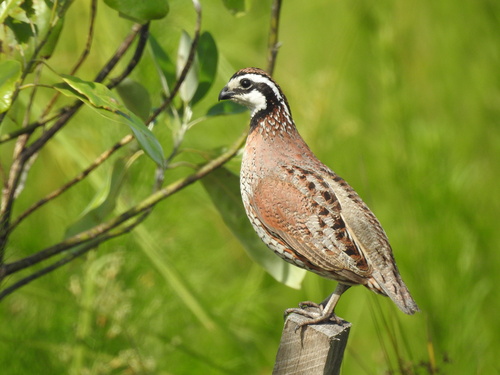 コリンウズラ
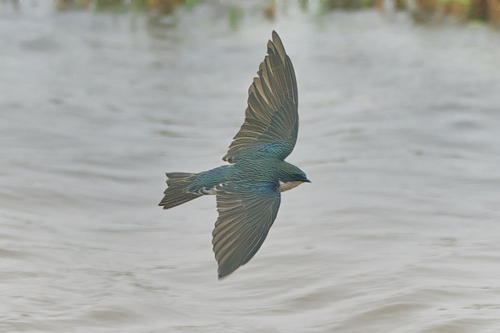 ミドリツバメ
要点
The most reliable field mark to separate Northern Bobwhite from Tree Swallow is overall structure and flight style: bobwhites are chunky, ground-dwelling quail with short, rounded wings and a stubby tail, while tree swallows are slim, aerial insectivores with long, pointed wings and a shallowly forked tail. In flight, tree swallows appear sleek and agile, often high above open areas, whereas bobwhites flush low with rapid, whirring wingbeats. Plumage is also diagnostic: bobwhites show rufous and gray mottling with a distinctive white and black face pattern (in males), while tree swallows are glossy blue-green above and white below (adults), or brown above (juveniles and first-year females). If you see a small, chunky bird on the ground or in grass, it's a bobwhite; if it's swooping over water or fields, it's a tree swallow.
識別のコツ
- Flight style and structure: Bobwhites flush low with rapid, whirring wingbeats and short, rounded wings; tree swallows are agile, with long, pointed wings and a shallow forked tail, often seen swooping high above ground.
- Perched posture: Bobwhites are squat, chunky, and almost always on the ground or hidden in grass; tree swallows perch upright on wires, branches, or boxes, rarely on the ground.
- Bill shape: Bobwhites have a short, stout, curved bill suited for seeds; tree swallows have a tiny, slender, straight bill for catching insects.
- Facial pattern: Male bobwhites have a bold white throat and brow stripe bordered by black; females have buff or brownish stripes. Tree swallows of all ages lack any face pattern, showing a plain white cheek and underparts.
- Upperparts color: Adult tree swallows are glossy blue-green above (males) or duller blue/brown (females, immatures); bobwhites are rufous with gray mottling and never blue or green.
- Underparts: Tree swallows are clean white below (adults), sometimes with a gray-brown wash in juveniles; bobwhites have whitish underparts with black scalloping and white scalloped flanks.
- Tail: Bobwhites have a short, rounded gray tail; tree swallows have a longer, shallowly forked blackish tail.
- Juvenile confusion: Juvenile tree swallows are brown above and gray-brown below, but still slim and aerial; they lack the scalloped, patterned look of bobwhite and never show a face pattern.
- Habitat: Bobwhites are always terrestrial, in grass or brush; tree swallows are aerial, over open water or fields.
- Voice: The 'bobwhite' whistle is unique and diagnostic; tree swallows never give this call.
- Group behavior: Bobwhites may be seen in coveys on the ground; tree swallows often form flocks in flight or at roosts, rarely on the ground.
- Seasonality: Tree swallows are migratory and may appear in large numbers in spring/fall; bobwhites are resident year-round.
- Size impression: Bobwhites look much heavier and more robust; tree swallows are slim and lightweight.
- Wing shape in flight: Bobwhites have short, rounded wings; tree swallows have long, pointed wings.
- Context: If you flush a bird from grass or brush, it's likely a bobwhite; if you see a bird swooping over water or perched on a wire, it's a tree swallow.
大きさ
Northern Bobwhite is much heavier and bulkier, with an adult mass around 171 g [wikidata], compared to the tree swallow's much lighter 17–25.5 g [wikipedia]. Bobwhites are 24–28 cm long with a 33–38 cm wingspan, while tree swallows are smaller at 12–14 cm long and a similar wingspan (30–35 cm), but their slim build and long wings make them look even lighter in flight. The bobwhite's short, rounded wings and tail contrast with the swallow's long, pointed wings and shallow forked tail. In the field, bobwhites appear squat and robust, while tree swallows are slender and aerodynamic.
羽色
Juvenile and first-year tree swallows have brown upperparts and a gray-brown wash on the breast, lacking the adult's blue-green gloss, which can cause confusion with other brownish birds but not with the rufous, gray, and white pattern of bobwhite. Bobwhites of all ages show a complex pattern: males have a white throat and brow stripe bordered by black, rufous upperparts with gray mottling, white scalloped flanks, and black-scalloped whitish underparts. The tail is gray. Females are similar but with buff or brownish facial stripes. In contrast, adult tree swallows are glossy blue-green above, blackish on wings and tail, and pure white below, with a clean, sharp division between upperparts and underparts. Females are duller, and first-year females can retain brown upperparts with some blue feathers. No age or sex of tree swallow shows the face pattern or scalloped underparts of bobwhite. In flight, tree swallows show uniform dark upperwings, while bobwhites (if flushed) show rounded wings with mottled gray and rufous patterning, never the swallow's sleek, pointed look.
行動
Northern Bobwhites are almost always seen on the ground, walking or running through grass, fields, or brush, and flush only when approached closely, flying low and rapidly for short distances. They rarely perch in the open. Tree swallows are highly aerial, often seen swooping, gliding, or darting over water, fields, or open areas, rarely landing on the ground. When perched, they choose wires, branches, or nest boxes, often in loose groups. The difference in movement—terrestrial and furtive for bobwhite, aerial and acrobatic for swallow—is a key behavioral separation.
生息環境
Bobwhites are found in grasslands, open woodlands, agricultural fields, and edges—always terrestrial habitats, often with dense ground cover. They are year-round residents in their range. Tree swallows favor open areas near water, wetlands, or fields, especially where there are cavities for nesting. They are migratory, appearing in large numbers in spring and fall, and are rarely found on the ground or in dense cover. If you see a bird in flight over water or perched on a wire, it's almost certainly a tree swallow, not a bobwhite.
声
Bobwhites have a distinctive, clear whistle: 'bob-WHITE' or 'bob-bob-WHITE,' with slow, widely spaced syllables rising in pitch. They also give lisps, peeps, and rapid warning calls. Tree swallows do not give any similar whistled calls; their vocalizations are high, twittering, and chattering, often given in flight or at the nest. If you hear the classic 'bobwhite' whistle, it's diagnostic for the quail.