

マガモ 対 ショウドウツバメ
Anas platyrhynchos 対 Riparia riparia
マガモとショウドウツバメのクイズ
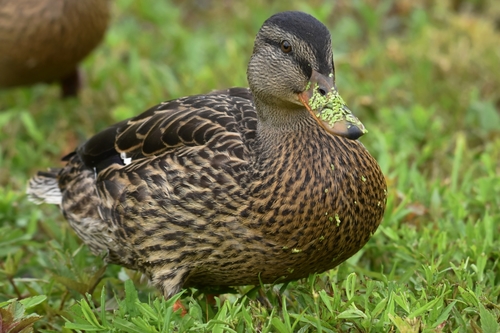 マガモ
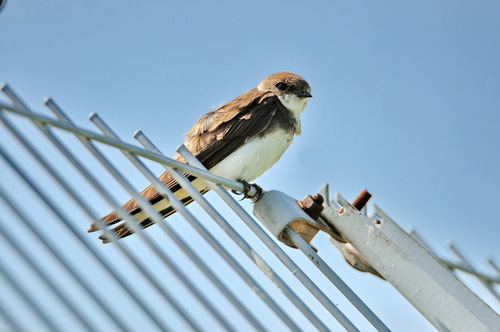 ショウドウツバメ
要点
The most reliable field mark to separate Mallard from Sand Martin is overall structure and flight style: Mallard is a large, heavy-bodied duck with broad wings and slow, steady wingbeats, while Sand Martin is a tiny, slender swallow with pointed wings and rapid, fluttery flight. Juvenile and adult Mallards in flight show a bold blue speculum edged with white on the wing, absent in Sand Martin. In perched views, Mallard’s size, thick bill, and mottled brown (female/juvenile) or bright green head (adult male) are unmistakable compared to the Sand Martin’s small, delicate build and brown-and-white plumage with a narrow brown breast band. These two species differ so dramatically in size, shape, and behavior that confusion is only likely at great distance or in poor viewing conditions.
識別のコツ
- Size is the first check: If the bird is anything but duck-sized, it is not a Mallard. Sand Martin is tiny, swallow-sized.
- Flight style: Mallard flies with slow, deep wingbeats and a straight path; Sand Martin is rapid, fluttery, and highly maneuverable, often twisting and turning in pursuit of insects.
- Wing pattern in flight (all ages): Mallard shows a blue speculum bordered with white on the upperwing, visible in both sexes and ages. Sand Martin’s wings are plain brown above, with no colored panel or white border.
- Breast band: Sand Martin has a narrow brown band across the white chest (all ages), never present in Mallard.
- Bill shape and color: Mallard has a broad, flat, duck bill (yellow in males, orange/black in females/juveniles); Sand Martin has a tiny, pointed bill suited for catching insects.
- Tail: Mallard’s tail is short and rounded; adult males have a curled central feather. Sand Martin’s tail is short and slightly notched but never curled.
- Plumage: Female and juvenile Mallards are mottled brown with a buff face and dark eye-stripe; Sand Martin is brown above, white below, with a clean demarcation and a brown breast band.
- Leg color and length: Mallard’s legs are orange (adults) or dark (juveniles), and clearly visible when walking or swimming; Sand Martin’s legs are short, brown, and rarely seen except when perched.
- Perched posture: Mallard sits upright or waddles on land; Sand Martin perches horizontally on wires or banks, often in groups.
- Habitat context: Mallard is found on water or nearby land; Sand Martin is usually flying over water or fields, rarely on water.
- Voice: Mallard’s quack is loud and distinctive; Sand Martin’s twittering is soft and continuous, never a quack.
- Season and location: Sand Martin is present only during the breeding season in temperate zones and migrates away in winter; Mallard is resident or present year-round in most of its range.
- Group behavior: Mallards often gather in loose flocks on water; Sand Martins form dense, swirling flocks in flight, especially near colonies.
- Sexual dimorphism: Only Mallard males have a green head and curled tail feather; Sand Martin shows no strong sexual dimorphism in the field.
- Potential confusion: Female/juvenile Mallard may be confused with other brown ducks, but never with a swallow if size and structure are checked. Sand Martin may be confused with other swallows, but never with a duck.
大きさ
Mallard is vastly larger: 50–65 cm long, with an 81–98 cm wingspan and weighing 0.7–1.6 kg [wikipedia][avonet]. In contrast, Sand Martin is tiny, just 12–13 cm long, with a 26.5–29 cm wingspan and weighing only 11–16 g [wikipedia]. In the field, Mallard dwarfs even the largest swallows; a direct size comparison is unmistakable if both are seen together. Even at a distance, the bulk and long body of a Mallard are evident, while Sand Martin appears as a small, agile, sparrow-sized bird.
羽色
- Juvenile/immature Mallard: Mottled brown overall, similar to adult female, with a bold blue speculum (wing patch) bordered by white, visible in flight and often at rest. Bill color helps: juvenile males develop yellow bills, females show orange and black. No breast band.
- Adult male Mallard: Iridescent green head, white neck ring, chestnut breast, pale grey body, black rear, curled central tail feather.
- Adult female Mallard: Mottled brown with buff face and dark eye-stripe, blue speculum with white borders, orange and black bill.
- Sand Martin (all ages): Brown above, white below, with a narrow brown breast band across the upper chest. Juveniles have rufous tips to wing coverts and secondaries. No blue speculum or white-bordered wing patch. The brown breast band is unique among swallows in its range.
- Key contrast: Mallard (any age) never shows a brown breast band; Sand Martin never shows a blue/white speculum or mottled brown body.
行動
Mallard is a dabbling duck, usually seen swimming, feeding on water, or walking on land in groups. Flight is strong, direct, and steady, with broad wings and regular wingbeats. Sand Martin is highly aerial, almost always seen flying swiftly over water or open ground, catching insects on the wing, rarely perching except on wires or banks near colonies. Its flight is quick, fluttery, and erratic, with frequent changes in direction. Mallards rarely perch above water or on wires, and never exhibit the swallow’s buoyant, acrobatic flight.
生息環境
Mallard prefers wetlands, lakes, ponds, rivers, and marshes—any body of water with emergent vegetation. It is often found in urban parks and can be seen on land near water. Sand Martin breeds in colonies in sandy banks near rivers, lakes, or gravel pits, and forages over open water or fields. While both may be seen near water, Sand Martin is almost always in the air, while Mallard is usually on the water or nearby ground. Sand Martin’s nesting colonies in sandy banks are distinctive; Mallard nests on the ground in vegetation.
声
Mallard gives loud, classic duck quacks (female) and softer rasping or whistling calls (male). Sand Martin’s voice is a continuous, gravelly twittering in flight and a conversational undertone at the roost; its alarm is a harsh, chattering call. The two are entirely different and not likely to be confused.