

Motmot

シロオビアメリカムシクイ 対 キマユアメリカムシクイ

Setophaga magnolia 対 Setophaga fusca

シロオビアメリカムシクイとキマユアメリカムシクイのクイズ
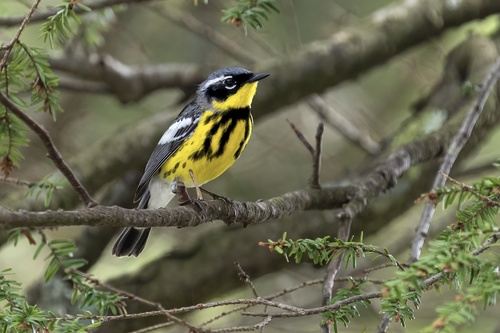
シロオビアメリカムシクイ (Setophaga magnolia) シロオビアメリカムシクイ
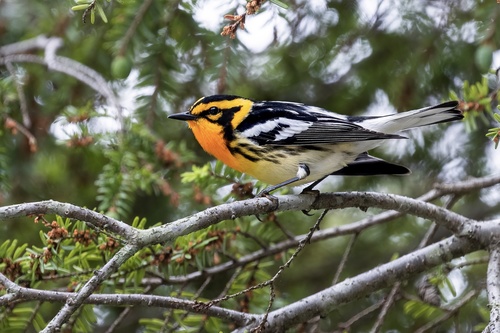
キマユアメリカムシクイ (Setophaga fusca) キマユアメリカムシクイ

メディア

読み込み中…

要点

The most reliable field mark between Magnolia Warbler and Blackburnian Warbler is the throat color: Magnolia Warbler (all ages) shows a yellow throat, while adult male Blackburnian Warbler in breeding plumage has a unique flaming-orange throat, and even duller birds retain a yellowish throat with a contrasting facial pattern. Both species have white wing bars and streaked underparts, but Magnolia Warbler males (and some females/immatures) show bold black streaks on yellow underparts, while Blackburnian is more white below with black streaks and a strong facial pattern. In flight or perched, look for the Magnolia's white tail spots below and more extensive yellow on the underparts, versus the Blackburnian's more contrasting head and orange/yellow throat. Size and structure overlap, but Blackburnian averages slightly heavier and longer-winged.

識別のコツ

  1. Throat color is key: Magnolia Warbler always shows a yellow throat (all ages and sexes), while adult male Blackburnian Warbler in breeding plumage has a bright orange throat (unique among North American warblers). Females and immatures Blackburnian have a yellowish throat, but it still contrasts with the face pattern.
  2. Facial pattern: Blackburnian Warbler (all plumages) shows a strong, contrasting face pattern with a pale supercilium (eyebrow) and grayish cheeks, especially obvious in males. Magnolia Warbler has a plainer face with less contrast, lacking the bold supercilium.
  3. Underpart streaking: Magnolia Warbler males (and some females/immatures) have bold black streaks on a yellow breast and belly. Blackburnian Warbler has black streaks on white underparts, with yellow restricted to the throat and upper breast.
  4. Tail pattern in flight: Magnolia Warbler shows large white tail spots on the underside, visible when the bird fans or flicks its tail. Blackburnian's tail is less distinctly marked below.
  5. Wing bars: Both species have double white wing bars, but Magnolia's are often sharper and more contrasting, especially in fresh plumage.
  6. Back and crown: Blackburnian males have a dark brown or black crown and back, contrasting with the orange throat and yellow face. Magnolia's back is gray to black with white, but lacks the intense head contrast.
  7. Size and structure: Blackburnian averages slightly heavier and longer-winged, but this is subtle and not usually diagnostic in the field.
  8. Foraging height: During breeding, Magnolia Warbler is often low in dense undergrowth, while Blackburnian is usually high in the canopy. During migration, this distinction is less reliable but can help.
  9. Sex and age effects: Female and immature Magnolia Warblers are duller but still yellow below; female/immature Blackburnians are paler, with a yellowish throat and less intense face pattern, but still show the supercilium and cheek contrast.
  10. Habitat context: In dense, low fir or spruce, especially in the north, Magnolia is more likely; in mature, tall coniferous woods, especially high in the canopy, Blackburnian is favored.
  11. Voice: If you hear a high, thin, ascending series of notes, suspect Blackburnian; Magnolia's song is not described here, so use caution.
  12. Tail flicking: Magnolia Warbler often fans and flicks its tail, flashing the white spots; this behavior is less pronounced in Blackburnian.
  13. Pitfalls: Dull female/immature Blackburnians can be confused with Magnolia, but the face pattern (supercilium and cheek contrast) and yellowish (not pure yellow) throat are clues. Dull Magnolias lack the strong facial contrast and have more extensive yellow below.
  14. Migration context: Both species can occur together in migration, but foraging height and tail pattern remain useful.
  15. When in doubt: Focus on throat color and facial pattern first, then check for white tail spots (Magnolia) and overall underpart color (yellow for Magnolia, white for Blackburnian).

大きさ

Both species are small wood-warblers, but Blackburnian Warbler averages a bit heavier (mean adult mass ~10.2 g vs. Magnolia's ~8.6 g) and has a slightly longer wingspan (20–22 cm vs. Magnolia's 16–20 cm). Length is similar (both 11–13 cm). In the field, this difference is subtle and rarely diagnostic, but Blackburnian may appear a touch bulkier or longer-winged, especially in direct comparison.

羽色

For all ages, Magnolia Warbler shows a yellow throat and bold black streaks on a yellow breast and belly, with a white undertail pattern (distinct white tail spots visible from below). Immature and female Magnolias are duller but still yellow below and lack the strong face pattern of Blackburnian. Blackburnian Warbler adult males in breeding plumage are unmistakable with a flaming-orange throat, black crown, and a bold black-and-yellow face pattern; even females and immatures retain a yellowish throat and a pale supercilium contrasting with grayish cheeks. Both species have double white wing bars, but Magnolia's are often more sharply defined. In non-breeding and immature plumages, Blackburnian loses the orange intensity but keeps a yellowish throat and contrasting facial pattern, while Magnolia remains yellow below but duller overall. Magnolia's white tail spots are a key field mark in flight for all ages.

行動

Both species are active foragers, typically moving through foliage in search of insects. Blackburnian Warbler tends to forage higher in the canopy, often near treetops, while Magnolia Warbler is more likely to be found in lower or mid-level dense undergrowth, especially in breeding season. During migration, both may join mixed-species flocks, but their foraging height and preferred microhabitat can help separate them.

生息環境

Magnolia Warbler breeds in dense, low coniferous undergrowth (often fir or spruce), usually close to the ground. Blackburnian Warbler prefers mature coniferous woodlands and is a specialist of the upper canopy, especially in breeding season. During migration, both species can occur in a wider range of wooded habitats, but Magnolia is more likely to be found low in shrubs or saplings, while Blackburnian is often higher up.

声

Blackburnian Warbler's song is a high-pitched, thin series of ascending notes ("zip zip zip..." or "titititi tseeeeee"). Magnolia Warbler's song is not described in the provided notes, so vocal differences are not reliably diagnostic here.

より良い説明を送る

比較と同じ項目を使ってください。文章はすぐに公開されます。

The most reliable field mark between Magnolia Warbler and Blackburnian Warbler is the throat color: Magnolia Warbler (all ages) shows a yellow throat, while adult male Blackburnian Warbler in breeding plumage has a unique flaming-orange throat, and even duller birds retain a yellowish throat with a contrasting facial pattern. Both species have white wing bars and streaked underparts, but Magnolia Warbler males (and some females/immatures) show bold black streaks on yellow underparts, while Blackburnian is more white below with black streaks and a strong facial pattern. In flight or perched, look for the Magnolia's white tail spots below and more extensive yellow on the underparts, versus the Blackburnian's more contrasting head and orange/yellow throat. Size and structure overlap, but Blackburnian averages slightly heavier and longer-winged.

  1. Throat color is key: Magnolia Warbler always shows a yellow throat (all ages and sexes), while adult male Blackburnian Warbler in breeding plumage has a bright orange throat (unique among North American warblers). Females and immatures Blackburnian have a yellowish throat, but it still contrasts with the face pattern.
  2. Facial pattern: Blackburnian Warbler (all plumages) shows a strong, contrasting face pattern with a pale supercilium (eyebrow) and grayish cheeks, especially obvious in males. Magnolia Warbler has a plainer face with less contrast, lacking the bold supercilium.
  3. Underpart streaking: Magnolia Warbler males (and some females/immatures) have bold black streaks on a yellow breast and belly. Blackburnian Warbler has black streaks on white underparts, with yellow restricted to the throat and upper breast.
  4. Tail pattern in flight: Magnolia Warbler shows large white tail spots on the underside, visible when the bird fans or flicks its tail. Blackburnian's tail is less distinctly marked below.
  5. Wing bars: Both species have double white wing bars, but Magnolia's are often sharper and more contrasting, especially in fresh plumage.
  6. Back and crown: Blackburnian males have a dark brown or black crown and back, contrasting with the orange throat and yellow face. Magnolia's back is gray to black with white, but lacks the intense head contrast.
  7. Size and structure: Blackburnian averages slightly heavier and longer-winged, but this is subtle and not usually diagnostic in the field.
  8. Foraging height: During breeding, Magnolia Warbler is often low in dense undergrowth, while Blackburnian is usually high in the canopy. During migration, this distinction is less reliable but can help.
  9. Sex and age effects: Female and immature Magnolia Warblers are duller but still yellow below; female/immature Blackburnians are paler, with a yellowish throat and less intense face pattern, but still show the supercilium and cheek contrast.
  10. Habitat context: In dense, low fir or spruce, especially in the north, Magnolia is more likely; in mature, tall coniferous woods, especially high in the canopy, Blackburnian is favored.
  11. Voice: If you hear a high, thin, ascending series of notes, suspect Blackburnian; Magnolia's song is not described here, so use caution.
  12. Tail flicking: Magnolia Warbler often fans and flicks its tail, flashing the white spots; this behavior is less pronounced in Blackburnian.
  13. Pitfalls: Dull female/immature Blackburnians can be confused with Magnolia, but the face pattern (supercilium and cheek contrast) and yellowish (not pure yellow) throat are clues. Dull Magnolias lack the strong facial contrast and have more extensive yellow below.
  14. Migration context: Both species can occur together in migration, but foraging height and tail pattern remain useful.
  15. When in doubt: Focus on throat color and facial pattern first, then check for white tail spots (Magnolia) and overall underpart color (yellow for Magnolia, white for Blackburnian).

Both species are small wood-warblers, but Blackburnian Warbler averages a bit heavier (mean adult mass ~10.2 g vs. Magnolia's ~8.6 g) and has a slightly longer wingspan (20–22 cm vs. Magnolia's 16–20 cm). Length is similar (both 11–13 cm). In the field, this difference is subtle and rarely diagnostic, but Blackburnian may appear a touch bulkier or longer-winged, especially in direct comparison.

For all ages, Magnolia Warbler shows a yellow throat and bold black streaks on a yellow breast and belly, with a white undertail pattern (distinct white tail spots visible from below). Immature and female Magnolias are duller but still yellow below and lack the strong face pattern of Blackburnian. Blackburnian Warbler adult males in breeding plumage are unmistakable with a flaming-orange throat, black crown, and a bold black-and-yellow face pattern; even females and immatures retain a yellowish throat and a pale supercilium contrasting with grayish cheeks. Both species have double white wing bars, but Magnolia's are often more sharply defined. In non-breeding and immature plumages, Blackburnian loses the orange intensity but keeps a yellowish throat and contrasting facial pattern, while Magnolia remains yellow below but duller overall. Magnolia's white tail spots are a key field mark in flight for all ages.

Both species are active foragers, typically moving through foliage in search of insects. Blackburnian Warbler tends to forage higher in the canopy, often near treetops, while Magnolia Warbler is more likely to be found in lower or mid-level dense undergrowth, especially in breeding season. During migration, both may join mixed-species flocks, but their foraging height and preferred microhabitat can help separate them.

Magnolia Warbler breeds in dense, low coniferous undergrowth (often fir or spruce), usually close to the ground. Blackburnian Warbler prefers mature coniferous woodlands and is a specialist of the upper canopy, especially in breeding season. During migration, both species can occur in a wider range of wooded habitats, but Magnolia is more likely to be found low in shrubs or saplings, while Blackburnian is often higher up.

Blackburnian Warbler's song is a high-pitched, thin series of ascending notes ("zip zip zip..." or "titititi tseeeeee"). Magnolia Warbler's song is not described in the provided notes, so vocal differences are not reliably diagnostic here.

変更を破棄しますか?

保存していない編集があります。今離れると失われます。

シロオビアメリカムシクイ · キマユアメリカムシクイ · 苦手な鳥