

アメリカグンカンドリ 対 コグンカンドリ
Fregata magnificens 対 Fregata ariel
アメリカグンカンドリとコグンカンドリのクイズ
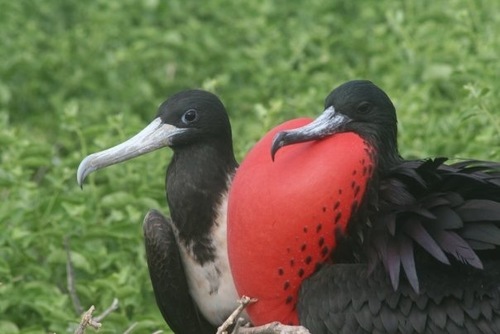 アメリカグンカンドリ
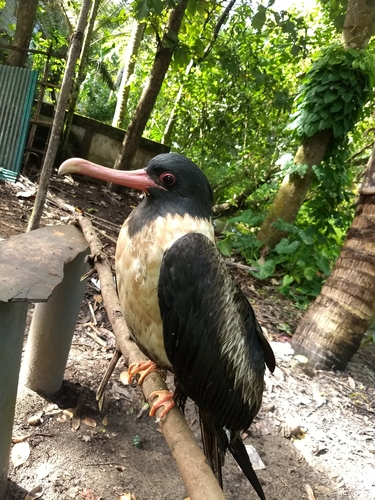 コグンカンドリ
要点
The most reliable field mark to separate Magnificent and Lesser Frigatebirds is the presence or absence of a white axillary (armpit) spur on the underwing: Lesser Frigatebird of all ages shows a distinctive white spur extending from the body onto the underwing, while Magnificent Frigatebird never shows this mark. Juvenile and immature Magnificent Frigatebirds instead have a white head and underparts with a diamond-shaped belly patch, but no white spur. Structural differences are also important: Magnificent is much larger and bulkier, with a longer wingspan and heavier build, while Lesser is noticeably smaller and lighter. Adult males of both species are mostly black with a red gular sac, but only Magnificent males show purple iridescence on the scapulars (not green, which is Great Frigatebird) and lack the white flank spur. Females of both species have white breasts, but Magnificent females have a blue eye-ring and a more extensive white area, while Lesser females have a red eye-ring and a narrower white collar. In flight, focus first on the underwing pattern and overall size to avoid confusion.
識別のコツ
- White Axillary Spur (Underwing): The single best mark—Lesser Frigatebird (all ages and sexes) shows a white spur or patch in the armpit area extending onto the underwing; Magnificent Frigatebird never shows this feature. Check this first on any frigatebird in flight.
- Juvenile/Immature Underparts: Magnificent juveniles have a white head and underparts with a diamond-shaped belly patch, but no white spur. Lesser juveniles have a white head and underparts, but always with a white axillary spur.
- Adult Male Flank and Underwing: Lesser males have a white patch on the flank that extends as a spur onto the underwing; Magnificent males are all-black below (except for the red gular sac) and lack any white on the underwing or flank.
- Adult Male Iridescence: Magnificent males show a purple sheen on scapulars in good light; Lesser males lack this feature. (Note: Great Frigatebird males have green, not purple, sheen.)
- Adult Female Eye-ring: Magnificent females have a diagnostic blue eye-ring; Lesser females have a narrow red eye-ring. This is subtle but useful at close range.
- Adult Female Breast Pattern: Magnificent females have a broad white breast and lower neck sides, while Lesser females have a narrower white collar and breast, with a black head and neck.
- Adult Female Underwing Spur: Lesser females show a white underwing spur; Magnificent females do not.
- Size and Structure: Magnificent is much larger and bulkier, with a longer wingspan and heavier build. Lesser is noticeably smaller and lighter. Use this with caution unless birds are seen together or with familiar species for scale.
- Tail Shape: Both have deeply forked tails; not a reliable separator between these two.
- Upperwing Pattern (Male Lesser): Lesser males have a pale bar on the upperwing, which is absent in Magnificent males. Look for this in good light.
- Geographic Context: In the Americas, Magnificent is the default; Lesser is rare except off Brazil and as a vagrant. In the Indo-Pacific, Lesser is common and Magnificent is absent.
- Behavior: Both species soar and rarely land; flight style is not a reliable separator, but Magnificent may appear more powerful and heavyset, while Lesser is more buoyant.
- Voice: Not useful in the field except at colonies; both are silent in flight.
- Pitfalls: Do not rely on the red throat sac alone—both adult males have it. The white belly of juveniles is not diagnostic unless you check for the axillary spur. Be wary of using size alone at a distance.
- Sexual Dimorphism: Both species show sexual dimorphism, but the combination of eye-ring color and underwing pattern is more reliable than overall color or size for separating females.
大きさ
Magnificent Frigatebird is by far the largest frigatebird, measuring 89–114 cm in length with a wingspan of 217–244 cm and weighing 1.1–1.59 kg. Lesser Frigatebird is much smaller, at 66–81 cm in length, wingspan 155–193 cm, and body mass around 806 g (males 625–875 g, females 760–955 g). Even at a distance, Magnificent appears longer-winged and bulkier, while Lesser is more compact and lighter in flight. If seen together, the size difference is striking, but beware of lone birds, as perspective can mislead.
羽色
- Juvenile/Immature: Magnificent Frigatebird juveniles have a white head and underparts with a distinctive diamond-shaped belly patch, but crucially lack any white axillary spur on the underwing. Lesser Frigatebird juveniles and immatures always show a white spur or patch in the armpit area extending onto the underwing, which is the single best mark in flight for all non-adult birds.
- Adult Male: Both species' males are mostly black with a red throat pouch, but Magnificent males have a purple iridescence on the scapulars (not present in Lesser) and never show a white flank or underwing spur. Lesser males have a white patch on the flank that extends as a spur onto the underwing, and a pale bar on the upperwing.
- Adult Female: Magnificent females have a white breast and lower neck sides, a brown band on the wings, and a diagnostic blue eye-ring. Lesser females have a black head and neck, a white collar and breast, a white underwing spur, and a narrow red eye-ring. The white on Magnificent is broader and more extensive, while Lesser's is more restricted and sharply defined.
行動
Both species are highly aerial, rarely landing except to breed, and are masters of soaring flight. Both may harass other seabirds for food (kleptoparasitism), but this is not a reliable field separation. Magnificent Frigatebird is heavier and more powerful in flight, often soaring higher and for longer periods, while Lesser Frigatebird is lighter and more agile. Both species rarely swim or walk, but Lesser may be more likely to clamber in vegetation at nesting sites. Courtship displays are similar, with males inflating their red throat sacs and performing aerial displays.
生息環境
Magnificent Frigatebird is found over tropical and subtropical waters of the Americas, including the Pacific and Atlantic coasts from northern Mexico and Florida south to Peru and southern Brazil, as well as the Galápagos and Cape Verde. Lesser Frigatebird is more widespread in the Indian and Pacific Oceans, but also occurs off the Atlantic coast of Brazil. Both species are pelagic outside the breeding season and are most often seen soaring over open ocean or near breeding colonies. Overlap is possible off Brazil and in rare vagrancy, but context can help: Magnificent is the default frigatebird in the Americas, while Lesser is more likely in the Indo-Pacific.
声
Both species are generally silent in flight. At the nest, Magnificent Frigatebird makes rattling sounds, while Lesser Frigatebird males produce a variety of calls and bill rattling during courtship. These vocalizations are rarely helpful for field identification unless at a breeding colony.
アメリカグンカンドリ · コグンカンドリ · 苦手な鳥