

ヒメハチクイ 対 ヨーロッパハチクイ
Merops pusillus 対 Merops apiaster
ヒメハチクイとヨーロッパハチクイのクイズ
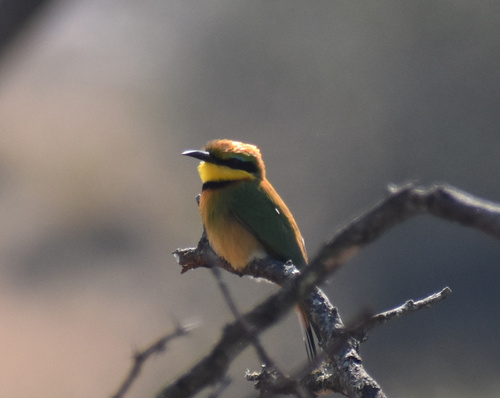 ヒメハチクイ
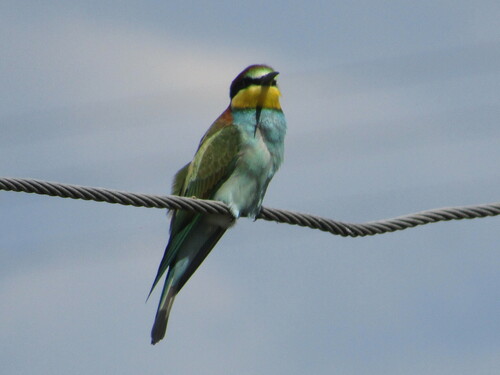 ヨーロッパハチクイ
要点
The most reliable way to separate Little Bee-eater from European Bee-eater is by size and tail shape: Little Bee-eater is much smaller and has a short, square or slightly forked tail, while European Bee-eater is nearly twice as long, with long, pointed wings and distinctive elongated central tail feathers in adults. Both are colorful, but Little Bee-eater shows a yellow throat bordered by a black gorget and green upperparts, while European Bee-eater has a chestnut-brown back and yellow upperparts with a blue belly. Juveniles of European Bee-eater lack the long tail streamers but are still much larger and duller than any Little Bee-eater. If you see a small, compact bee-eater with a yellow throat and no tail streamers, it's almost certainly a Little Bee-eater; a large, slender bird with a long tail and chestnut back is European Bee-eater.
識別のコツ
- Size is the quickest check: Little Bee-eater is tiny (15–17 cm, 14.6 g), while European Bee-eater is nearly twice as long (27–29 cm) and much heavier (52 g average). If the bird looks big for a bee-eater, it's not Little Bee-eater.
- Tail shape is critical: Little Bee-eater has a short, square or slightly forked tail with no elongated central feathers. Adult European Bee-eaters have long, pointed tail streamers; juveniles lack these but still have a longer, more tapered tail than Little Bee-eater.
- Upperparts color: Little Bee-eater is green above, blending well with foliage. European Bee-eater has chestnut-brown and yellow upperparts with a greenish back in non-breeding plumage.
- Throat and gorget: Little Bee-eater always shows a bright yellow throat bordered below by a sharp black gorget. European Bee-eater has a yellow throat but lacks the black gorget; instead, the throat is bordered by a blue band.
- Breast and belly: Little Bee-eater's upper breast is rich brown fading to ochre, while European Bee-eater's underparts are blue.
- Wing pattern in flight: Both are colorful, but European Bee-eater's wings are longer and more pointed, giving a more graceful, buoyant flight. Little Bee-eater's wings are shorter and more rounded.
- Bill and legs: Both have black bills and legs, so these are not useful for separation.
- Perched jizz: Little Bee-eater is compact, often perched low and partly hidden, while European Bee-eater is larger, more upright, and often perches in the open.
- Juvenile confusion: Juvenile European Bee-eaters lack tail streamers and are duller, but are still much larger and bulkier than any Little Bee-eater. Their back is blue-green, not bright green as in Little Bee-eater.
- Sex differences: Both species are sexually monomorphic, but female European Bee-eaters may have slightly greener shoulders—this is subtle and not reliable in the field.
- Voice: European Bee-eater is much more vocal, with loud, rolling calls. Little Bee-eater is often silent or gives a soft "seep."
- Habitat context: In wetter, bushier habitats in Sub-Saharan Africa, expect Little Bee-eater. In open country, especially in Europe or during migration in Africa, European Bee-eater is more likely.
- Flock size: Little Bee-eater is usually alone or in small groups; European Bee-eater often forms large, noisy flocks.
- Camouflage: Little Bee-eater's green back makes it hard to spot when perched; European Bee-eater is more conspicuous.
- Seasonal presence: European Bee-eater is migratory in most of its range; Little Bee-eater is resident. In southern Africa, both may occur, but European Bee-eater is present mainly in the non-breeding season.
大きさ
Little Bee-eater is the smallest African bee-eater, reaching only 15–17 cm in length and weighing about 14.6 g. In contrast, European Bee-eater is much larger, at 27–29 cm (including the long central tail feathers) and averages 52 g. Even juvenile European Bee-eaters, which lack the long tail streamers, are still much bulkier and longer than Little Bee-eaters. This size difference is obvious in the field, especially if seen side by side or with a familiar reference.
羽色
Juvenile and non-breeding European Bee-eaters lack the long central tail feathers but are still large, with a blue-green back and relatively duller colors compared to adults. Their upperparts are brown and yellow, with green wings and a blue belly. Little Bee-eater, of all ages and sexes, shows green upperparts, a bright yellow throat bordered below by a sharp black gorget, and a rich brown upper breast fading to ochre on the belly. The tail is short, square, or slightly forked, never with elongated streamers. Both species have black bills and legs, but only European Bee-eater adults have the long, pointed tail streamers. In flight, European Bee-eater appears long-winged and slender, while Little Bee-eater is compact with shorter wings and tail. Sexes are similar in both species, though female European Bee-eaters may have slightly greener shoulders. The green back of Little Bee-eater provides camouflage, making them harder to spot when perched.
行動
Both species are aerial insectivores, catching prey on the wing, but Little Bee-eater is more often seen singly or in small groups, perching low and unobtrusively. European Bee-eater is more gregarious, often forming larger flocks, especially during migration or at breeding colonies. European Bee-eaters are more likely to be seen in open country, hawking insects high in the air, while Little Bee-eaters may be more secretive and closer to cover. Both species sally from perches, but the larger size and longer wings of European Bee-eater give it a more graceful, buoyant flight compared to the quicker, more direct flight of Little Bee-eater.
生息環境
Little Bee-eater is restricted to Sub-Saharan Africa and occurs in a range of habitats including savanna, bushveld, and marshy areas. European Bee-eater has a much wider range, breeding across southern and central Europe, parts of Africa, and western Asia, and is migratory except for some southern African populations. In Africa, European Bee-eater is typically found in more open, arid country and along riverbanks, especially during migration. Overlap is possible in southern Africa, but Little Bee-eater is resident and more likely in wetter, bushier habitats, while European Bee-eater is a passage or breeding visitor in open areas.
声
Little Bee-eater is often silent, but when heard, its call is a soft "seep." European Bee-eater is much more vocal, especially in flocks, with a rolling, fluty "prruup" or "trill" that carries over distance. In mixed flocks or at breeding colonies, the constant calling of European Bee-eaters is distinctive and much louder than the soft calls of Little Bee-eater.